Tests
Vitamin D Test | Check for vitamin D deficiency, which affects immunity and the skin barrier
Table of Contents
1. What is a vitamin D test?
A vitamin D test measures the level of 25-OH vitamin D in the blood to assess your body’s vitamin D status. It is performed with a single blood draw, and results are reported in ng/mL.
Vitamin D is directly involved in regulating immune system balance. Specifically, the following mechanisms are known.
- Regulation of Th1/Th2 balance — Vitamin D suppresses excessive Th1 and Th17 responses and promotes the production of regulatory T cells (Treg), helping to reduce immune hypersensitivity.
- Maintaining the skin barrier — Vitamin D contributes to maintaining skin barrier function by supporting epidermal differentiation and ceramide synthesis. It may help compensate for the barrier damage commonly seen in patients with atopic dermatitis.
For these reasons, checking vitamin D levels in patients with atopic dermatitis can be practically helpful in determining the direction of treatment.
2. Atopic dermatitis and vitamin D
According to the Korea National Health and Nutrition Examination Survey, about 80–90% of Korean adults have vitamin D insufficiency (below 30 ng/mL). In addition, patients with atopic dermatitis are more likely to become vitamin D deficient because itching often reduces outdoor activity.
In fact, studies have shown that blood vitamin D levels in patients with atopic dermatitis are significantly lower than in healthy controls, and lower vitamin D levels have also been reported to be associated with greater atopic dermatitis severity.
In a 2024 meta-analysis (11 randomized controlled trials, 686 participants), the vitamin D supplementation group showed a significant reduction in SCORAD scores compared with the control group.1 In addition, in a trial combining vitamin D 1,600 IU and vitamin E 600 IU for 60 days, SCORAD decreased by 64.3%, confirming a clearer synergy than vitamin D alone (34.8%).2
However, atopic dermatitis is not cured by vitamin D supplementation alone. The goal is to improve treatment outcomes by correcting vitamin D deficiency while maintaining basic care such as moisturization and medication.
3. Test cost
The test is performed by drawing a small amount of blood, and no special preparation is required. You do not need to fast, and results are usually available within 3–5 days.
When performed for atopic dermatitis, the vitamin D test is a non-covered service, and the test cost at our clinic is KRW 30,000.
If you also undergo an allergy test, both tests can be performed with a single blood draw, so no additional blood draw is needed.
4. Interpreting results and supplementation
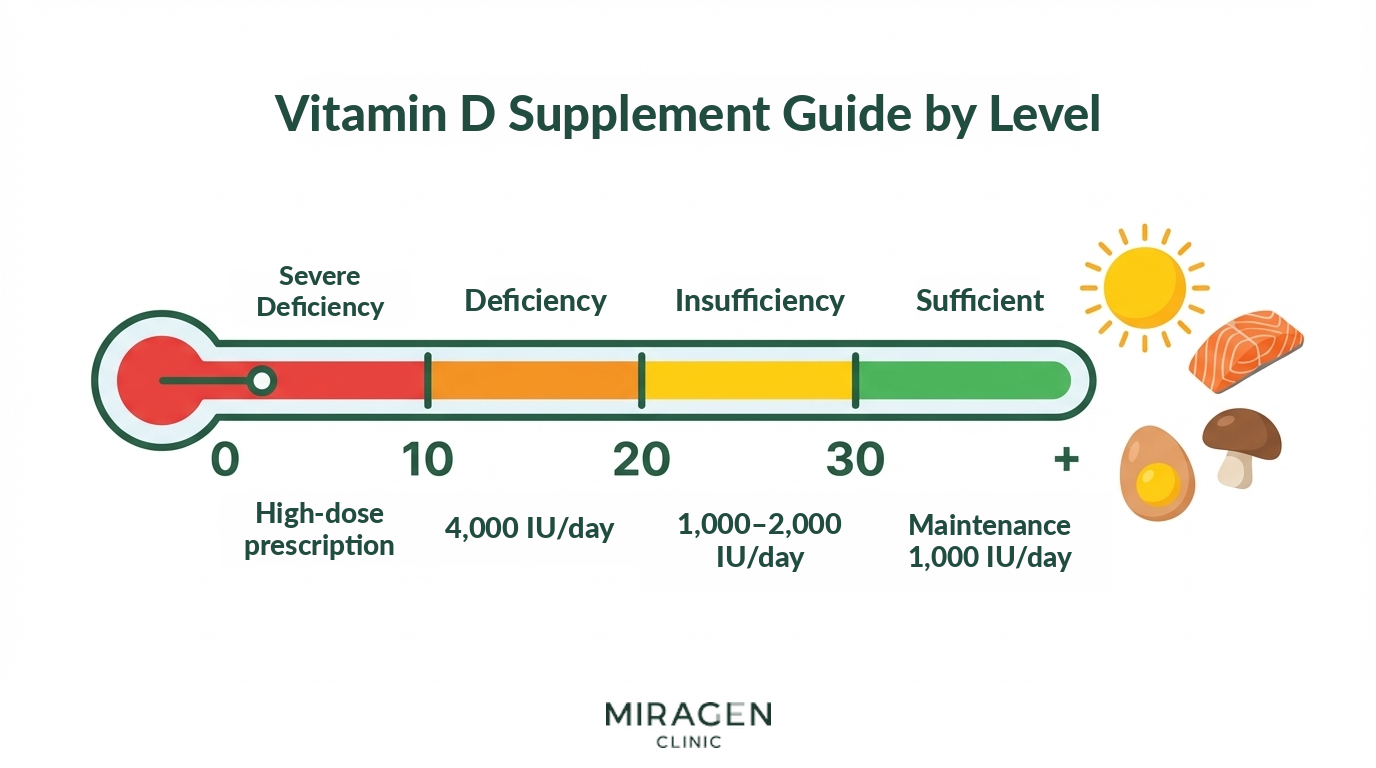
Interpretation and recommended supplement doses by vitamin D level are as follows.3
- 30 ng/mL or higher (sufficient) — Maintenance dose: 1,000 IU daily
- 20–30 ng/mL (insufficient) — 1,000–2,000 IU daily
- 10–20 ng/mL (deficient) — Supplement 4,000 IU daily for 6–8 weeks, then switch to a maintenance dose
- Below 10 ng/mL (severe deficiency) — High-dose oral supplementation or a vitamin D injection; even if you receive an injection, start an oral maintenance supplement (1,000–2,000 IU/day) at the same time
If you are diagnosed with vitamin D deficiency, oral vitamin D supplements are covered by National Health Insurance. Vitamin D injections (200,000 IU) are not covered, and cost KRW 30,000 at our clinic. After starting supplementation, we re-test after 2 months to confirm that levels have recovered sufficiently and then adjust the dose.
Studies suggest that supplementing vitamin D together with vitamin E may further improve atopic dermatitis symptoms.2 We recommend taking vitamin E 600 IU daily together with a natural d-alpha-tocopherol product. However, if you are taking anticoagulants or antiplatelet agents (warfarin, aspirin, etc.) or are scheduled for surgery, vitamin E may increase the risk of bleeding, so please consult your doctor before deciding whether to take it.
References
- Nielsen AY et al. Vitamin D Supplementation for Treating Atopic Dermatitis in Children and Adults: A Systematic Review and Meta-Analysis. Nutrients. 2024;16(23):4128.
- Javanbakht MH et al. Randomized controlled trial using vitamins E and D supplementation in atopic dermatitis. J Dermatolog Treat. 2011;22(3):144-50.
- Holick MF et al. Evaluation, treatment, and prevention of vitamin D deficiency: an Endocrine Society clinical practice guideline. J Clin Endocrinol Metab. 2011;96(7):1911-30.
Frequently Asked Questions
Do I need to fast for a vitamin D test?
No. A vitamin D test can be performed regardless of whether you have fasted.
Is the vitamin D test covered by insurance?
For atopic dermatitis alone, it is not covered by National Health Insurance and costs KRW 30,000 as a non-covered service. Coverage may apply if you have certain diagnoses, such as osteoporosis.
If I’m low in vitamin D, do I have to take supplements?
If your level is below 20 ng/mL (deficiency), supplementation is recommended. If it is in the insufficient range (20–30 ng/mL), we first review your diet and sun exposure before deciding.
Can I get it together with an allergy test?
Yes, the vitamin D test and an allergy test can be performed at the same time with a single blood draw.
I’m already taking a vitamin D supplement—can I still get tested?
Yes, testing is actually recommended to confirm whether your current supplementation is appropriate. Please let us know the product and dose you are taking during your visit.


