When I ask people with severe flushing about situations where their symptoms worsen, the most common answer relates to temperature. In particular, many people say, ‘My face turns red just by being exposed to heater air.’
In such cases, there is a high possibility of neurogenic rosacea, which does not respond well to typical rosacea treatments. We will explain what neurogenic rosacea is and what tests are used to distinguish it.
1. What is Neurogenic Rosacea?
The skin has heat sensors (TRPV1) that detect temperature. These sensors are originally designed to respond to heat above 43°C, but in some rosacea patients, these sensors are produced in much higher quantities than normal.1 Not only are there more sensors, but the response threshold of each sensor is lowered, causing them to activate even at temperatures like heater air or warm food.
When these heat sensors are activated, substances called CGRP and Substance P are released from the nerves.2 CGRP dilates blood vessels, causing flushing, while Substance P creates stinging and burning sensations. This is neurogenic rosacea.
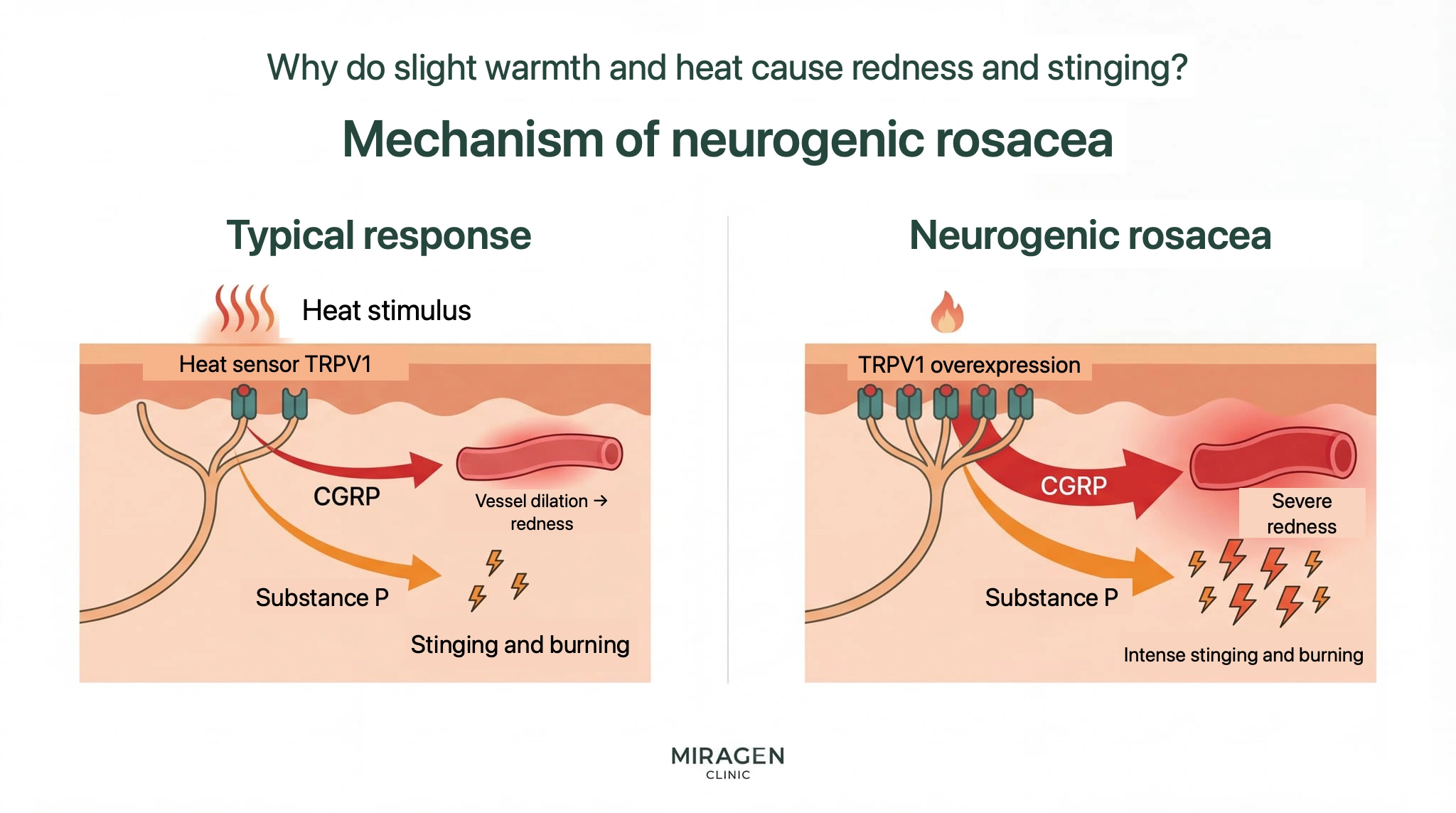
Typical erythematotelangiectatic rosacea is primarily caused by immune responses. Demodex mites or UV rays stimulate the skin’s immune pathways, causing inflammation, and treatments like antibiotics or Soolantra block these pathways. In contrast, because the core of neurogenic rosacea is nerve hypersensitivity, conventional treatments targeting immunity have limitations.3
Approximately 10–15% of all rosacea cases are of this type.
2. Why Do Sensory Nerves Become Hypersensitive? — The TRPV1 Vicious Cycle
In addition to the increase in the number of receptors, the sensitivity of individual receptors also increases. Substances like prostaglandins or bradykinin produced in inflammatory environments directly sensitize TRPV1, and a low pH (acidic environment) also lowers the threshold. The more inflammation persists in the skin, the more sensitive the sensors become.
There are several pathways through which overexpression begins.
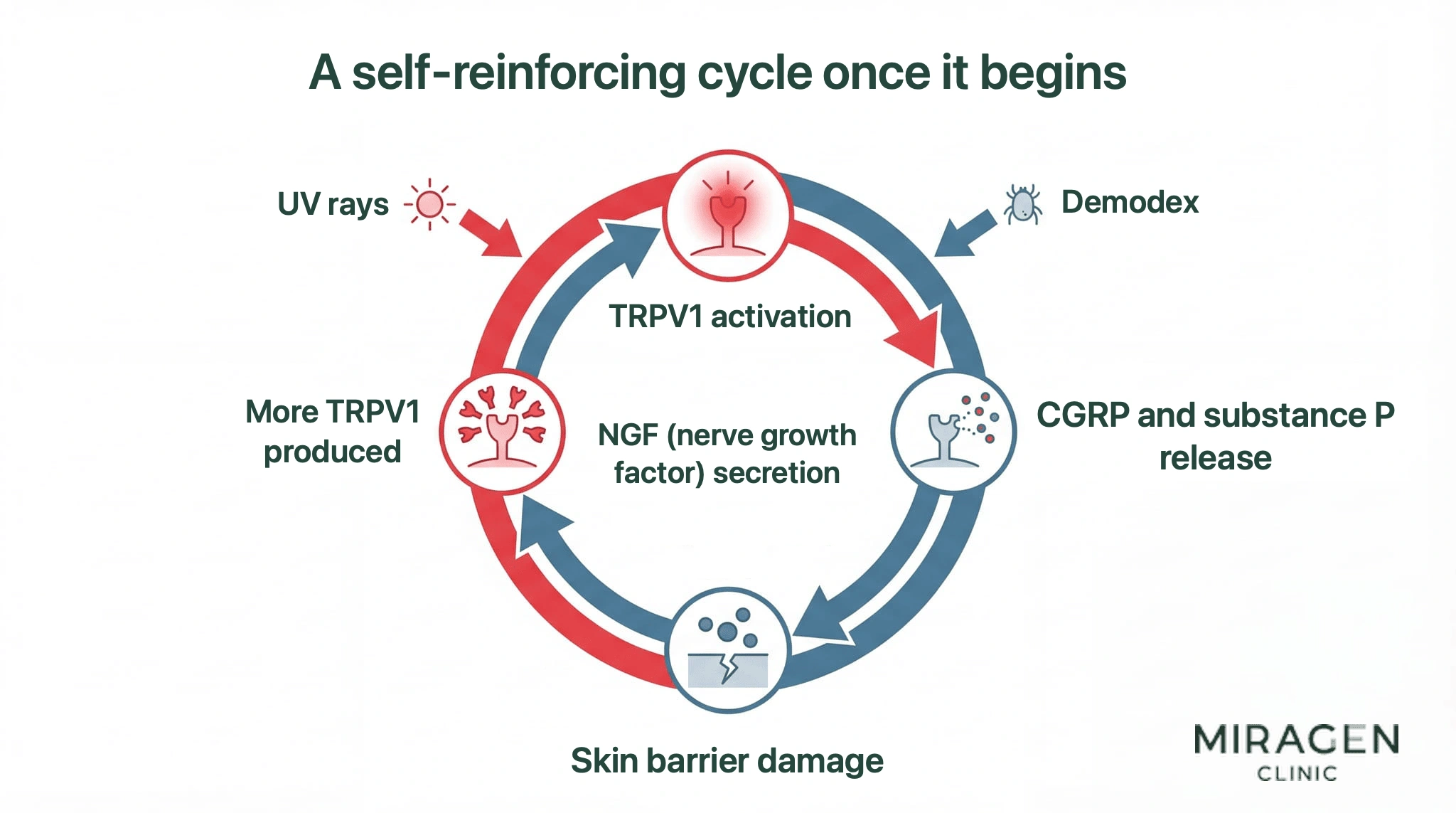
UV rays are a primary example. The face is an area exposed to UV rays daily, and recent research has confirmed that UV rays directly increase TRPV1 expression.4
Demodex mites are also a cause. When the skin barrier weakens, byproducts of Demodex mites penetrate the skin, causing an inflammatory response, which further increases TRPV1 expression.5 This is also why Demodex treatment is fundamental to flushing management. We have covered Demodex treatment in detail in the Soolantra article.
The real problem comes next. When TRPV1 is activated, nerve growth factor (NGF) is released, which produces more TRPV1 through TRKA receptors.5 It is a vicious cycle: more TRPV1 leads to easier activation, more nerve growth factor is released, and TRPV1 increases again.
Once this cycle begins, it reinforces itself, so it does not improve easily just by avoiding triggers.
3. Differences from Emotional Flushing
Symptoms of the face turning severely red in specific situations appear commonly in both neurogenic rosacea and emotional flushing. Although they look similar, the causes differ.
| Item | Emotional Flushing | Neurogenic Rosacea |
|---|---|---|
| Sweat | May accompany | Not present |
| Sensation | Heat sensation | Stinging · Burning · Soreness |
| Main Triggers | Tension, emotion, stress | Heat, spicy food, alcohol |
| Pathway | Sympathetic nerves → Blood vessels + Sweat glands | Sensory nerves TRPV1 → CGRP · Substance P |
The key distinguishing point is the presence or absence of sweat. If sweating accompanies the redness, it is highly likely to be emotional flushing. However, the absence of sweat does not necessarily confirm neurogenic rosacea, so objective differentiation through HRV testing and TEWL testing is required.
4. Differential Testing
We consider autonomic nervous system and TEWL test results together with the pattern of symptoms and examination findings when deciding on treatment.
The autonomic nervous system test assesses cardiac vagal nerve response through changes in heart rate during deep breathing. To judge whether the sympathetic nervous system contributes to symptoms, we also look for flushing, heat sensation, palpitations, and sweating during tension or emotional changes.
- Low cardiac vagal nerve response with a matching symptom pattern → Consider autonomic nervous system regulation therapy.
- Sufficient cardiac vagal nerve response → Narrow the treatment focus to the skin, blood vessels, and sensory nerves.
Frequently Asked Questions
Is there anything I can do at home first?
It’s safest to reduce clear triggers for you, such as heat, alcohol, and spicy foods, and to maintain gentle cleansing and moisturizing. If you add several new products at once, it’s hard to tell what caused irritation, so it’s best to make only one change at a time.
How is the HRV test performed?
At our clinic, we perform the Heart Rate Variability during Deep Breathing Test. Clip electrodes are attached to both wrists and ankles, and you slowly inhale and exhale in time with the equipment’s audio guidance. Changes in heart rate during breathing are used to assess cardiac vagal nerve response.
South Korea’s National Health Insurance applies if the clinician determines after consultation that autonomic function needs evaluation. When covered, the patient’s co-payment for the test is approximately 8,500 KRW. The actual amount may vary with the consultation fee, other tests or procedures performed at the same visit, age, and insurance eligibility.
For preparation and more details, see our autonomic nervous system test guide.
References
- Sulk M, Seeliger S, Aubert J, et al. Distribution and expression of non-neuronal transient receptor potential (TRPV) ion channels in rosacea. J Invest Dermatol. 2012;132(4):1253-62.
- Steinhoff M, Schauber J, Leyden JJ. New insights into rosacea pathophysiology: a review of recent findings. J Am Acad Dermatol. 2013;69(6 Suppl 1):S15-26.
- Wu C, Zhang K, Guo Y, et al. Clinical Characteristics and Serum CGRP Level Differences Between Neurogenic Rosacea and Non-neurogenic Rosacea. Int J Dermatol. 2025;64 Suppl 2:42-51.
- Xie Y, Hu Y, Huang J, et al. UVB Upregulates Inflammatory Cytokines in Rosacea Cell Model by Promoting the Expression of TRPV1 and TLR2. Immunotargets Ther. 2026;15:571037.
- Lee SG, Kim J, Lee YI, et al. Cutaneous neurogenic inflammation mediated by TRPV1-NGF-TRKA pathway activation in rosacea. J Eur Acad Dermatol Venereol. 2023;37(12):2589-2600.