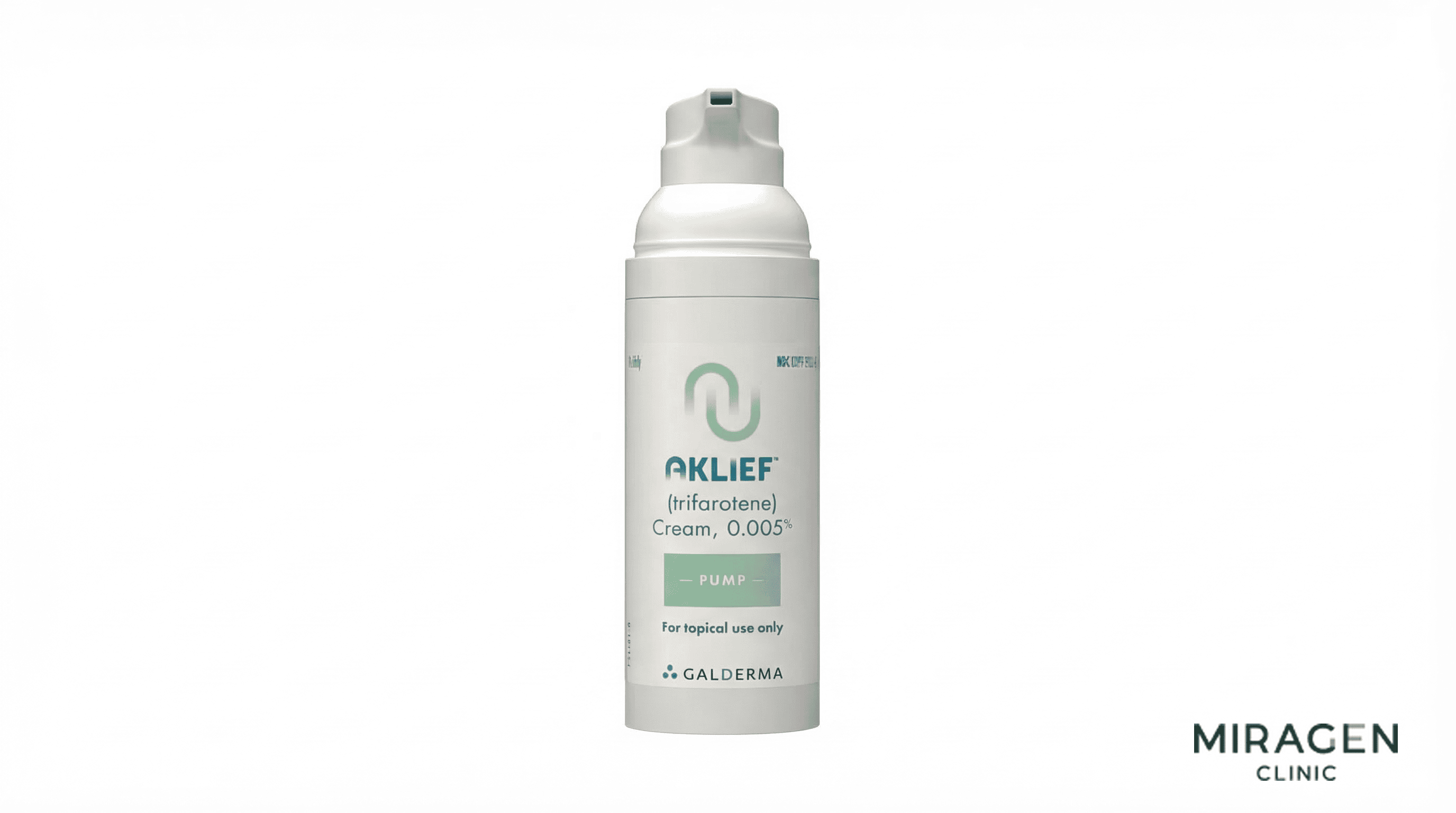
Aklief is a topical retinoid used to treat acne.
Since it can easily trigger dermatitis, the key is finding the right dosage and frequency to control acne with minimal irritation.
1. What is Aklief?
Aklief is a 4th-generation retinoid ointment that follows Stieva-A and T&T Cream (1st generation) and Differin (3rd generation).
Its active ingredient is trifarotene, which selectively binds to the RAR-γ receptor—the most widely distributed in the skin—to regulate gene activity involved in skin cell differentiation and inflammation.1,2
2. Precautions for dermatitis
Topical retinoids weaken the bonds between keratinocytes and cause changes in intercellular lipids, thereby weakening the skin barrier.3,4
And signals that trigger inflammation increase, which can lead to redness, flaking, dryness, and stinging.5
3. Oral retinoids are recommended first
In clinical experience, starting Aklief after reducing pore blockage with an oral retinoid like Isotinone tends to allow acne to be controlled with a smaller amount.
This is presumed to be because Aklief reaches the inside of the pores more effectively.
You can learn more about oral retinoids on the Isotinone page.
4. How to use
- Mix an amount of Aklief about half a fingernail with a moisturizer, then spread a thin layer over the entire face, avoiding the mouth and eye areas. The reason for mixing it with a moisturizer is to start with an amount so small that you would not be able to apply it to the entire face without mixing.
- For the first 2 weeks, apply it only once every 3 days and check your skin’s response.
- If the skin becomes red, stings, or itches after use, reduce the amount or frequency of use. If acne is not sufficiently controlled, increase the amount or frequency of use.
5. Pregnancy · breastfeeding
Because Aklief is a retinoid medication, it cannot be used during pregnancy. Systemic absorption is very low with topical application, but it is still contraindicated during pregnancy. If you learn you are pregnant while using it, you must stop immediately.2
Caution is also needed while breastfeeding. It has not been confirmed whether a topically applied medication transfers into breast milk. If use is necessary while breastfeeding, use it for a short period on the smallest area possible, and do not apply it to the nipple or areola.2
Frequently Asked Questions
Can I use Aklief without Isotinone?
Yes, it is possible. However, in clinical experience, when pores are severely blocked, starting Aklief after first reducing pore blockage with Isotinone may allow control with a smaller amount. The order of use is determined based on pore condition.
Can I apply only Aklief without a moisturizer?
We do not recommend it. Because Aklief is used in a very small amount (half a fingernail), it should be mixed with a moisturizer to apply it evenly over the entire face. Since a moisturizer also reduces irritation caused by retinoids, it is best to use them together.
After applying it, my face turned red and my dermatitis flared up again.
You should reduce the amount and frequency, or stop completely if necessary. Once your skin stabilizes, you can try again with a smaller amount.
Can I apply it during the day?
Aklief is applied in the evening. During use, you may become more sensitive to sunlight, so minimize unnecessary sun exposure and use sunscreen.
Does using it for a long time improve the skin barrier even more?
The irritation that occurred early on may lessen, but it’s hard to say that this means the skin barrier has improved further. We don’t increase the dose or frequency for barrier improvement, and we maintain the minimum dose and frequency that controls acne.
References
- Kassir M, Karagaiah P, Sonthalia S, et al. Selective RAR agonists for acne vulgaris: A narrative review. J Cosmet Dermatol. 2020;19(6):1278-1283.
- Korea Pharmaceutical Information Center. Aklief Cream 0.005% Drug Information.
- Kim MY, Lee SE, Chang JY, Kim SC. Retinoid Induces the Degradation of Corneodesmosomes and Downregulation of Corneodesmosomal Cadherins: Implications on the Mechanism of Retinoid-induced Desquamation. Ann Dermatol. 2011;23(4):439-447.
- Li J, Li Q, Geng S. All-trans retinoic acid alters the expression of the tight junction proteins Claudin-1 and -4 and epidermal barrier function-associated genes in the epidermis. Int J Mol Med. 2019;43(4):1789-1805.
- Kim BH, Lee YS, Kang KS. The mechanism of retinol-induced irritation and its application to anti-irritant development. Toxicol Lett. 2003;146(1):65-73.