
For patients who come to our clinic with chronic dermatitis caused by misuse of medication, acne treatments are the next most common cause after steroids.
When choosing acne medication, irritation therefore deserves as much attention as effectiveness.
Here is how acne develops, how acne medications work, and what people with sensitive skin should consider.
How does acne develop?
The pore visible on the skin surface is the opening of a tube called a follicle. Further down, it branches toward the sebaceous gland and the hair root.
Normally, sebum made in the sebaceous gland travels through the follicle and out onto the skin.
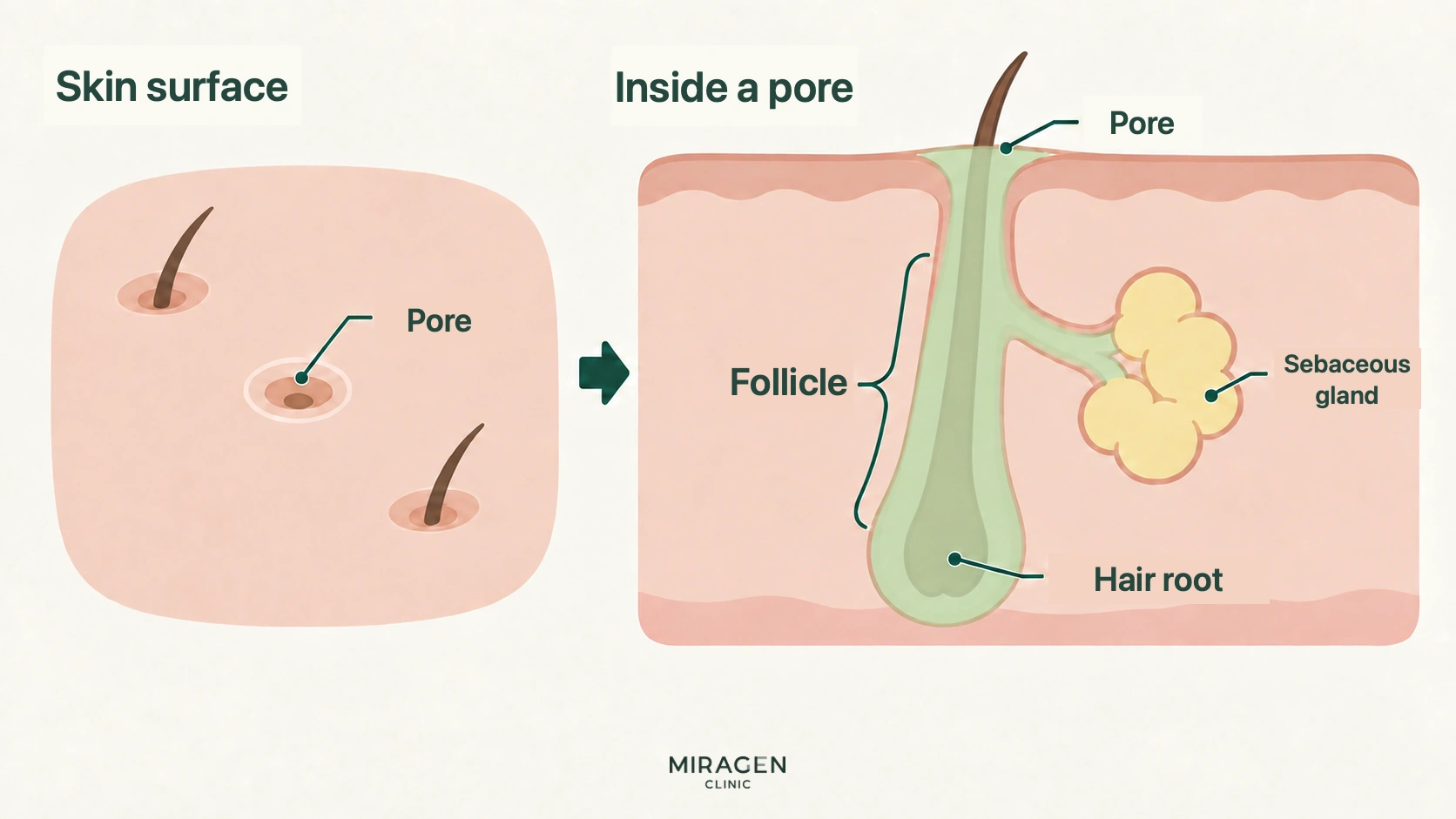
Acne begins when a buildup of dead skin cells blocks the follicle. This is noninflammatory acne, which includes whiteheads and blackheads.1,2
When a follicle is blocked, sebum accumulates and expands it, and acne bacteria that thrive without oxygen increase. Both contribute to inflammation; this is inflammatory acne.1,2
Ways to treat acne
Acne treatments target excessive keratinization of the follicle, sebum production, acne bacteria, and inflammation. A single medication can act on several of these processes.
Retinoids
- Oral retinoids (such as isotretinoin): reduce excessive follicular keratinization, sebum production, and inflammation.2
- Topical retinoids (such as Differin Gel): act on excessive follicular keratinization and inflammation.2 In theory, topical retinoids may also reduce sebum production.3
Regulating androgen activity
- Androgens contribute to excessive follicular keratinization and increased sebum production.4,5
- Combined oral contraceptives (such as Yaz): reduce both androgen levels and androgen activity.
- Spironolactone and clascoterone (Winlevi cream): reduce androgen activity.6,7,8,9
Antimicrobial treatments
- Benzoyl peroxide and antibiotics: reduce acne bacteria.2
Why acne treatment is difficult when skin is sensitive
Retinoids regulate excessive keratinization inside follicles and reduce sebum, but they also affect the outermost layer of skin that we commonly call the skin barrier. Less sebum and reduced ability of that layer to retain moisture can lead to dryness, itching, and dermatitis.10,11
Benzoyl peroxide reduces acne bacteria through oxidation, but it can also oxidize the skin's lipids. Reduced barrier function and increased water loss after use have been reported.12,13
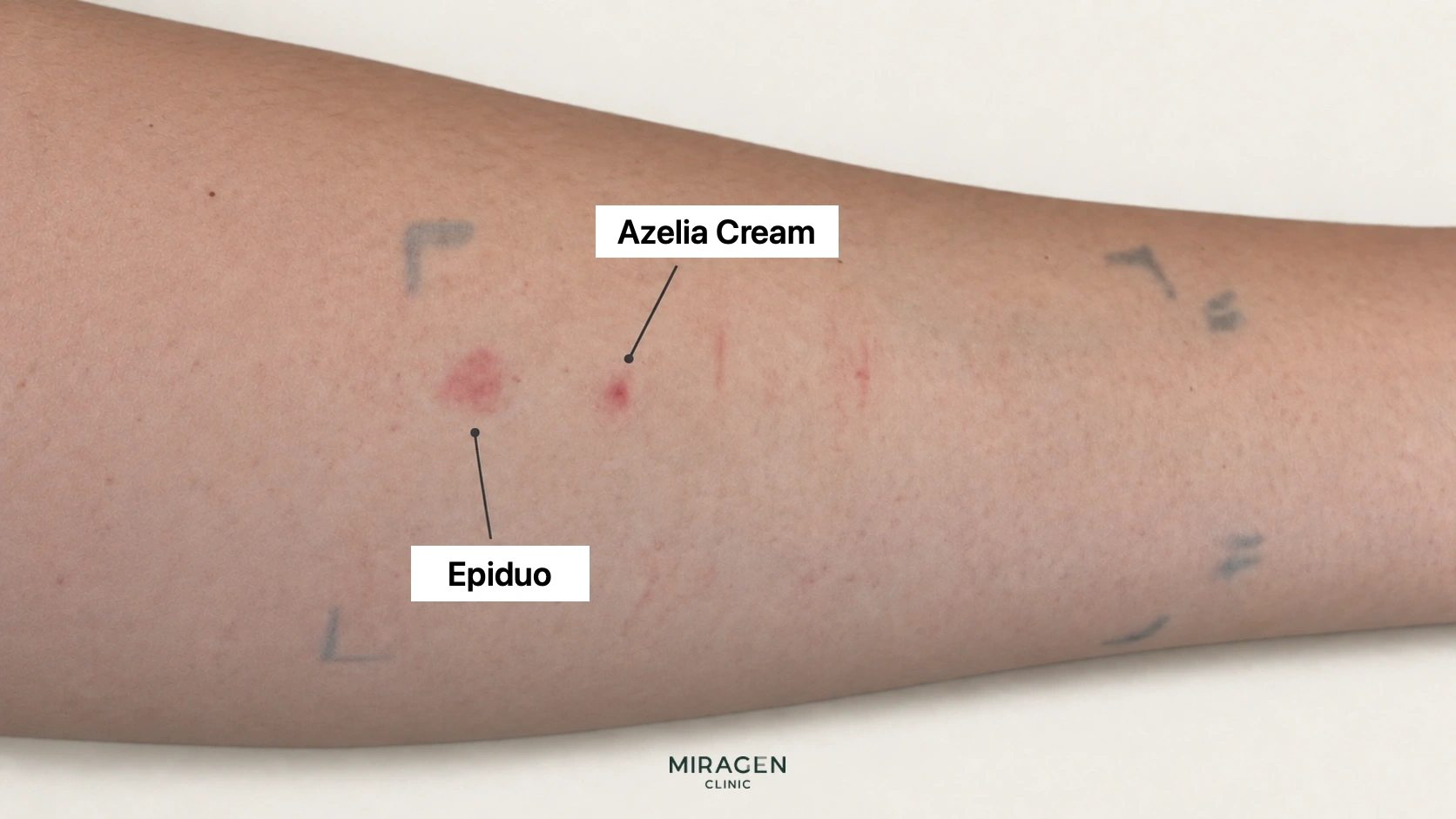
Beyond these structural changes, topical acne medications can cause allergic contact dermatitis or irritant contact dermatitis.12 That is why our clinic performs a patch test before using an acne ointment. It helps us assess the chance of a problem during actual use.
Deciding when to start treatment | TEWL test
If your skin is sensitive or you have only recently recovered from dermatitis, it is best to check whether your skin barrier can tolerate acne treatment before starting.
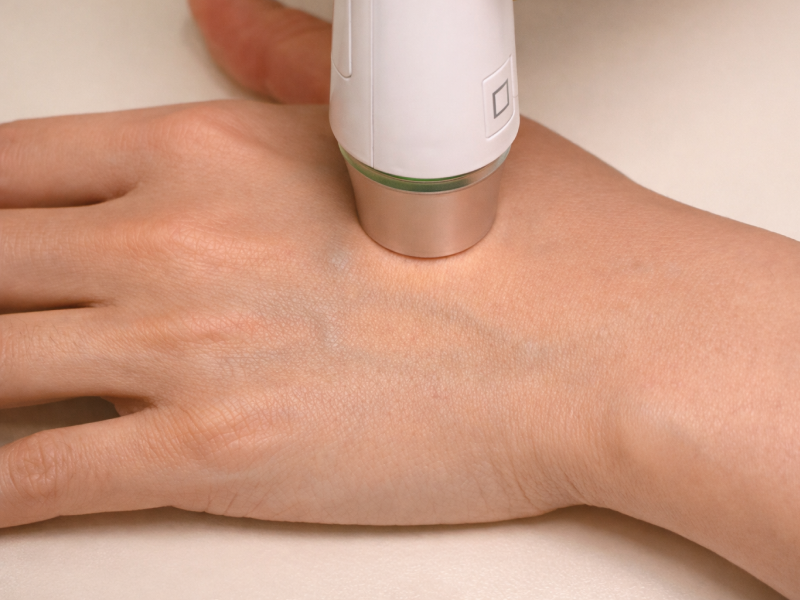
At our clinic, we use a TEWL test to decide when to begin acne treatment. TEWL measures water loss from the skin to assess barrier function.14
If barrier function is poor, we begin acne treatment after the barrier has recovered.
Deciding whether oral medication is needed | Wood's lamp examination
Once the skin is ready for treatment, we assess how blocked the follicles are to decide whether to start with topical medication alone or add an oral medication.
When follicles are severely blocked, topical medication may not be absorbed sufficiently.
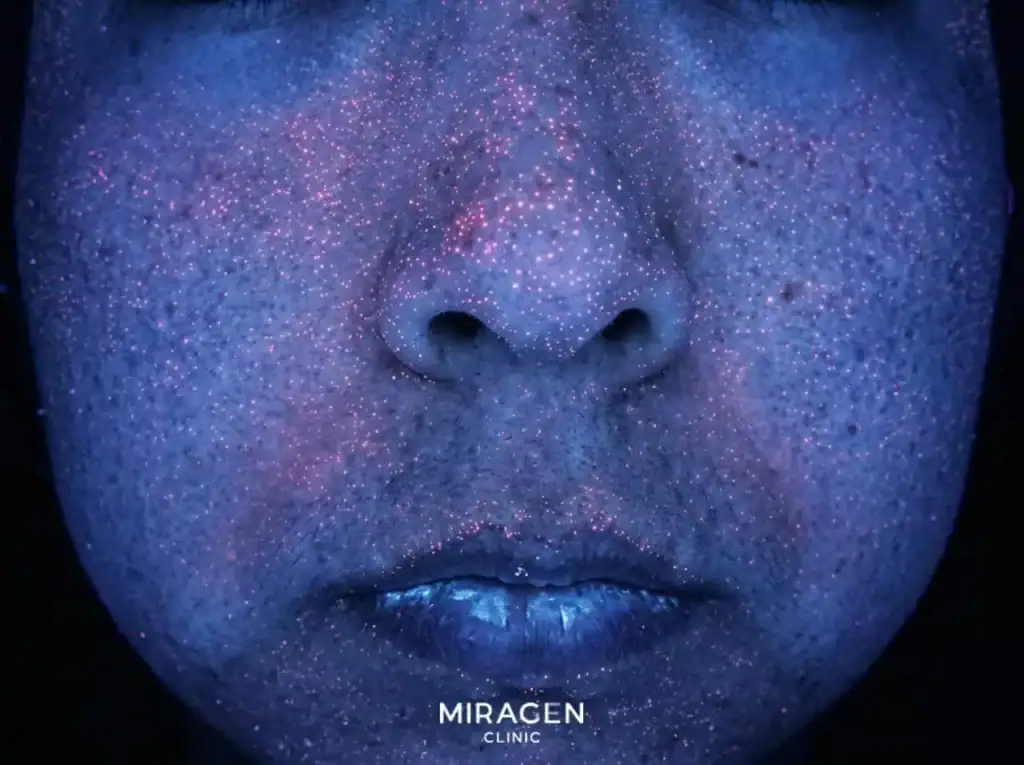
A Wood's lamp examination lets us observe fluorescence from porphyrins made by acne bacteria inside the follicles.15 If there is substantial porphyrin fluorescence, we consider oral medication.
Choose oral medication according to hormonal status
For women with dermatitis, we first look for a way to control acne with medication other than isotretinoin, if possible. Menstrual patterns and hormonal status are important in choosing a medication.
If periods are irregular, identify the cause
When a woman comes in with acne, we first ask whether her periods are irregular. If they are, we assess possible causes, including polycystic ovary syndrome (PCOS).6,16 Among our patients who underwent testing for both irregular periods and acne, approximately half were found to have PCOS.
The tests we perform include:
| Test | What it checks |
|---|---|
| Total testosterone · SHBG | Assesses excess androgens.6 |
| AMH | Used with menstrual patterns to assess PCOS.6 |
| DHEA-S · 17-OHP | Differentiates adrenal androgen excess from nonclassic congenital adrenal hyperplasia.16 |
| TSH · free T4 · prolactin | Checks thyroid problems and excess prolactin that may affect periods.16,17 |
| β-hCG | Checks for pregnancy.16 |
| HbA1c · total cholesterol · triglycerides · HDL cholesterol · LDL cholesterol | Checks for accompanying metabolic disease and helps guide medication choice.6 |
| AST · ALT · creatinine · eGFR · potassium | Checks liver and kidney function and potassium levels relevant to medication choice.2,7,18 |
If you have PCOS, consider combined oral contraceptives first
If PCOS causes both irregular periods and acne, we first consider a combined oral contraceptive, which may also help protect the endometrium. Combined oral contraceptives are among the main medications for menstrual irregularity and symptoms of androgen excess in PCOS.6,19
Consider additional medication according to barrier condition and acne severity
Alongside a combined oral contraceptive, we may consider adding spironolactone or isotretinoin according to the condition of the skin barrier, acne severity, and response to treatment.
For sensitive skin or skin that has just recovered from dermatitis, we consider spironolactone before isotretinoin.2,20
Initial and maintenance treatment with topical medication
If follicles are not severely blocked, we can try topical medication alone from the start. Even when they are blocked initially, topical medication alone may be an option for maintenance after the condition improves.2
As noted above, topical medication can weaken the skin barrier or cause contact dermatitis, so it must be chosen carefully. See our article on acne ointments for details.
Frequently asked questions
Do retinoids irritate the skin?
Retinoids can weaken the skin barrier during use. We therefore check the barrier first and adjust when treatment starts and the dose used.
Can acne be treated alongside dermatitis?
Yes. Starting acne treatment while the skin barrier is weak may cause more irritation, so we check it with a TEWL test before deciding when to start.
References
- Kurokawa I, Layton AM, Ogawa R. Dermatology and Therapy. 2021;11(4):1129-1139. PMID 34115308; DOI
10.1007/s13555-021-00552-6. - Reynolds RV, Yeung H, Cheng CE, et al. Journal of the American Academy of Dermatology. 2024;90(5):1006.e1-1006.e30. PMID 38300170; DOI
10.1016/j.jaad.2023.12.017. - Sato T, Akimoto N, Kitamura K, Kurihara H, Hayashi N, Ito A. Journal of Dermatological Science. 2013;70(3):204-210. PubMed abstract reviewed.
- Kumtornrut C, Yamauchi T, Koike S, Aiba S, Yamasaki K. Journal of Dermatological Science. 2019;93(3):150-158. PubMed search abstract and the publisher's summary and parts of the text reviewed.
- Giltay EJ, Gooren LJ. Journal of Clinical Endocrinology and Metabolism. 2000;85(8):2913-2921. PubMed search abstract reviewed.
- Teede HJ, Tay CT, Laven JJE, et al. Journal of Clinical Endocrinology and Metabolism. 2023;108(10):2447-2469.
- Bayer HealthCare Pharmaceuticals. YAZ prescribing information. Available through DailyMed.
- Dekkers OM, Thio BH, Romijn JA, Smit JWA. Nederlands Tijdschrift voor Geneeskunde. 2006;150(23):1281-1285.
- Rosette C, Agan FJ, Mazzetti A, et al. Journal of Drugs in Dermatology. 2019;18(5):412-418.
- Zydus Pharmaceuticals' US isotretinoin capsule prescribing information. Section 6, adverse reactions, and section 12.1, mechanism of action.
- Kmieć ML, Pajor A, Broniarczyk-Dyła G. Postepy Dermatol Alergol. 2013;30(6):343-349.
- Galderma. EPIDUO Gel, adapalene 0.1% and benzoyl peroxide 2.5%. DailyMed prescribing information. Section 5.2, local skin reactions; section 6, adverse reactions; section 11, description and ingredients; section 12.1, mechanism of action.
- Weber SU, Thiele JJ, Han N, et al. Free Radic Biol Med. 2003;34(2):170-176. PubMed search abstract and bibliographic information reviewed.
- Guidance on TEWL and skin hydration measurement published in 2013. PubMed abstract and public full text reviewed. Full text
- DermNet guidance on Wood's lamp examination.
- ASRM Practice Committee. Fertil Steril. 2024;122:52–61.
- American Thyroid Association guidance on thyroid function tests.
- Prescribing information for a repackaged Amneal spironolactone product. Revised June 2026.
- RCOG. Polycystic ovary syndrome: what it means for your long-term health. Patient information.
- Santer M, Lawrence M, Renz S, et al. BMJ. 2023;381:e074349. Double-blind phase 3 trial randomizing 410 adult women to spironolactone or placebo.