
1. What Is Telangiectasia?
Telangiectasia is a condition where small blood vessels in the skin dilate and appear as red thread-like lines. It is particularly common in patients with rosacea.1

2. Causes
When the skin barrier weakens and dermatitis becomes chronic, blood vessels proliferate to repair damage, lose responsiveness to constriction signals, and increased protein-degrading enzymes reduce the collagen and elastic fibers that support the vessels, leading to telangiectasia.1
Prolonged use of potent topical steroids can also lead to telangiectasia, as the skin becomes thinner and the collagen and elastic fibers that support blood vessels diminish.
3. Differential Diagnostic Tests
At our clinic, we use dermoscopy to confirm whether dilated vessels are actually present and determine if Excel V treatment is necessary.
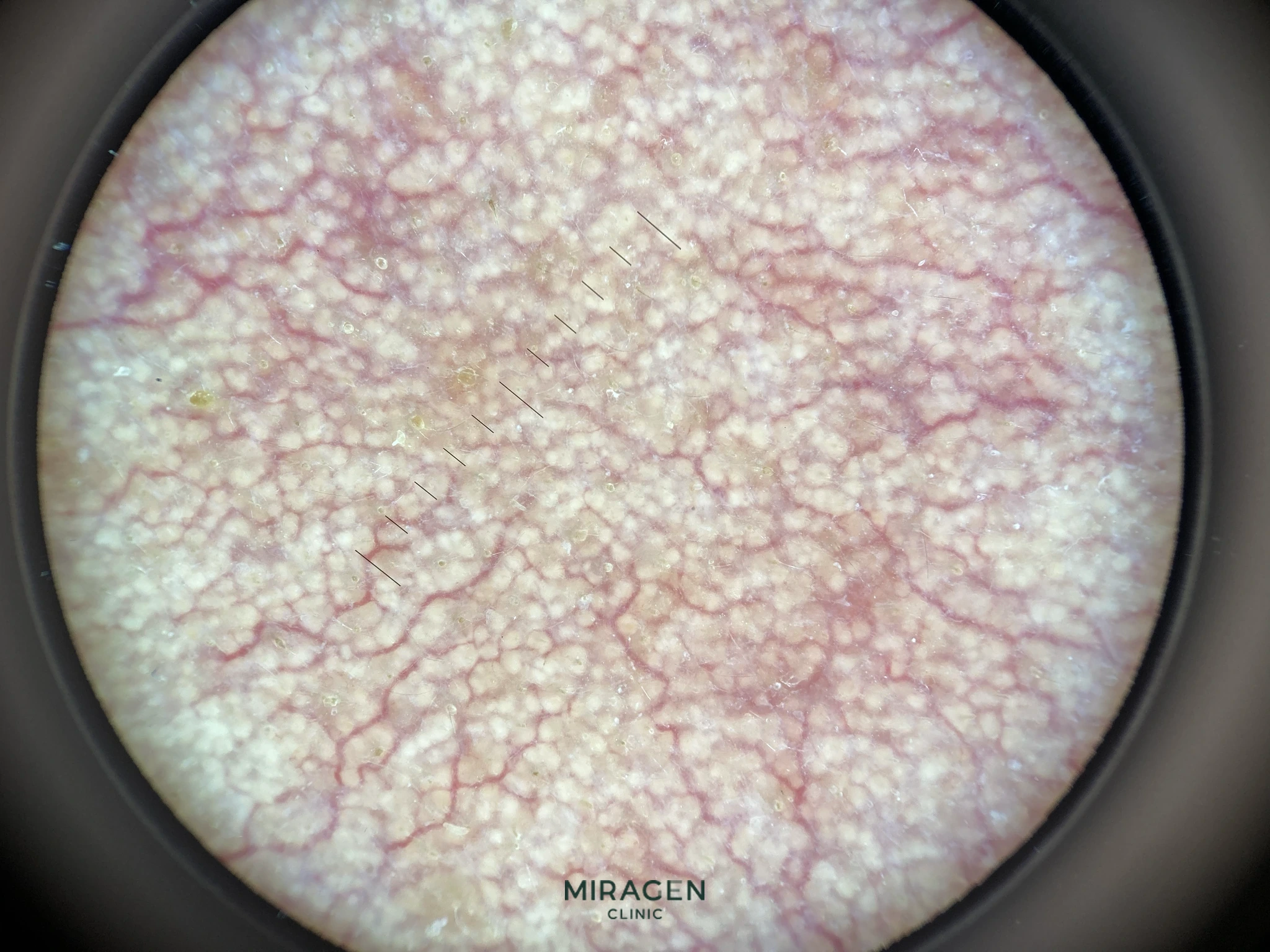
4. Treatment
Dilated blood vessels often do not reduce naturally on their own. In such cases, vascular laser treatment such as Excel V is considered. At our clinic, we treat telangiectasia with the Excel V laser, which supports both the 532nm wavelength suitable for removing red vessels and the 1064nm wavelength suitable for removing blue vessels.2,3
However, when dermatitis is severe, it is advisable to postpone laser treatment temporarily. Applying laser stimulation during active inflammation may worsen the condition.

Frequently Asked Questions
Can treatment be performed during severe dermatitis?
When stinging, burning, oozing, or crusting is prominent, vascular treatment is postponed. It is safer to begin after the dermatitis has sufficiently improved.
How many treatments are needed?
Typically, 2 to 3 treatments are performed at 2- to 4-week intervals while monitoring progress. For patients with a weakened skin barrier, it is safer to carefully adjust the energy while monitoring skin condition and response, rather than using high energy all at once.
Does telangiectasia resolve on its own?
Visibly dilated vessels often do not disappear naturally. However, they may appear less prominent temporarily when dermatitis and flushing subside.
References
- Nobeyama Y. Rosacea in East Asian populations: Clinical manifestations and pathophysiological perspectives for accurate diagnosis. J Dermatol. 2024;51(9):1143-1156.
- Becher GL, Cameron H, Moseley H. Treatment of superficial vascular lesions with the KTP 532-nm laser: experience with 647 patients. Lasers Med Sci. 2014;29(1):267-271.
- Eremia S, Li CY. Treatment of leg and face veins with a cryogen spray variable pulse width 1064-nm Nd:YAG laser–a prospective study of 47 patients. J Cosmet Laser Ther. 2001;3(3):147-53.