Medications
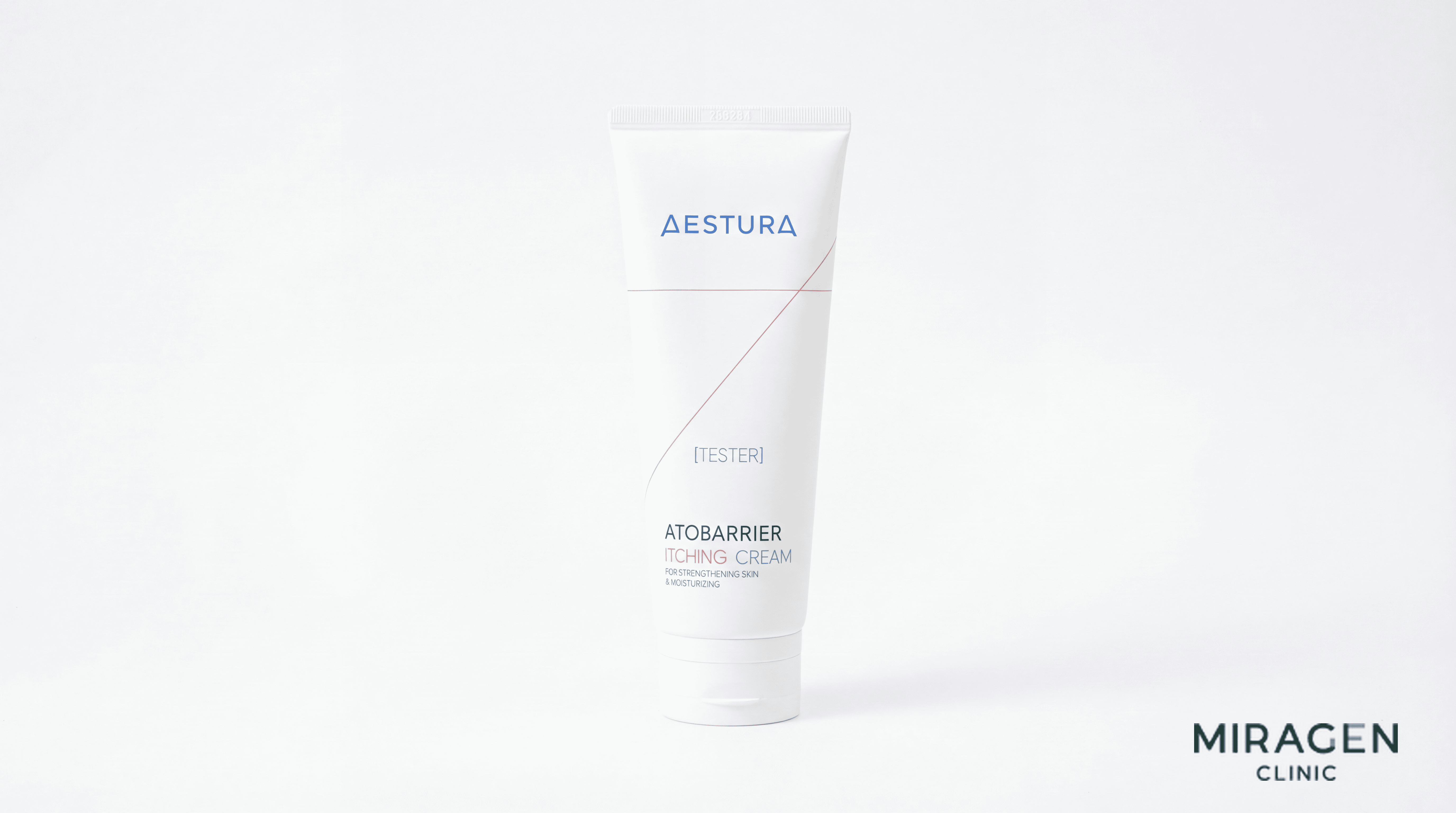
Atobarrier Itching Cream | A moisturizer that reduces itching, burning sensation, and redness
목차
1. What is Atobarrier Itching Cream?
Atobarrier Itching Cream is a cream whose main ingredient is Asivatrep, developed by Amorepacific. Its official name is Atobarrier Itching Cream MD, and it is classified as a medical device.
Asivatrep is a substance that selectively blocks the skin’s sensory-nerve heat sensor (TRPV1). TRPV1 is a receptor activated by heat that triggers itching, burning, and redness, and it is overexpressed in atopic dermatitis and rosacea.1,2
Within the same Atobarrier line, the moisturizing power is in the order of Aestura Cream > Atobarrier Cream > Itching Cream.
2. How does it work?
The key mechanism of Itching Cream is blocking TRPV1. This simultaneously suppresses two pathways.
- Suppresses itching · burning — reduces substance P release3
- Suppresses redness — reduces CGRP release → inhibits vasodilation
In neurogenic rosacea, TRPV1 is overexpressed, so even everyday stimuli can trigger CGRP release, causing burning and redness.1,4 Blocking TRPV1 may help relieve these symptoms.
3. Why use it with Protopic · Elidel
Protopic and Elidel stimulate TRPV1, triggering the release of substance P and CGRP.5 This is why itching, burning, and redness can worsen early on.
By inhibiting TRPV1 with Itching Cream, neuropeptide release decreases, minimizing early symptom worsening. Therefore, if irritation is severe even when used together, contact dermatitis may be suspected.
The anti-inflammatory effects of Protopic · Elidel work through calcineurin inhibition and are independent of the TRPV1 pathway. Therefore, Itching Cream does not interfere with the treatment effect.
4. Clinical evidence
Asivatrep has undergone Phase 2 and Phase 3 clinical trials for atopic dermatitis.
Phase 2
In two Phase 2 trials in patients with mild-to-moderate atopic dermatitis, the efficacy and safety of Asivatrep cream were confirmed.6,7
Phase 3 — CAPTAIN-AD
In CAPTAIN-AD, a large randomized controlled trial, Asivatrep 1% cream showed a meaningful improvement in mild-to-moderate atopic dermatitis. Both the IGA (Investigator’s Global Assessment) success rate and the EASI (Eczema Area and Severity Index) improvement rate showed statistically significant differences versus placebo.8
In particular, because it works via a different mechanism (TRPV1 blockade) than steroids or calcineurin inhibitors, it is meaningful in that it can be used in combination with existing treatments or as an alternative.
5. How to use
- Apply twice daily, morning and evening.
- Since the ingredient Asivatrep is sparingly soluble, the oil and water phases may separate; please shake the tube well before use at least once a week.
6. Conclusion
Atobarrier Itching Cream blocks TRPV1 to minimize early itching, burning, and redness from Protopic · Elidel, and to relieve the burning sensation and redness of neurogenic rosacea. It can also serve as a moisturizer, and it does not interfere with anti-inflammatory effects even when used with calcineurin inhibitors.
References
- Sulk M, Seeliger S, Aubert J, et al. Distribution and expression of non-neuronal transient receptor potential (TRPV) ion channels in rosacea. J Invest Dermatol. 2012;132(4):1253-62.
- Park J, Bhatt DK, Engström M, et al. Immunohistochemical evaluation of TRPV1 in rosacea skin. Acta Derm Venereol. 2019;99(13):1300-1301.
- Lee YW, Won CH, Jung K, et al. Efficacy and safety of PAC-14028 cream — a novel, topical, nonsteroidal, selective TRPV1 antagonist in patients with mild-to-moderate atopic dermatitis. J Dermatol Sci. 2018;91(3):289-296.
- Lee J, Kim MJ, Park S, et al. Demodex and rosacea: TRPV1-NGF-TRKA pathway in neurogenic inflammation. J Eur Acad Dermatol Venereol. 2023;37(12):2449-2459.
- Haerer W, Bhatt DK, Bhatt R, et al. Tacrolimus directly activates TRPV1. Pharmacology. 2017;99(3-4):179-185.
- Song K, Hou XY, Chen YJ, et al. Phase 2 trial of PAC-14028 cream for mild-to-moderate atopic dermatitis. Br J Dermatol. 2019;181(5):1014-1022.
- Lee JH, Won CH, Jung K, et al. Phase 2 randomized trial of PAC-14028 cream. Br J Dermatol. 2019;180(5):1202-1210.
- Park CW, Kim BJ, Lee YW, et al. Asivatrep, a TRPV1 antagonist, for the topical treatment of atopic dermatitis: Phase 3, randomized clinical trial (CAPTAIN-AD). J Allergy Clin Immunol. 2022;149(4):1340-1347.e4.
Frequently Asked Questions
Do I need a prescription for Itching Cream?
Itching Cream is classified as a medical device, so it can be purchased without a prescription. However, to file a claim for indemnity insurance, you must purchase it after receiving a prescription.
Can I use only Itching Cream on its own?
Yes. If itching or a burning sensation is your main symptom, it can be used on its own. However, if inflammation is also present, it is more effective to use it together with an anti-inflammatory treatment such as Protopic or Elidel.
How many times a day should I apply it?
Typically, apply it twice daily (morning and evening). When using it with Protopic or Elidel, apply Itching Cream first after washing your face in the evening, then apply the treatment on top.
Can I use it with a steroid ointment?
Yes. Itching Cream can be used together with steroids because it works through a different pathway.
How long can I use it?
It does not weaken the skin barrier like steroids, so it can be used long term.
Can I claim indemnity insurance (medical expense insurance)?
Yes. If you purchase it after receiving a prescription at the clinic, you can file an indemnity insurance claim. If you purchase it directly without a prescription, it is difficult to file a claim.


