Tests
Delayed Allergy Test | A Test to Identify Problematic Foods
Table of Contents
1. What is a Delayed Allergy Test?
The IgG4 test, commonly known as a “delayed allergy test,” actually measures IgG4 antibodies for specific foods in the blood.
Unlike the MAST test, which looks at IgE related to immediate allergic reactions, IgG4 is closer to a value showing traces of exposure to specific foods.1
The important point is that a high level does not necessarily mean that the food is a problem. Rather, IgG4 may be a signal that the body has become accustomed to that food. In fact, it is known that IgG4 levels rise when allergy treatment (immunotherapy) is successful.1,2
For this reason, both European and Canadian allergy societies do not recommend this test for allergy diagnosis.1,2 Therefore, this test should be used as reference material alongside diet logs and symptoms, rather than as a standalone diagnosis.
2. Who should consider this test?
The IgG4 test is not for identifying immediate allergies that cause hives, lip swelling, or difficulty breathing right after eating a specific food. In such cases, MAST should be considered first.
Conversely, it can be used as a limited reference along with a food diary when there are recurring chronic symptoms but the connection to food is ambiguous.
- When skin symptoms recur hours to days later rather than immediately after eating
- When you are already cutting out foods indiscriminately and need a standard for systematic reorganization
However, cutting out many foods based solely on IgG4 test results can lead to nutritional imbalances or anxiety about having nothing to eat. Caution is especially required for children as it can affect growth.2
3. Test Method
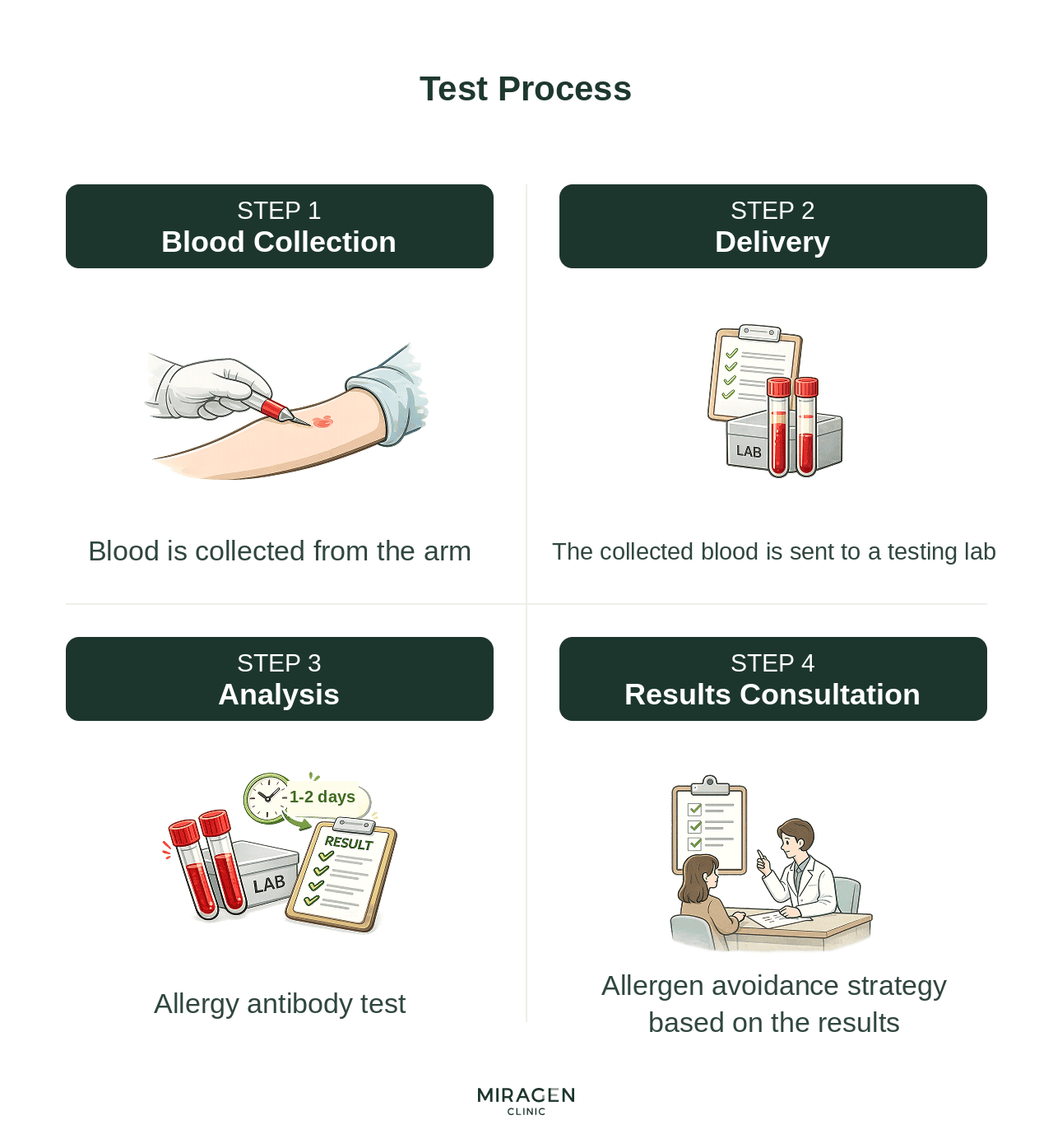
The IgG4 test itself is completed with a single blood draw, but the process of interpreting the results is crucial.
- 1) Blood Collection: Blood is drawn to measure IgG4 levels for each food.
- 2) Result Confirmation: Identify which foods showed high levels.
- 3) Medical History Comparison: Match the results with the timing and recurring patterns of symptoms after daily meals.
- 4) Dietary Planning: Instead of cutting everything out unconditionally, eliminate only the suspected foods for a certain period and then reintroduce them to check the actual reaction.
In other words, the core of this test is not “finding positive items,” but the process of verifying whether they match actual symptoms. If the test results do not match real-life reactions, the food cannot be concluded as the cause even if the levels are high.
Test Types and Costs
- 90 Types · 250,000 KRW: Measures IgG4 for 90 types of food frequently consumed by Koreans in daily life.
- 200 Types · 300,000 KRW: An expanded test that measures IgG for 200 types of domestic and international foods.
Both tests are not covered by national health insurance. Coverage by private health insurance may vary depending on your plan, so please check with your insurance company in advance.
Result Delivery Schedule
90 Types
- Blood drawn Monday afternoon – Thursday morning → Results on the following Monday
- Blood drawn Thursday afternoon – Friday morning → Results on the following Wednesday
- Blood drawn Friday afternoon – Monday morning → Results on the following Thursday
200 Types
- Blood drawn Monday afternoon – Friday morning → Results on Thursday of the following week
- Blood drawn Friday afternoon – Monday morning → Results on Thursday of the same week
※ The AM/PM cutoff is 1:30 PM. Results will be delivered via KakaoTalk.
4. Precautions for Interpreting Results
The delayed allergy test (IgG4) is a test whose results are easily misunderstood. There are points you must remember when viewing the results.
- Positive = May be frequently consumed food. In fact, IgG4 levels can be higher for foods to which you are frequently exposed.1
- High levels do not mean severe symptoms. The magnitude of the number is not proportional to the actual symptoms.3
- Food restriction should be kept to a minimum. Cutting out multiple foods at once leads to nutritional imbalance and is difficult to maintain.2
- The immune pathways observed are different from MAST and patch tests. MAST is more direct for immediate reactions, and patch tests are more direct for delayed reactions caused by skin contact. You can find more details on the MAST and Patch Test pages.
IgG4 test results should not be viewed in isolation but should be judged alongside symptom photos, food diaries, skin condition, and other test results. Especially in diseases like atopic dermatitis where dietary restrictions can easily become excessive, it is safer to use it as reference material to organize hypotheses rather than as a test to create a “list of foods to quit.”
References
- Stapel SO, Asero R, Ballmer-Weber BK, et al. Testing for IgG4 against foods is not recommended as a diagnostic tool: EAACI Task Force Report. Allergy. 2008;63(7):793-796.
- Carr S, Chan E, Lavine E, Moote W. CSACI Position statement on the testing of food-specific IgG. Allergy Asthma Clin Immunol. 2012;8:12.
- Antico A, Pagani M, Crema A. Food-specific IgG4 lack diagnostic value in adult patients with chronic urticaria and other suspected allergy skin symptoms. Int Arch Allergy Immunol. 2011;155(1):52-56.
Frequently Asked Questions
What kind of test is the IgG4 test?
Also known as a delayed allergy test, it measures IgG4 antibodies for specific foods in the blood. However, a positive result does not immediately confirm a food as the cause; it must be interpreted supplementally alongside symptom records.
Should I choose the 90-type or 200-type test?
Most people start with the 90-type (Korean Panel). It consists mainly of foods frequently consumed by Koreans, making it sufficient to identify correlations with daily diets. The 200-type can be considered when you want to check international foods or a broader range.
How much does the test cost?
The 90-type (Korean Panel) is 250,000 KRW, and the 200-type is 300,000 KRW. Both are non-reimbursable tests not covered by National Health Insurance, but a claim for private indemnity insurance is possible if performed for the purpose of differentiating diseases such as atopic dermatitis.
How do IgG4 and MAST tests differ?
MAST is a test that looks at IgE related to immediate allergic reactions, while IgG4 is a test that looks at antibody responses to food exposure. If immediate reactions like hives, swelling, or difficulty breathing are suspected, MAST is more direct.
If the test result is positive, must I stop eating that food?
No. A positive result may reflect frequently consumed foods or traces of exposure. It is safer to verify if it is repeatedly linked to actual symptoms and then narrow it down using a restriction-rechallenge method only when necessary.
Is it the same concept as a patch test?
No. A patch test is a test that directly observes delayed contact reactions by attaching substances to the skin, while an IgG4 test looks at antibodies in the blood. Although they are grouped under the term “delayed,” the immune pathways they identify and the ways they are interpreted are different.


