

If you’re concerned about facial redness, the lasers you’re probably most curious about are Vbeam and Excel V. In the clinic, I’m often asked by patients considering vascular laser treatment which of the two is better.
They share some similarities, but because their wavelength configurations differ, the types of vessels they treat best also differ—and the treatment cost can vary quite a bit due to whether consumables are required. I’ll explain both devices so you can choose the laser that suits you better based on the color and thickness of visible vessels, cost, and post-treatment symptoms.
목차
Targets of Vbeam and Excel V
Both lasers target hemoglobin inside blood vessels. When the laser is fired at hemoglobin, hemoglobin absorbs the light, generating heat that causes the vessel to shrink.
These lasers work best for visibly enlarged vessels. Typical examples include the fine facial capillaries on the sides of the nose or on the cheeks as shown below, and cherry angiomas that protrude like small red dots. For why dilated vessels occur, please refer to the Telangiectasia Guide.
Although there are clinical trials showing effectiveness for diffuse erythema—what we commonly call “redness”—in my experience, it’s difficult to expect meaningful improvement in redness with either laser alone.1 For those who have redness without visible vessels, improving the skin barrier and creating an environment where inflammation is less likely is a higher priority than laser treatment.

Wavelength Differences Between Vbeam and Excel V
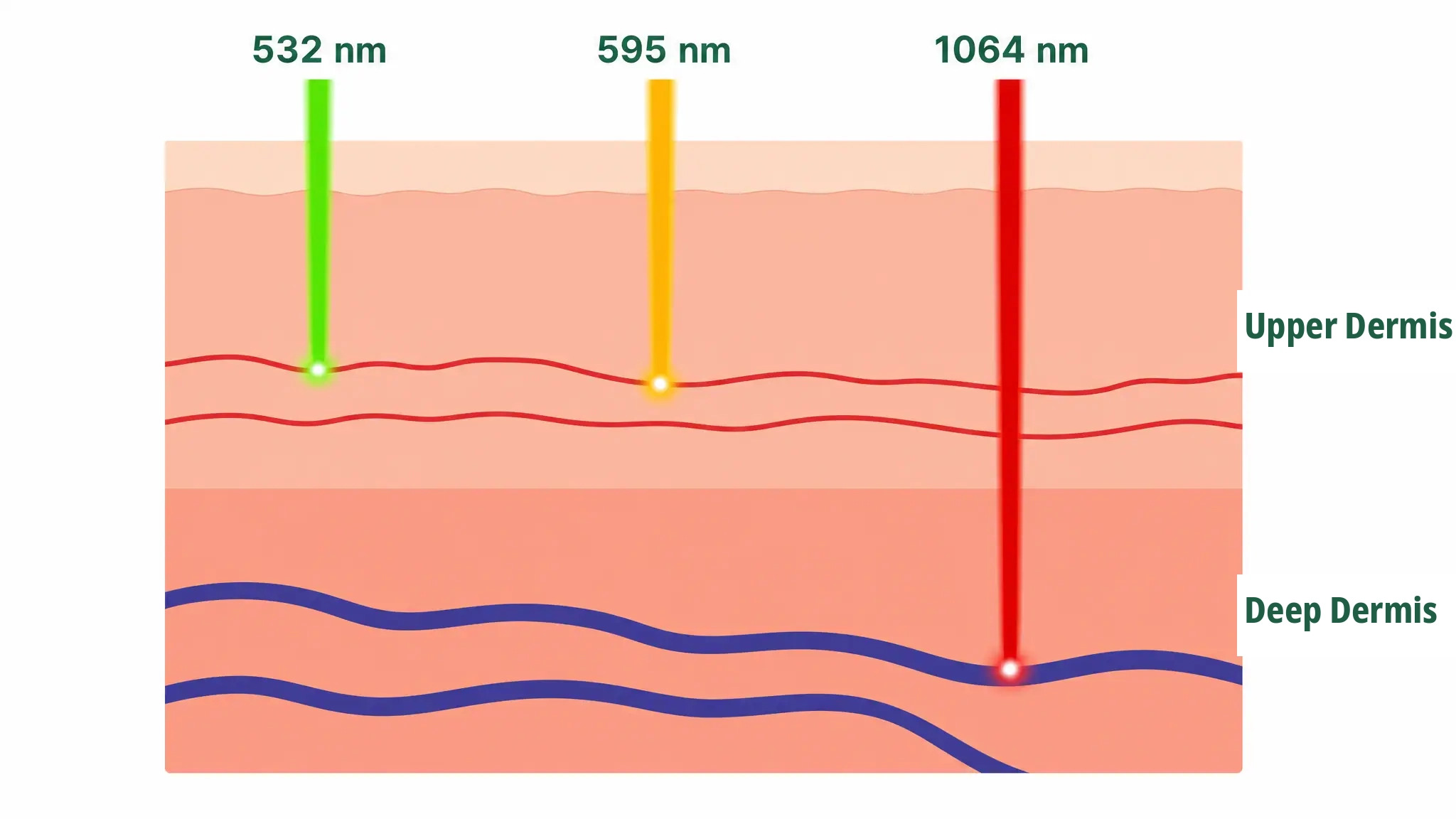
Among the components of skin, three absorb laser energy well: melanin, water, and hemoglobin.
Both devices emit lasers that are well absorbed by hemoglobin, but the type of laser they emit differs.
Excel V’s 532 laser is absorbed about 7.7 times more strongly by hemoglobin and about 1.45 times more strongly by melanin than Vbeam’s 595 laser.2,3
To selectively remove blood vessels, the laser needs to be well absorbed by hemoglobin and less absorbed by melanin and water. In theory, that means Excel V can produce better results with fewer side effects.
Clinical trials also support this theoretical difference. In a study of 15 people where 532 was applied to one side of the face and 595 to the other, the 532 side had a higher vessel clearance rate.4 In another study of 45 patients with rosacea dermatitis, bruising was reported only with Vbeam, and Excel V had fewer overall post-treatment side effects.1 That said, bruising can still occur with Excel V if the settings are stronger or the area has densely packed vessels.
And because Excel V supports a 1064 nm laser in addition to 532, it can treat a wider variety of vessels than the Vbeam Perfecta model.
| Target | Suitable Wavelength | Excel V | Vbeam Perfecta | Vbeam Prima |
|---|---|---|---|---|
| Thin, red vessels | 532 · 595 | Possible | Possible | Possible |
| Thick, blue vessels | 1064 | Possible | Difficult | Possible |
| Redness | 532 · 595 | Possible | Possible | Possible |
| Main Side Effect | – | Relatively low | Bruising | Bruising |
Why Treatment Costs Differ
The two lasers generate light in different ways.
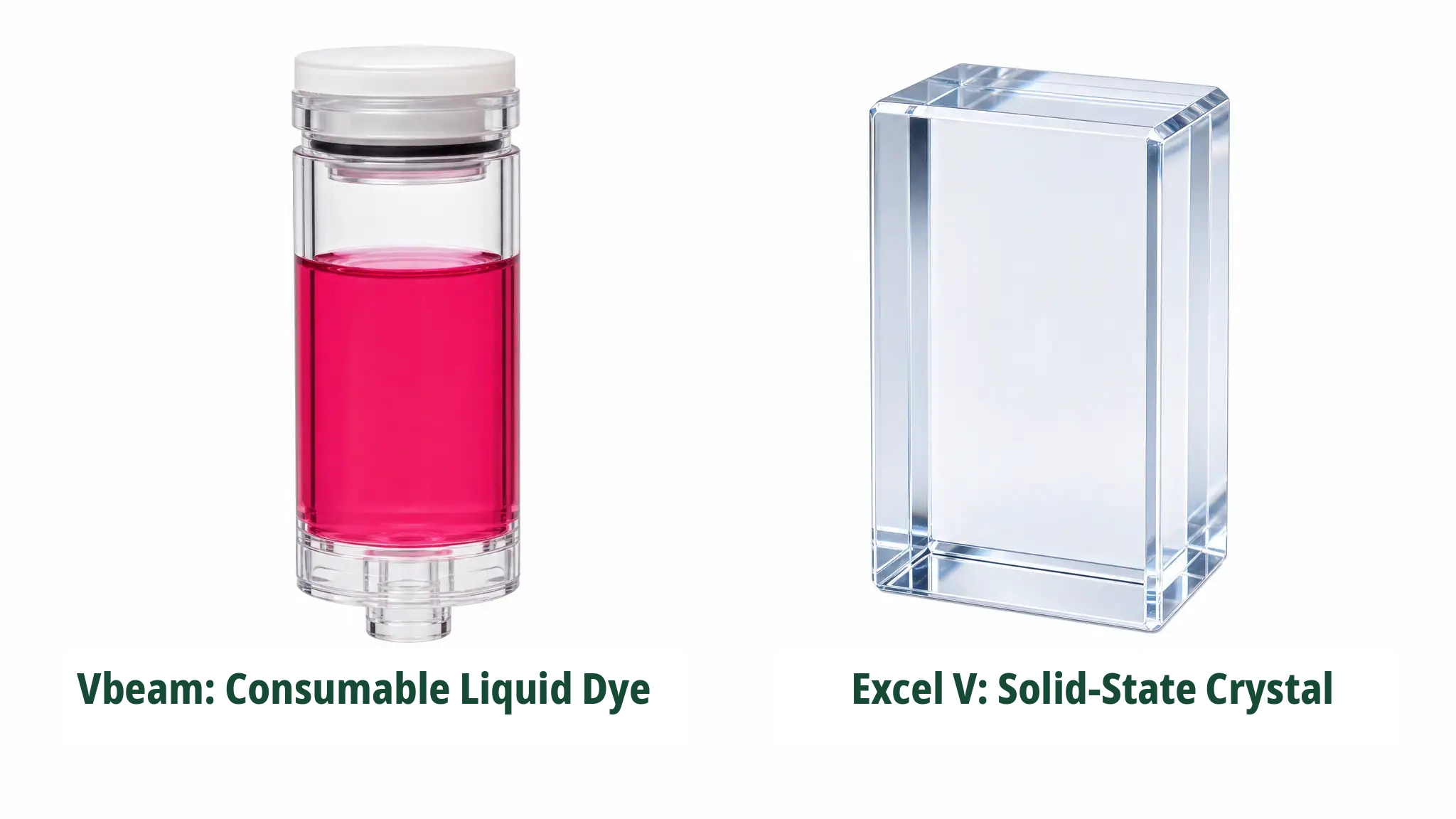
Excel V passes light through two crystals—KTP and Nd:YAG—to produce 532 and 1064 wavelengths. The crystals are long-lasting components and don’t need periodic replacement.
Vbeam, on the other hand, uses a liquid dye—called a dye—as the lasing medium. With repeated treatments, the dye is gradually depleted and must be replaced at a certain point.
Because the cost of this consumable is reflected in the per-treatment price, Vbeam is generally priced higher than Excel V.
In summary, there isn’t a big difference in how effective the two lasers are for red vessels. However, while Excel V can also treat thick, blue vessels, Vbeam can do so only with the Prima model.
And since the treatment cost often differs quite a bit, I recommend considering that as well and choosing the option that’s more suitable for you.
References
- Nguyen L, Dierckxsens C, Kerscher M, et al. Rosacea treatment with 532 nm KTP versus 595 nm pulsed dye laser – A prospective, controlled study. J Cosmet Dermatol. 2024;23(7):2443-2449.
- Prahl S. Tabulated molar extinction coefficient for hemoglobin in water. Oregon Medical Laser Center [Internet]. [cited 2026 May].
- Jacques SL. Skin optics summary. Oregon Medical Laser Center [Internet]. [cited 2026 May].
- Uebelhoer NS, Bogle MA, Stewart B, et al. A split-face comparison study of pulsed 532-nm KTP laser and 595-nm pulsed dye laser in the treatment of facial telangiectasias and diffuse telangiectatic facial erythema. Dermatol Surg. 2007;33(4):441-8.
Frequently Asked Questions
Can Vbeam or Excel V get rid of redness too?
u003cpu003eTo be honest, redness is hard to treat with lasers. However, redness often comes with telangiectasia, so as those dilated vessels are treated, you may feel that the overall red tone becomes a bit lighter. u003c/pu003e
Is it normal to have bruise-like marks after Vbeam?
u003cpu003eYes—595 nm tends to bruise more easily. That said, Excel V can also cause bruising if the settings are turned up. In general, bruising is more likely when removing densely packed red vessels. Bruising usually fades within 1–2 weeks. u003c/pu003e
Will it all go away in one session?
u003cpu003eUsually, 1–2 sessions are enough to see a good effect.u003c/pu003e

We treat atopic dermatitis, rosacea, and seborrheic dermatitis.
Thanks to the valuable reviews you have shared in the community, many of you visit us even from far away.
We will repay you with sincere, attentive care.
DK Han
Chief Director, MIRAGEN Clinic
Graduate of University of Michigan, Ross School of Business
Graduate of Chungnam National University School of Medicine
(Former) Representative Director of Ewha Phoenix Rehabilitation Hospital
(Current) Representative Director of MIRAGEN Clinic


