

Treatments commonly referred to as “flushing lasers” mean vascular lasers such as Vbeam and Excel V.
During consultations, I often meet patients who say they have received these lasers multiple times without any effect, or that their skin became redder or started flushing more frequently. Conversely, some patients experience significant improvement after only one or two sessions.
The reason the results can differ so much even with the same vascular laser for the same flushing is that there are various causes of flushing.
If you decide to get a vascular laser based only on the symptom of flushing, you may end up trying to treat causes that the laser cannot improve with the laser itself.
목차
Common Reasons Flushing Occurs
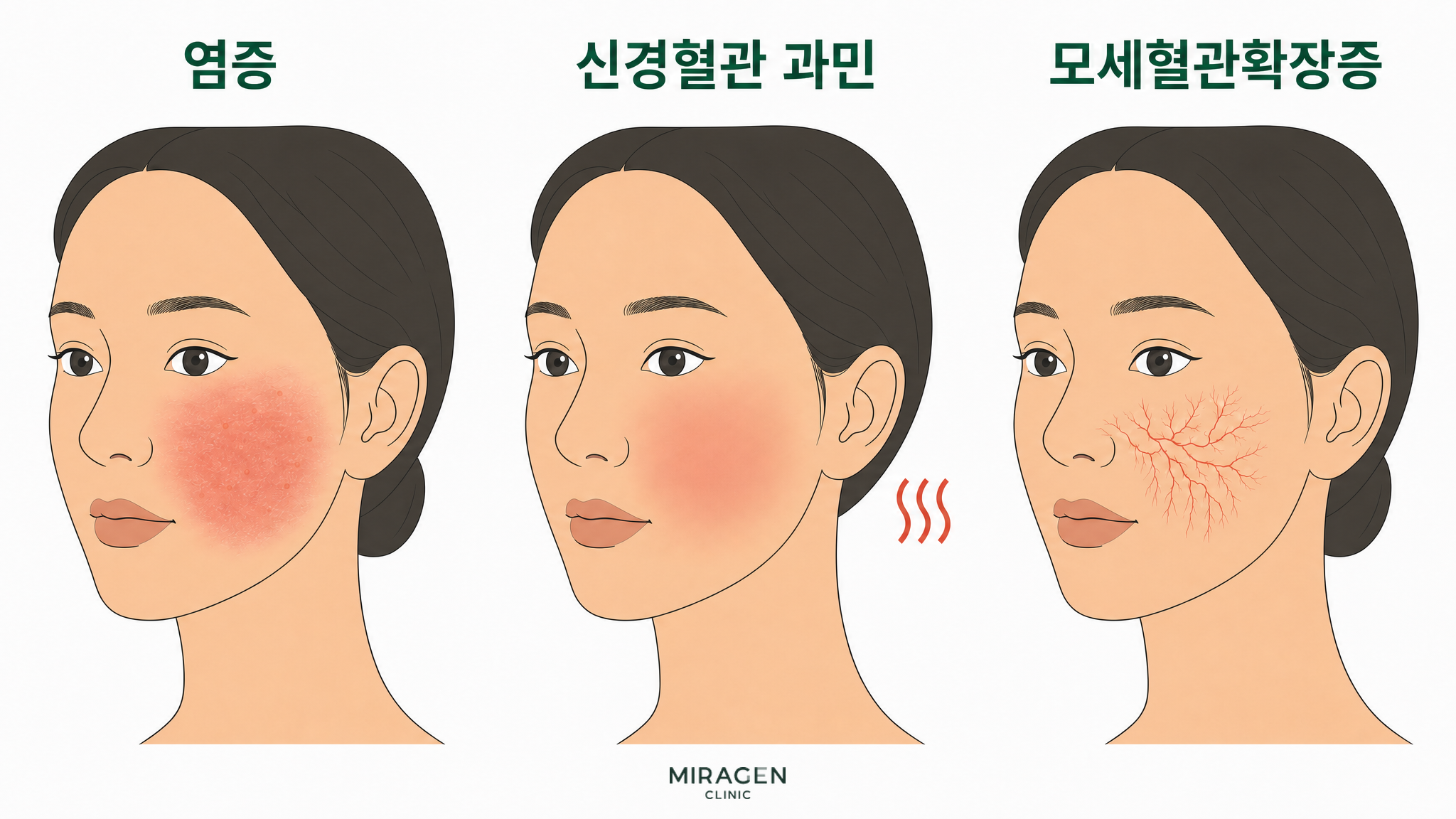
Flushing is a general term for symptoms in which the skin appears red. However, the main causes of flushing—inflammation, neurovascular hypersensitivity, and telangiectasia—each respond differently to treatment.
| Cause | Primary Appearance | Role of Flushing Lasers |
|---|---|---|
| Inflammation | Red even at rest, with itching or stinging; scaling; or red, bumpy patches | Cannot treat the inflammation itself |
| Neurovascular Hypersensitivity | The face suddenly becomes intensely red due to heat, stress, alcohol, or spicy food | Cannot treat neurovascular hypersensitivity itself |
| Telangiectasia | Fine blood vessels remain visible on the sides of the nose or cheeks | Can directly reduce telangiectasia |
The first cause is inflammation. This is more likely when flushing is accompanied by itching or stinging, scaling, or red, bumpy patches. For this type of flushing, treating inflammation and the skin barrier comes before vascular lasers.
The second cause is neurovascular hypersensitivity. The skin has a kind of sensor called TRPV1 that detects stimuli such as heat and spiciness. In rosacea, where flushing and telangiectasia primarily appear, studies have reported increased TRPV1 gene expression compared to normal skin.1 A typical example is when the face suddenly flushes intensely upon entering a warm place or when feeling nervous, despite being fine otherwise.
The third cause is telangiectasia. This is a state where fine blood vessels remain visible on the sides of the nose and cheeks. Telangiectasia is what vascular lasers directly target.
All three can appear together in the same person.
What Flushing Lasers Can Treat
Vascular lasers such as Vbeam and Excel V emit light that is absorbed by hemoglobin in the blood vessels. The principle is that the light converts into heat, reducing telangiectasia. I have summarized the differences between these two devices in a separate article, Comparison of Vbeam and Excel V.
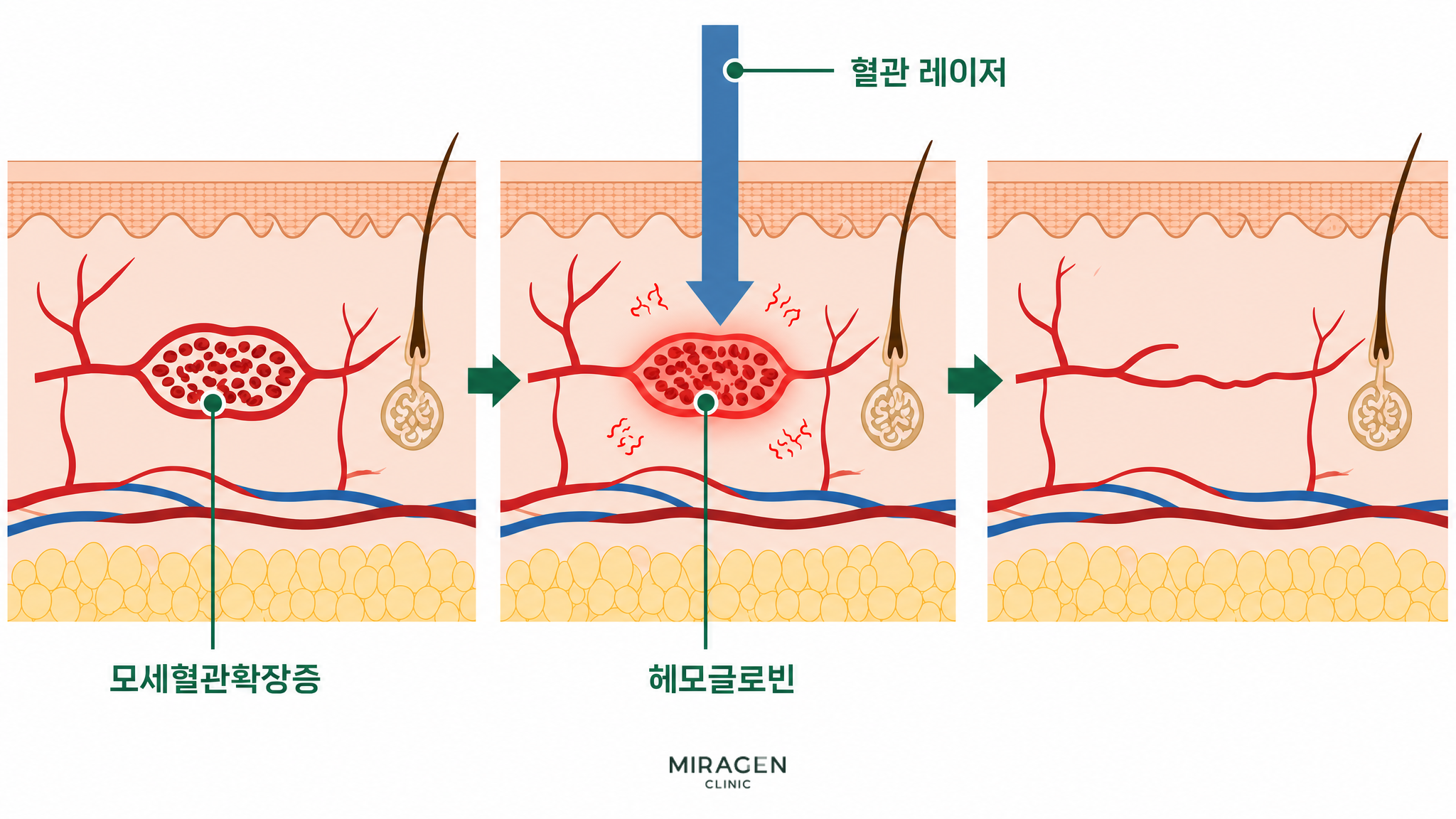
Among types of flushing, vascular lasers help most directly with flushing caused by telangiectasia. A meta-analysis combining multiple clinical trials also evaluated vascular lasers as helpful for reducing telangiectasia.2
There are reports that they also help diffuse erythema, where the entire face is evenly red without clear borders, but my clinical experience is somewhat different. If telangiectasia is prominent along with diffuse erythema, the overall redness lightens as telangiectasia decreases. However, if there is only inflammation or neurovascular hypersensitivity without telangiectasia, there is no target for the laser to reduce, so it provides little benefit and may even worsen symptoms.
Cases Where Flushing Worsens After Laser Treatment
Because vascular lasers deliver heat to the skin, redness, swelling, and stinging can occur immediately after the procedure. In my experience, these irritations tend to last longer in people who already have severe inflammation or a damaged skin barrier.
The anesthetic cream used before the procedure can also be problematic. Anesthetic creams containing lidocaine and prilocaine can cause not only temporary redness but also irritant dermatitis and allergic contact dermatitis.3
In various chronic dermatitis conditions, an increase in TRPV1—the skin’s heat sensor—has been observed, making the skin more sensitive to stimuli such as heat.4,5 There are no direct studies showing that lasers increase TRPV1, but if inflammation triggered by irritation from the laser or anesthetic cream persists for a long time, it is presumed that the process of increasing TRPV1 may be involved.
Therefore, if redness is still severe even 1–2 weeks after the procedure, it is better to reassess the cause of flushing rather than repeating the laser right away.
Checking for Telangiectasia with Polarized Dermoscopy
When flushing is present, it is not easy to determine with the naked eye whether telangiectasia is present. This is because telangiectasia is often obscured by flushing and hard to see.
This is where polarized dermoscopy is very useful. By minimizing light reflected from the skin surface and magnifying the skin, polarized dermoscopy allows you to check whether telangiectasia can be observed over the reddened skin.
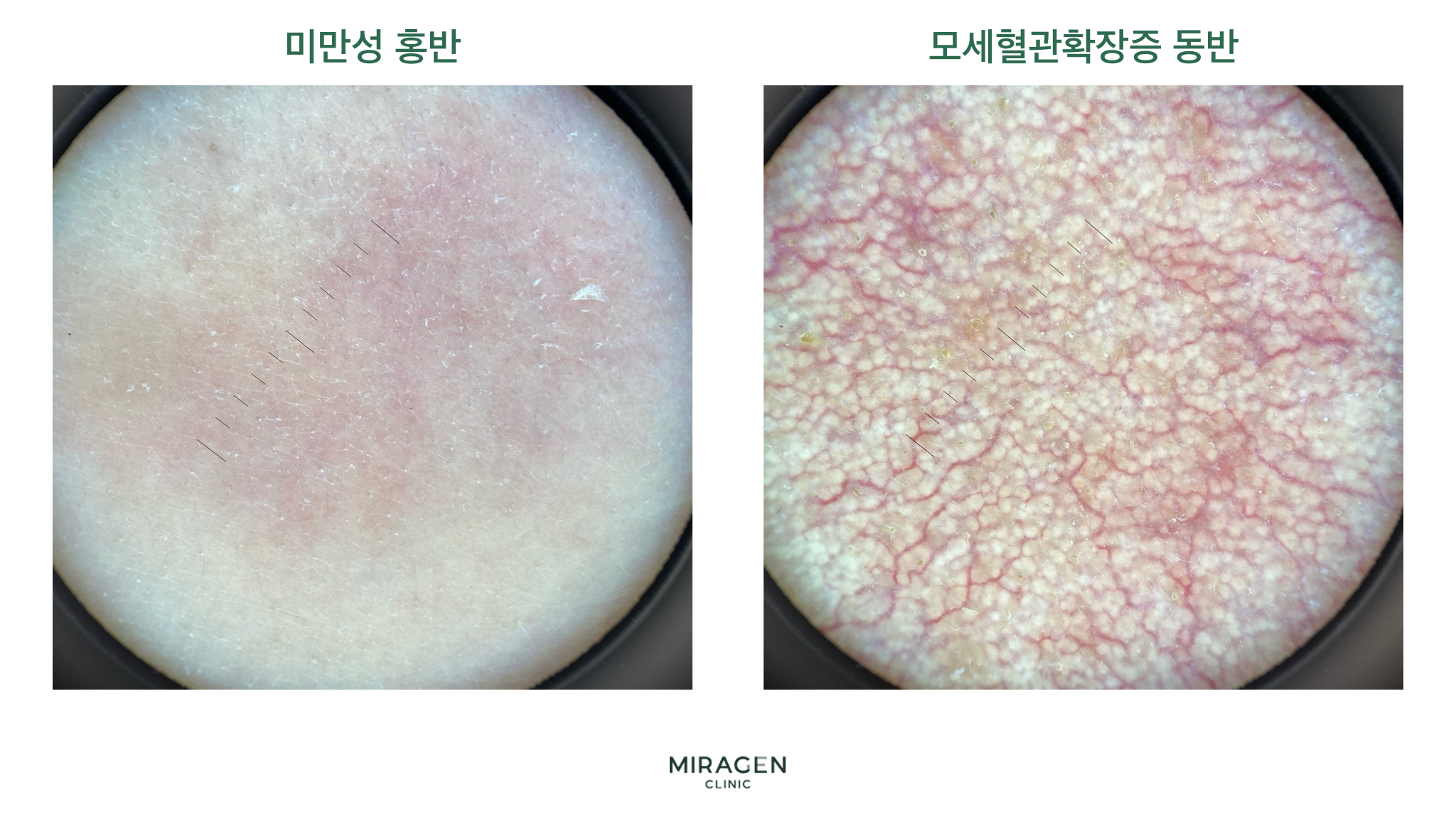
Because flushing does not have a single cause, whether flushing lasers will help depends on whether telangiectasia is actually present. If inflammation or neurovascular hypersensitivity is the main cause, the treatment may be ineffective or even worsen symptoms. That is why, before deciding on flushing lasers, it is better to check with polarized dermoscopy whether telangiectasia is present.
References
- Sulk M, Seeliger S, Aubert J, et al. Distribution and expression of non-neuronal transient receptor potential (TRPV) ion channels in rosacea. J Invest Dermatol. 2012;132(4):1253-62.
- van Zuuren EJ, Fedorowicz Z, Tan J, et al. Interventions for rosacea based on the phenotype approach: an updated systematic review including GRADE assessments. Br J Dermatol. 2019;181(1):65-79.
- Roldán-Marín R, de-la-Barreda Becerril F. Petechial and purpuric eruption induced by lidocaine/prilocaine cream: a rare side effect. J Drugs Dermatol. 2009;8(3):287-8.
- Marek-Jozefowicz L, Nedoszytko B, Grochocka M, et al. Molecular Mechanisms of Neurogenic Inflammation of the Skin. Int J Mol Sci. 2023;24(5):5001.
- Xiao T, Sun M, Zhao C, et al. TRPV1: A promising therapeutic target for skin aging and inflammatory skin diseases. Front Pharmacol. 2023;14:1037925.
Frequently Asked Questions
Can I receive flushing laser treatment if I have flushing?
First, you need to confirm whether the cause of flushing is telangiectasia. If you only have inflammation or neurovascular hypersensitivity and no telangiectasia, it is difficult to expect vascular lasers to be effective.
If I can see fine blood vessels on my face, will flushing lasers work well?
If the persistently visible fine vessels are confirmed as telangiectasia, they are a target that vascular lasers can directly reduce. However, not all visible fine vessels are telangiectasia, so confirmation is needed first.
What should I do if my skin becomes redder and burns after a flushing laser?
It is necessary to distinguish whether it is a temporary reaction immediately after the procedure or a state where inflammation and skin barrier damage are persisting. Rather than repeating the laser treatment immediately, it is better to re-check the current inflammation and telangiectasia.
What is checked with polarized dermoscopy?
By magnifying the skin, it distinguishes diffuse erythema from telangiectasia. It helps determine whether telangiectasia is present, which is what vascular lasers can directly reduce.

We treat atopic dermatitis, rosacea, and seborrheic dermatitis.
Thanks to the valuable reviews you have shared in the community, many of you visit us even from far away.
We will repay you with sincere, attentive care.
DK Han
Chief Director, MIRAGEN Clinic
Graduate of University of Michigan, Ross School of Business
Graduate of Chungnam National University School of Medicine
(Former) Representative Director of Ewha Phoenix Rehabilitation Hospital
(Current) Representative Director of MIRAGEN Clinic


