

When we ask patients who come in saying the backs of their hands are cracked and itchy, some say they have simply assumed it was housewife’s eczema and have only been applying moisturizer.
Then, after months with no improvement and the skin gradually becoming hard and thick, they often come to the clinic. Treatment for back-of-hand eczema depends on the cause. The first step is to determine whether it is atopic dermatitis or housewife’s eczema.
목차
Back-of-hand eczema: How are atopic dermatitis and housewife’s eczema different?
| Item | Atopic dermatitis on the back of the hand | Housewife’s eczema |
|---|---|---|
| Main areas | Back of the hand · wrist · back of the fingers | Palm · fingertips · between the fingers |
| Key symptoms | Itching comes before the rash | Cracking · pain · stinging |
| Cause | A weak skin barrier | Water · detergents · friction |
| Associated conditions | Rhinitis · asthma · history of infantile eczema | No specific associated conditions |
| Symmetry | Symmetrical on both hands | May start on one hand first |
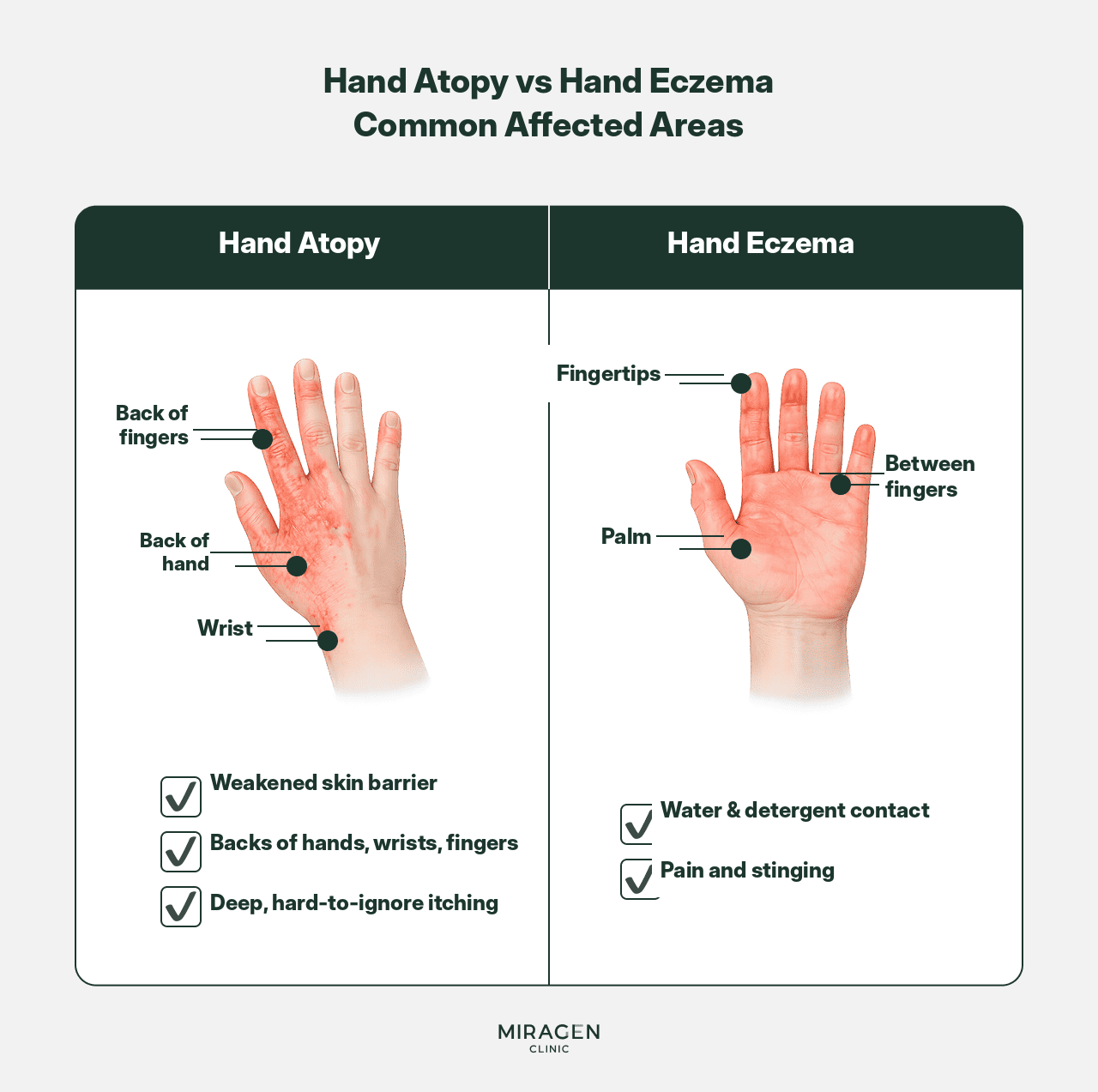
Hand atopic dermatitis is mainly caused by an inherently weak skin barrier and an excessive immune response. If you have had rhinitis or asthma, it is more likely to be atopic dermatitis.1
In contrast, housewife’s eczema is caused by external irritants that come into direct contact with the skin, such as water, detergents, and friction. Rather than itching, the main symptoms are pain and stinging from cracks, and it tends to be concentrated on the palms or fingertips.2
Where it occurs also provides a clue. Atopic dermatitis tends to develop on the thinner skin of the back of the hand and appears symmetrically on both hands, whereas housewife’s eczema starts on the palms and between the fingers where irritants directly touch, and the hand you use more often is frequently affected first.
Why you should distinguish early: lichenification
In back-of-hand atopic dermatitis, if time passes without proper treatment, it can progress to lichenification, where the skin becomes thickened and darkened.
Lichenification is when the skin defensively thickens as you repeatedly scratch because you cannot tolerate the itch.3 The more you scratch, the more nerve branches increase within the skin, the worse the itching becomes, and a vicious cycle develops in which you scratch again.
Lichenification is reversible, so if you control the itch and stop scratching, the skin can gradually become softer. However, once it has already thickened, ointments absorb less well and the treatment period becomes longer.
If it is atopic dermatitis, more proactive treatments are needed, and if it is housewife’s eczema, contact irritation must be physically blocked—so the earlier you identify the cause, the faster the treatment.
Treatment approach after distinguishing
Once the cause of back-of-hand eczema is identified, the treatment approach becomes clear.4
If it is housewife’s eczema, blocking irritants is key. Wearing rubber gloves over cotton gloves when washing dishes or cleaning, and making a habit of applying moisturizer immediately after washing your hands, can greatly reduce recurrence. For how to find a moisturizer that suits you, please see MD Cream Guide.
If atopic dermatitis is the cause, blocking irritants alone is not enough. Along with restoring the skin barrier, immune modulation using topical steroids or calcineurin inhibitors may be needed.5
References
- Paller AS, Spergel JM, Mina-Osorio P, et al. The atopic march and atopic multimorbidity: Many trajectories, many pathways. J Allergy Clin Immunol. 2019;143(1):46-55.
- Chan CX, Zug KA. Diagnosis and Management of Dermatitis, Including Atopic, Contact, and Hand Eczemas. Med Clin North Am. 2021;105(4):611-626.
- Renkhold L, Dajnoki Z, Béke G, et al. Scratching increases epidermal neuronal branching and alters psychophysical testing responses in atopic dermatitis and brachioradial pruritus. Front Mol Neurosci. 2023;16:1256244.
- Bauer A, Brans R, Brehler R, et al. S2k guideline diagnosis, prevention, and therapy of hand eczema. J Dtsch Dermatol Ges. 2023;21(9):1054-1074.
- Halling-Overgaard AS, Zachariae C, Thyssen JP. Management of Atopic Hand Dermatitis. Dermatol Clin. 2017;35(3):365-372.
Frequently Asked Questions
Why do the backs of my hands keep cracking even when I apply moisturizer regularly?
It may be “moisturizer dermatitis,” where the ingredients in the moisturizer are actually irritating, or it may be atopic dermatitis rather than housewife’s eczema. You can check with a no-moisturizer test by stopping moisturizer for three days, and if there is no improvement, it is advisable to have it distinguished through a consultation.
Can atopic dermatitis on the back of the hand be completely cured?
For atopic dermatitis, “remission” is a more accurate term than “complete cure.” If you break the vicious cycle of itching and restore the barrier, you can maintain a state that does not interfere with daily life. In particular, the prognosis is good for the back of the hand if you manage external irritants well.
Can lichenified skin return to normal?
Yes, it is reversible. If you control the itch and maintain a state of not scratching, the skin will gradually become softer. However, because thickened skin absorbs medication less well and the treatment period may become longer, early differentiation and treatment are important.

We treat atopic dermatitis, rosacea, and seborrheic dermatitis.
Thanks to the valuable reviews you have shared in the community, many of you visit us even from far away.
We will repay you with sincere, attentive care.
DK Han
Chief Director, MIRAGEN Clinic
Graduate of University of Michigan, Ross School of Business
Graduate of Chungnam National University School of Medicine
(Former) Representative Director of Ewha Phoenix Rehabilitation Hospital
(Current) Representative Director of MIRAGEN Clinic


