

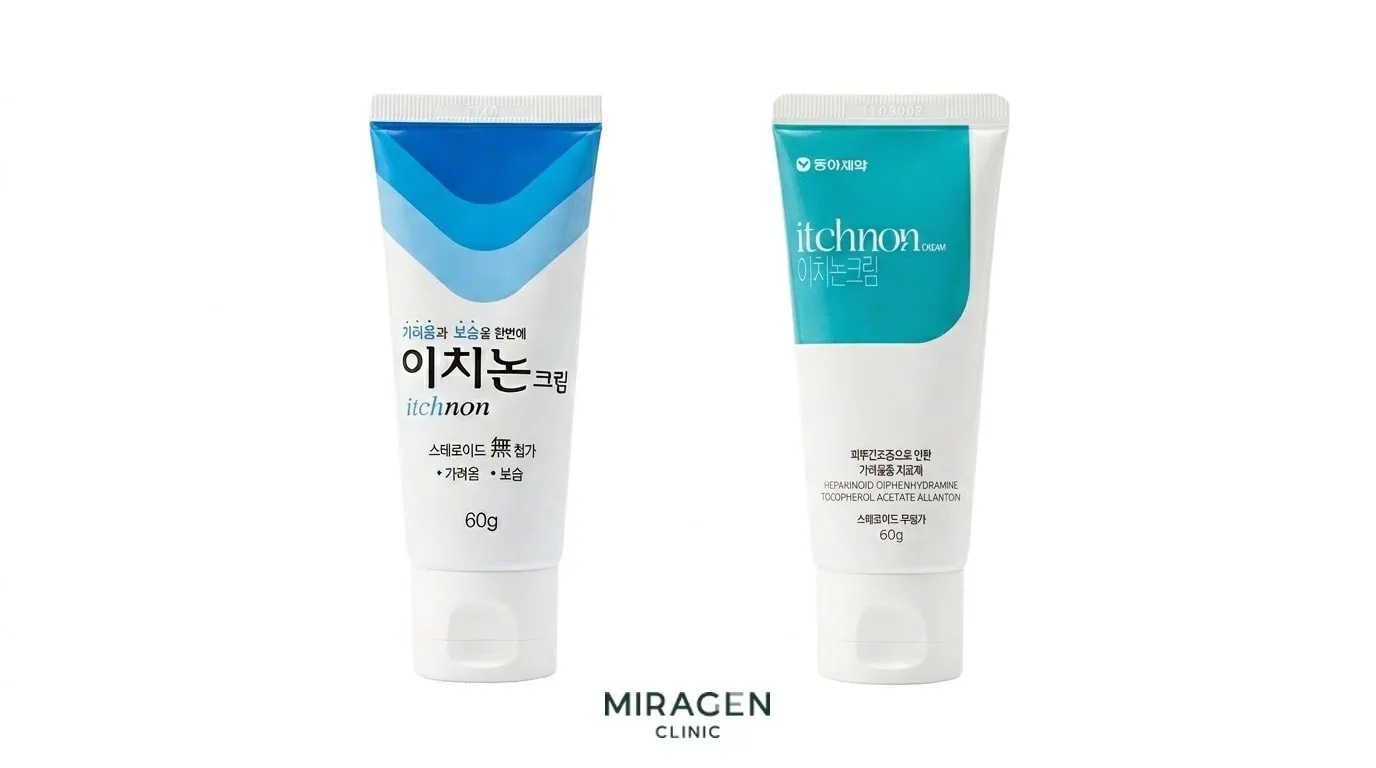
Among patients who visit our clinic for atopic dermatitis, some report that their symptoms worsened after using antihistamine ointments such as Ichinon Cream.
While oral antihistamines are commonly prescribed for atopic dermatitis (though unfortunately they provide limited benefit), the body responds very differently when this ingredient is applied to the skin.
We will explain how antihistamines relieve itching, how the body’s response differs between oral and topical administration, and what alternatives are available.
목차
Same Ingredient, Different Action
The sensation of itching can arise through multiple pathways, but one of the most common is the histamine pathway. During immediate allergic reactions such as urticaria, immune cells in the skin called mast cells release histamine, which binds to H1 receptors on nerves and creates the sensation of itching. Antihistamines work by blocking these H1 receptors, interrupting only the itch signal generated by histamine. Antihistamine ointments like Ichinon Cream operate on the same principle, but their mechanism of action differs significantly from oral administration.
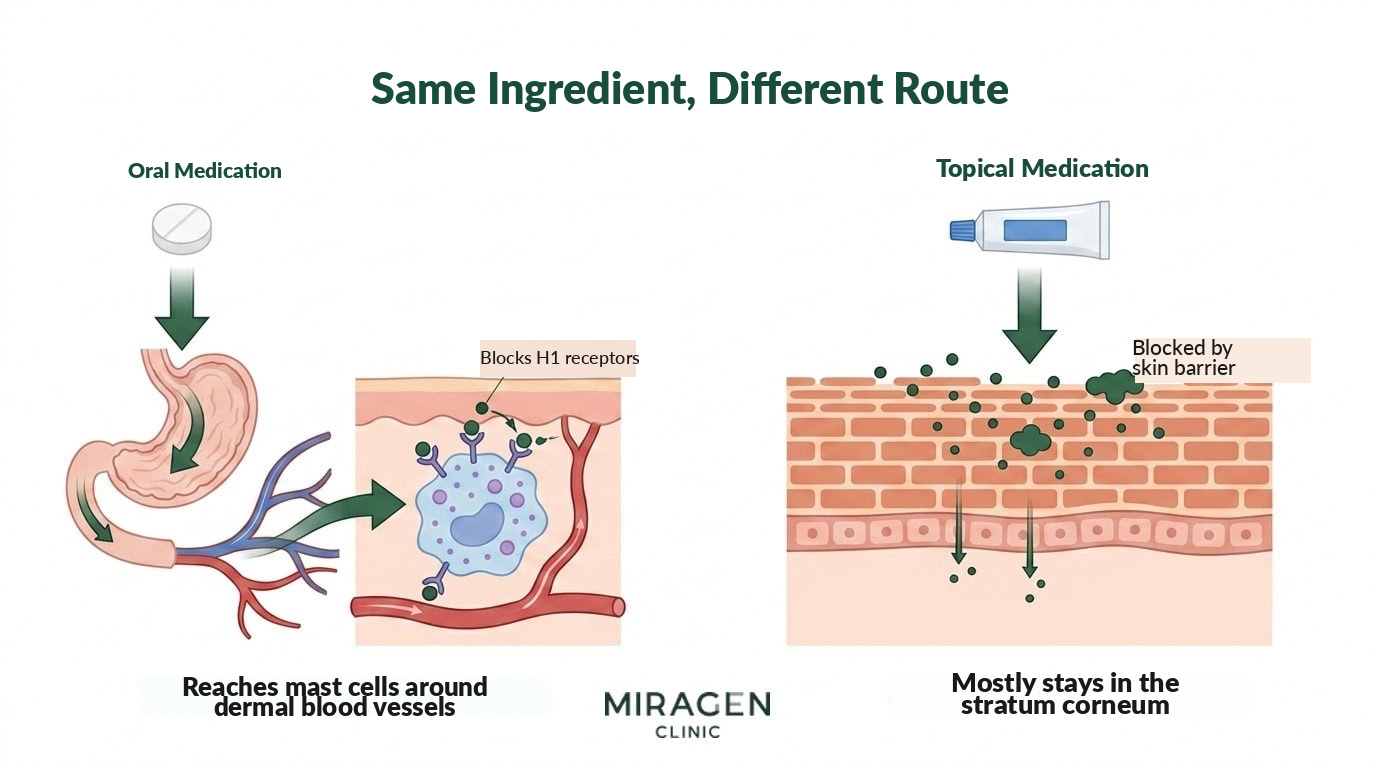
Mast cells are not located on the skin surface but in the deeper layers around blood vessels. Oral medications are absorbed through the gastrointestinal tract and reach the deep layers of the skin directly via the bloodstream, whereas topical medications must penetrate from the outside through the stratum corneum—a brick-wall barrier—and travel a considerable distance to reach mast cells. It is like reaching the same destination: short from the inside, long from the outside. Consequently, most of the antihistamine in an ointment remains trapped at the surface, with only a small amount reaching the dermis.
Moreover, unlike when taken orally, antihistamines are among the most common ingredients that cause allergic contact dermatitis when applied to the skin. When ingested, they are broken down into small metabolites through the gastrointestinal tract and liver, which the body does not recognize as harmful. However, when applied to the skin, the body may recognize them as dangerous substances.
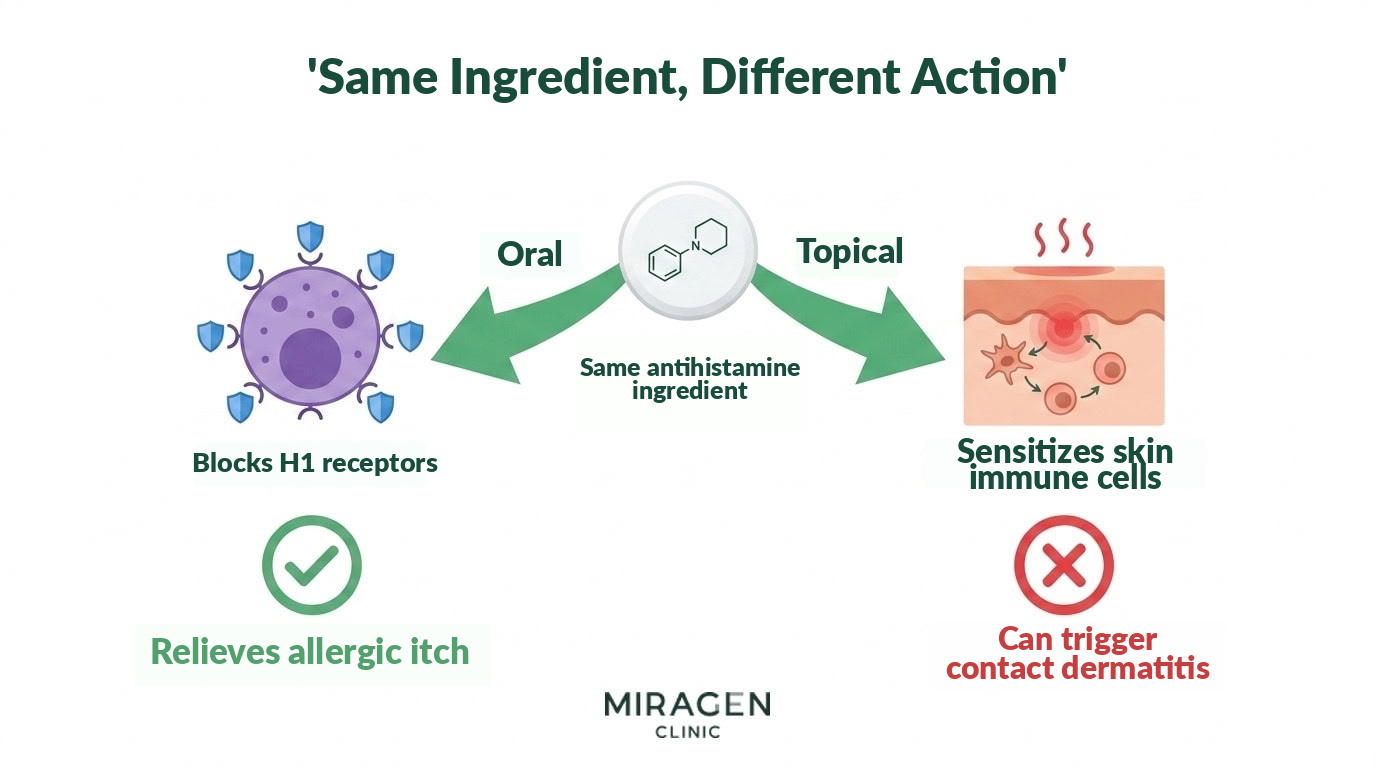
More specifically, immune cells in the epidermis (Langerhans cells) carry antihistamine molecules to lymph nodes and sensitize T cells. Once sensitized, re-exposure to the same ingredient triggers contact dermatitis at the site over 48 to 72 hours.
Diphenhydramine, the main ingredient in antihistamine ointments marketed in Korea, has been consistently reported to cause sensitization. A case was published in a European journal where a wife developed widespread contact dermatitis on her hands after applying diphenhydramine ointment to her husband’s back,1 and since the 1970s, cases have accumulated showing that recurrence patterns vary depending on the site of application. Lanolin in Bepanthen ointment is a similar case—sensitization risks often hide behind the image of a “gentle medication” in topical preparations.
Not All Itching Is Caused by Histamine
Another reason antihistamine ointments like Ichinon Cream do not work well for itching is that the equation “itching = histamine” only applies in certain cases. Histamine plays a leading role in immediate allergic reactions such as urticaria, but chronic itching primarily arises through other pathways.
According to a comprehensive review published in the Journal of the American Medical Association (JAMA) in 2024, approximately 60% of chronic itch patients have inflammatory conditions (eczema, psoriasis, seborrheic dermatitis, etc.), and 25% have neuropathic or mixed causes. In these types of itching, blocking H1 receptors alone does not effectively control the itch.2 Atopic dermatitis is a prime example: inflammatory signaling molecules (cytokines) such as IL-31 directly stimulate sensory nerves to produce itching, so blocking H1 leaves this pathway intact.3
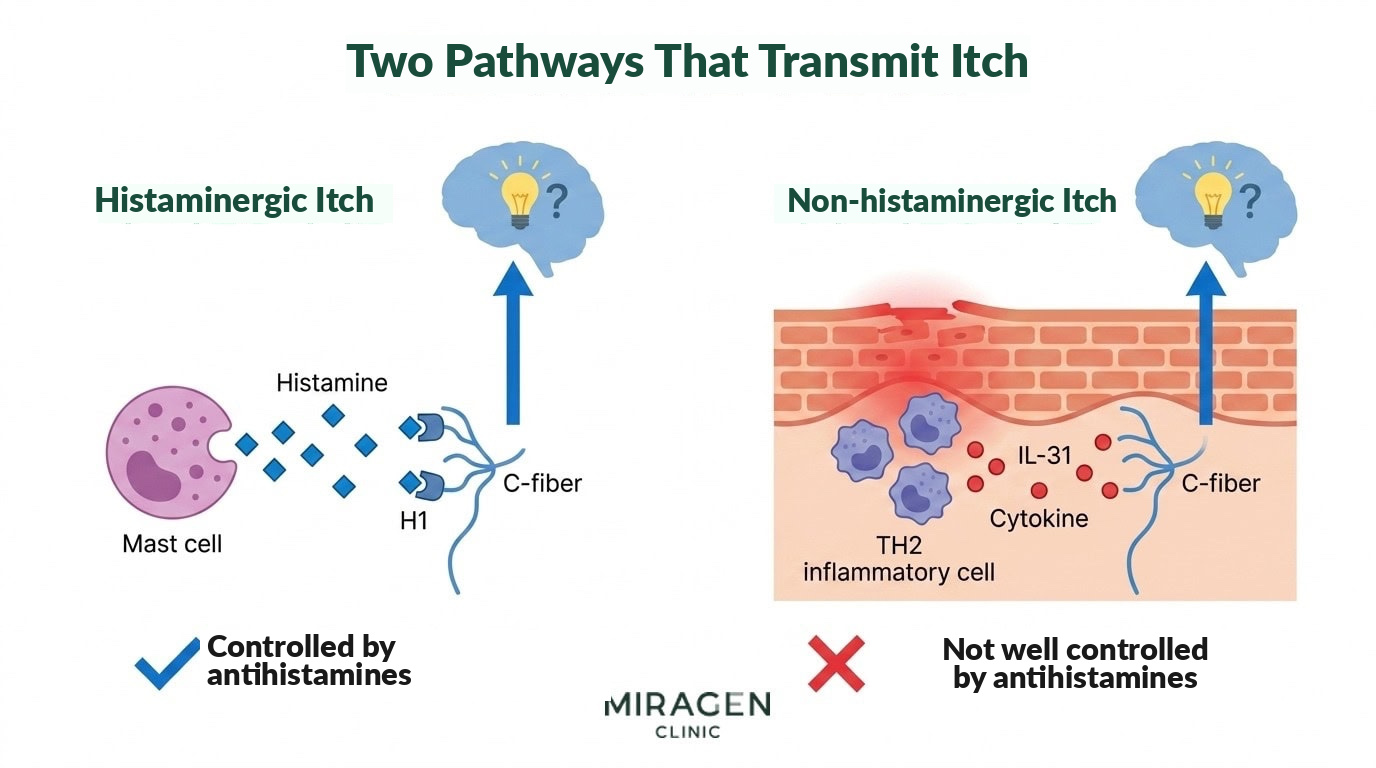
Therefore, American and European eczema guidelines do not recommend oral antihistamines as first-line treatment for atopic itch, but only suggest short-term use at night to aid sleep when itching disrupts rest.4 In Germany, a paper was published titled “Is the Era of Antihistamines for Itch Treatment Coming to an End?”5
If oral medications are this limited, the effectiveness of antihistamine ointments—which are absorbed even less—is naturally lower. A comprehensive review of 19 clinical trials on antihistamine ointments published from 1950 to 2009 found that only doxepin cream, developed in the United States, showed clear efficacy, and even that had limited recommendations due to contact dermatitis concerns.6
Nevertheless, some people do feel relief from itching after applying antihistamine ointments, but this is usually due to auxiliary ingredients rather than the antihistamine itself. Many antihistamine ointments contain menthol, camphor, or crotamiton, which stimulate TRPM8 receptors in the skin to create a cooling sensation or provide mild anesthetic effects.
Better Alternatives to Antihistamine Ointments
Instead of antihistamine ointments like Ichinon Cream, we have compiled safer and more effective options for itching by situation.
Mild Localized Itching or Insect Bites
Low-potency steroid ointments (Class 7 hydrocortisone 1%) are generally safer and more reliably effective. Sensitization reports are rare, and short-term use for 2 to 3 days poses minimal risk of skin barrier damage. For information on types and classes of topical steroids, please refer to our Steroid Ointment Classes article. Additionally, applying ice packs to insect bites helps reduce both histaminergic and non-histaminergic itching.7
Face, Skin Folds, Children’s Skin
For these areas, calcineurin inhibitors such as Protopic or Elidel are more appropriate than steroids. They can be used long-term without skin atrophy, and unlike antihistamine ointments, contact dermatitis reports are relatively rare. However, they require a physician’s prescription.
Generalized Dry Itching
In this case, the cause is often not histamine but moisture deficiency in the skin barrier. Consistently applying moisturizers containing barrier-repair ingredients such as ceramides is far more effective than antihistamine ointments. A leaking barrier is not a problem that can be resolved by blocking histamine.
Antihistamine Ointments Available in Korea
Despite the information provided above, you may still wish to try antihistamine ointments like Ichinon Cream, so we are sharing information on products currently marketed in Korea. Nearly all antihistamine ointments available in Korea are over-the-counter products containing diphenhydramine 10 mg/g.
| Product Name | Active Ingredient | Approved Indications |
|---|---|---|
| Ichinon Cream | Diphenhydramine 10 mg/g | Itching of dry skin |
| Mosqul Kid Cream | Diphenhydramine 10 mg/g | Itching, insect bites, heat rash, urticaria, eczema, chafing |
| Hanshin Bodri Ointment | Diphenhydramine 10 mg/g | Itching of dry skin |
| Twin N Ointment | Diphenhydramine 5 mg/g | Chapped skin, frostbite, cracks in hands and feet |
| Nuboclen Solution | Diphenhydramine 3 mg/mL | Scratches, wounds, hand disinfection and sterilization |
Ichinon Cream has the highest search volume, but the ingredients, efficacy, and limitations are similar to other diphenhydramine ointments. Some products have broad approved indications including “urticaria,” but listing an indication does not mean efficacy has been proven. Additionally, many combination products on the market mix diphenhydramine with menthol, camphor, crotamiton, dibucaine, or lidocaine. The more ingredients included, the more potential candidates for contact dermatitis, and identifying the cause becomes more difficult if dermatitis develops. Simpler products are preferable when possible.
References
- Teixeira V, et al. Exuberant connubial allergic contact dermatitis from diphenhydramine. Cutan Ocul Toxicol. 2014;33(1):82-84.
- Butler DC, et al. Chronic Pruritus: A Review. JAMA. 2024;332(15):1277-1290.
- Coscarella G, et al. Basic mechanisms of itch and advances in clinical management. Ann Allergy Asthma Immunol. 2026.
- Wollenberg A, et al. ETFAD/EADV Eczema task force 2020 position paper on diagnosis and treatment of atopic dermatitis. J Eur Acad Dermatol Venereol. 2020;34(12):2717-2744.
- Weisshaar E, et al. [Antihistamines for treating pruritus: The end of an era?]. Hautarzt. 2020;71(7):506-509.
- Eschler DC, Dayrit JF. An evidence-based review of the efficacy of topical antihistamines in the relief of pruritus. J Drugs Dermatol. 2010;9(8):992-997.
- Vander Does A, et al. Update on mosquito bite reaction: Itch and hypersensitivity, pathophysiology, prevention, and treatment. Front Immunol. 2022;13:1024559.
Frequently Asked Questions
Antihistamine ointments like Ichinon Cream are readily available at pharmacies. Are they dangerous?
Since they are approved as over-the-counter products, short-term use on small areas is generally not problematic. Issues arise when applied daily for weeks to treat chronic itching or when repeatedly applied over large areas. This pattern increases the risk of contact dermatitis.
Can I apply antihistamine ointment to insect bites?
For two or three bites over two or three days, you may try it. However, a combination of low-potency steroid ointment and oral second-generation antihistamines is generally faster and less irritating.
If I use diphenhydramine ointment and oral antihistamines together, will the effect be doubled?
No. Since oral antihistamines already act systemically, applying the same class topically provides minimal additional benefit and only increases the risk of skin sensitization. It is better to switch the ointment to a low-potency steroid or omit it altogether.

We treat atopic dermatitis, rosacea, and seborrheic dermatitis.
Thanks to the valuable reviews you have shared in the community, many of you visit us even from far away.
We will repay you with sincere, attentive care.
DK Han
Chief Director, MIRAGEN Clinic
Graduate of University of Michigan, Ross School of Business
Graduate of Chungnam National University School of Medicine
(Former) Representative Director of Ewha Phoenix Rehabilitation Hospital
(Current) Representative Director of MIRAGEN Clinic


