
Many people who come in with hives on the face that look like mosquito bites are worried about a condition such as rosacea. In most cases, though, it turns out to be contact urticaria caused by a cosmetic or ointment applied to the face.
Contact urticaria appears within a few minutes to 1 hour after something is applied to the skin. The skin swells up like a mosquito bite and itches.
The raised marks usually fade without a trace within a day.1 But if you apply the same product again, the symptoms usually come back. It happens more easily when the skin barrier is weak and less often when it is strong.
Because it looks exactly like hives, quite a few people try antihistamines before they visit, but antihistamines often do not work well for this condition. Finding and avoiding the product that caused it matters more.
1. What Is Contact Urticaria?
Contact urticaria is when a substance that touches the skin makes the skin swell into a raised bump like a mosquito bite, with redness around it. Doctors call this kind of lesion a "wheal," while patients often call it a "mosquito-bite rash." It may also itch or sting.
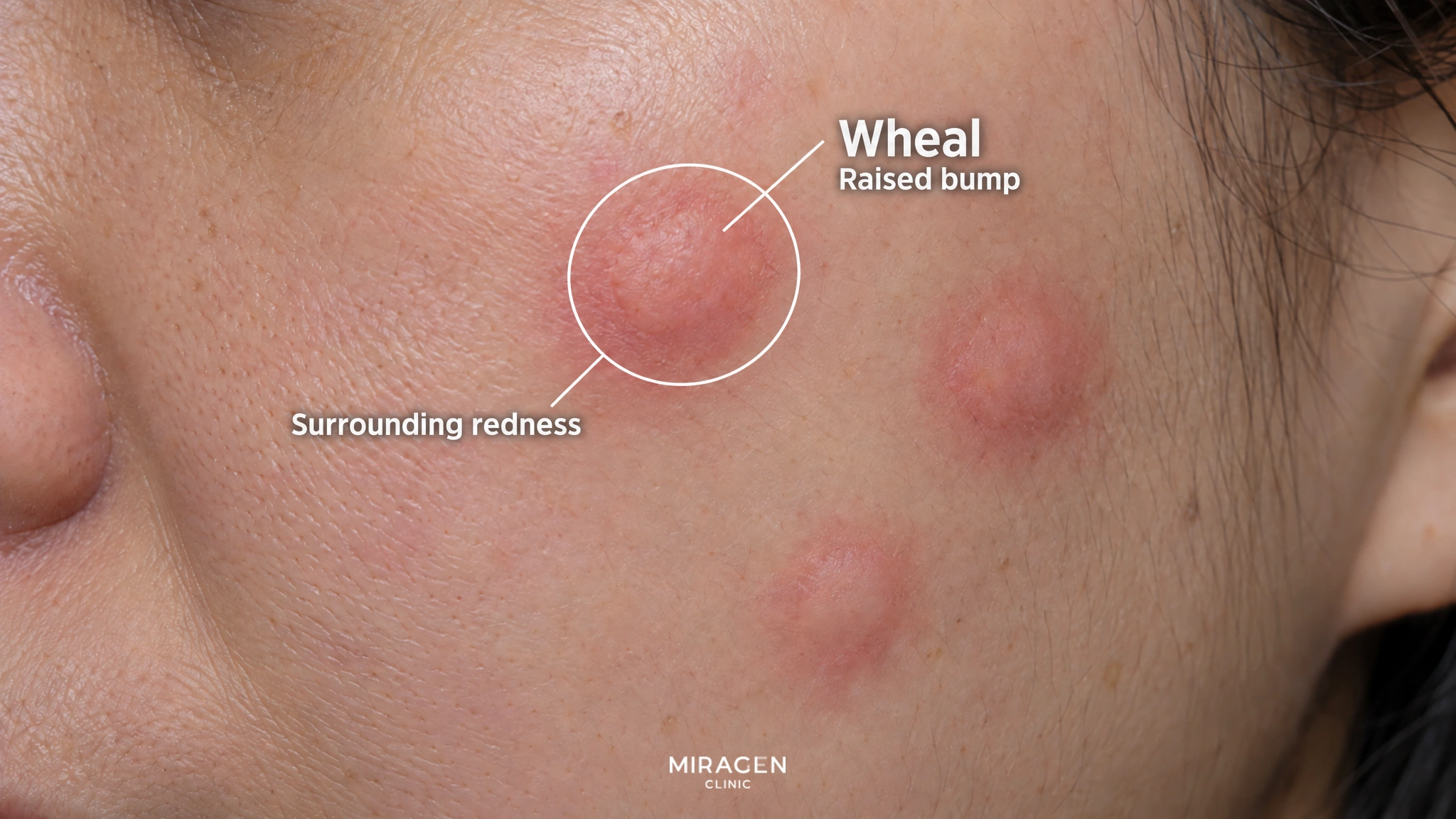
In most cases it appears only where the substance touched the skin, but when it is caused by an allergy, it can spread over the whole body. The raised marks usually fade without a trace within a day.
2. Types of Contact Urticaria
There are two types of contact urticaria: one that happens regardless of allergy, and one that is caused by an allergy.
Non-allergic contact urticaria can appear even with a product you are using for the first time, and it can happen to anyone.1 Preservatives and fragrances, which are common in cosmetics and ointments, are typical causes. The skin on the face is thin, so this reaction shows up especially easily there.1
Allergic contact urticaria happens only in people who are allergic to that substance. Latex gloves, foods such as fruit and fish, and animal hair are common causes. It starts where the substance touched the skin and can spread over the whole body, but it rarely becomes severe enough to make the lips or throat swell or to cause shortness of breath.
Both types happen more easily when the skin barrier is weak, because the substance that causes them gets into the skin more easily.
| Non-allergic contact urticaria | Allergic contact urticaria | |
|---|---|---|
| Who gets it | Anyone | Only people allergic to the substance |
| Common causes | Preservatives (benzoic acid · sorbic acid), fragrances (cinnamaldehyde · balsam of Peru), stinging nettle | Latex gloves, foods, animals |
| Area | Only where it touched | Can spread over the whole body |
| Antihistamines | Do not work well | Work well |
3. How It Differs From Contact Dermatitis
The biggest difference is the swelling. Contact urticaria is marked by raised bumps like mosquito bites that appear within 1 hour.
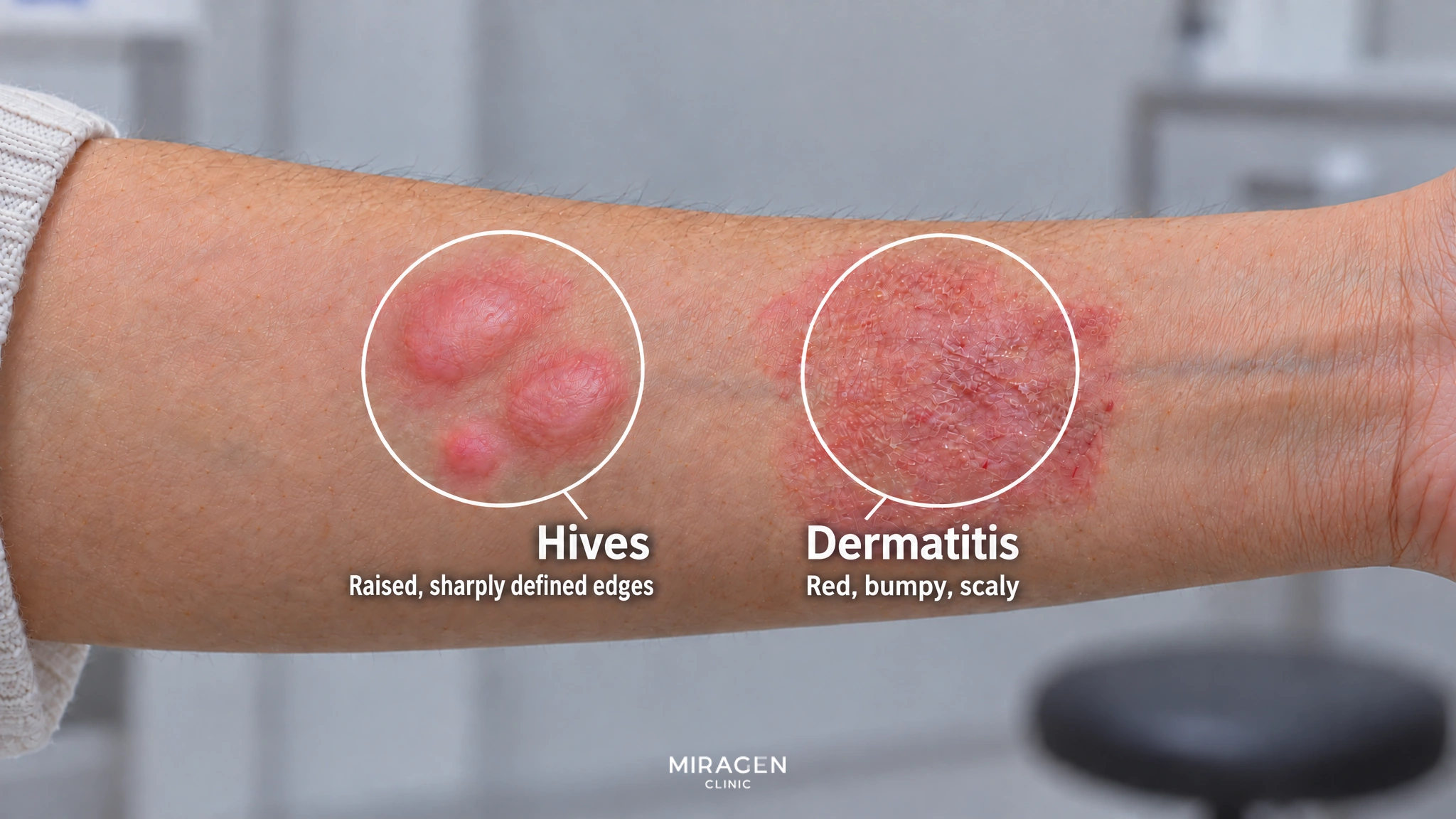
If the skin only stings right after you apply something and does not swell, or if it starts to itch a few days later, it is more likely to be contact dermatitis.
Contact dermatitis also comes in two types: irritant and allergic.2
Irritant contact dermatitis is caused by strong, irritating ingredients such as AHA, BHA, or retinol. It is not related to allergy, so it can happen to anyone whose skin barrier is weak. Usually the skin burns and stings right after you apply the product, and it gets worse as the same irritation is repeated.
Allergic contact dermatitis happens only in people who are allergic to the ingredient, and the skin becomes more and more itchy 1~2 days after applying it.
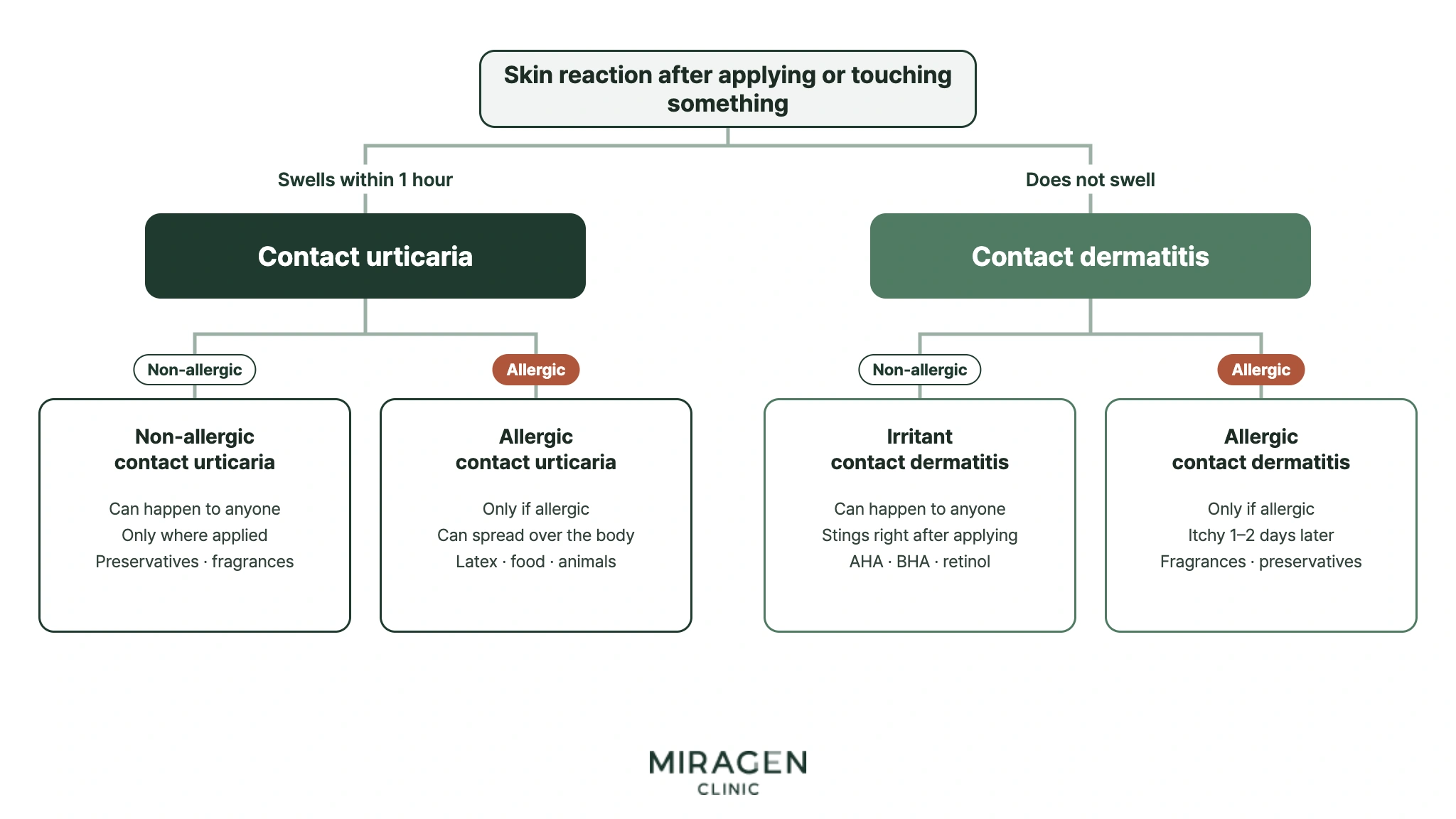
Here are the four types in one table.
| Type | Category | Who gets it | Features | Common causes |
|---|---|---|---|---|
| Non-allergic contact urticaria | Contact urticaria · non-allergic | Anyone | Swells up and appears only where applied | Preservatives · fragrances |
| Allergic contact urticaria | Contact urticaria · allergic | Only people with the allergy | Swells up and can spread over the whole body | Latex · foods · animals |
| Irritant contact dermatitis | Contact dermatitis · non-allergic | Anyone | Stings right after applying | AHA · BHA · retinol |
| Allergic contact dermatitis | Contact dermatitis · allergic | Only people with the allergy | Itching 1~2 days later | Fragrances · preservatives |
4. Treatment
For contact urticaria, stopping the product that causes it is the most reliable treatment.3
If you wash off the product that caused it, the symptoms go away within a day, but if you apply the same product again, they usually come back. It happens more easily when the skin barrier is weak and less often when it is strong.
For non-allergic contact urticaria, taking antihistamines does not improve the symptoms.4 Instead, taking or applying an anti-inflammatory pain reliever such as aspirin helps.56
However, taking anti-inflammatory pain relievers regularly can be hard on the stomach, so it is best to use them only to tell which type of contact urticaria it is when symptoms appear. If antihistamines do not work but an anti-inflammatory pain reliever calms the symptoms, it is likely to be non-allergic contact urticaria.
Antihistamines work well for allergic contact urticaria, so it is best to avoid the cause and take antihistamines.1 You can find out what you are allergic to with an allergy test.
Frequently Asked Questions
What does "mosquito-bite rash" mean?
It means a rash that swells into a raised bump as if bitten by a mosquito. Doctors call this symptom a wheal, while patients often call it a mosquito-bite rash. If it appears on the face, it is usually contact urticaria caused by a product applied to the skin.
Why do hives suddenly appear on my face?
If they suddenly appear only on the face, it is usually contact urticaria caused by a cosmetic or ointment you applied recently. If you started using a new product just before the symptoms appeared, it is best to stop that product first. If hives appear over the whole body at the same time, there may be another cause, such as food or medicine.
Can I apply an ointment to a rash that looks like mosquito bites?
Yes, you can. A steroid ointment or Protopic may help, but washing off the product usually calms the symptoms faster than applying an ointment.
Can food cause contact urticaria?
Yes. It can appear on the hands or around the mouth when you touch or eat foods such as fruit, fish, or raw meat. When it is caused by food, it is often an allergy, so if your lips or throat swell or you feel short of breath, it is best to see a doctor right away.1
Does contact urticaria go away on its own?
If you wash off the product that caused it, it usually calms down within a day. But if you apply the same product again, it can come back.
References
- Bizjak M, Aerts O, Pesqué D, et al. Contact Urticaria and Related Conditions: Clinical Review. Contact Dermatitis. 2025;93(2):87-107.
- Tan CH, Rasool S, Johnston GA. Contact dermatitis: allergic and irritant. Clin Dermatol. 2014;32(1):116-24.
- Giménez-Arnau AM, Pesqué D, Maibach HI. Contact Urticaria Syndrome: a Comprehensive Review. Curr Dermatol Rep. 2022;11(4):194-201.
- Lahti A. Terfenadine does not inhibit non-immunologic contact urticaria. Contact Dermatitis. 1987;16(4):220-3.
- Lahti A, Väänänen A, Kokkonen EL, Hannuksela M. Acetylsalicylic acid inhibits non-immunologic contact urticaria. Contact Dermatitis. 1987;16(3):133-5.
- Johansson J, Lahti A. Topical non-steroidal anti-inflammatory drugs inhibit non-immunologic immediate contact reactions. Contact Dermatitis. 1988;19(3):161-5.