Most prescriptions brought in by dermatitis patients contain antihistamines. Many patients also believe that these medications are effective for all types of itching.
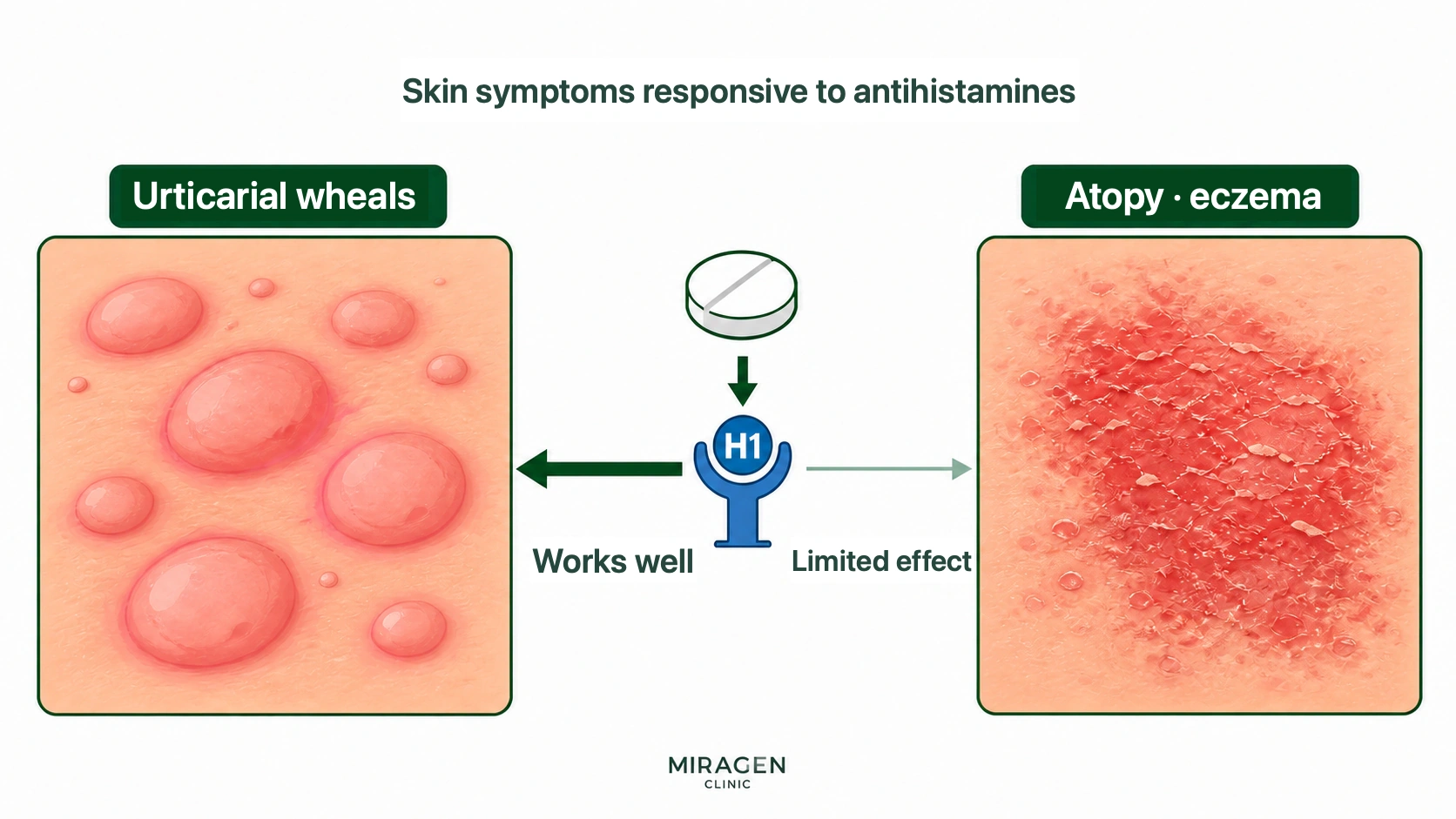
However, while antihistamines work well for wheals in hives—where the skin swells like a mosquito bite—they are rarely effective for itching caused by atopic dermatitis or eczema.1,2
Furthermore, the classification into 1st, 2nd, and 3rd generations does not indicate the order of potency.3
I will explain how these medications work, which skin lesions they are effective for, and what differs by generation.
Skin symptoms that respond well to antihistamines
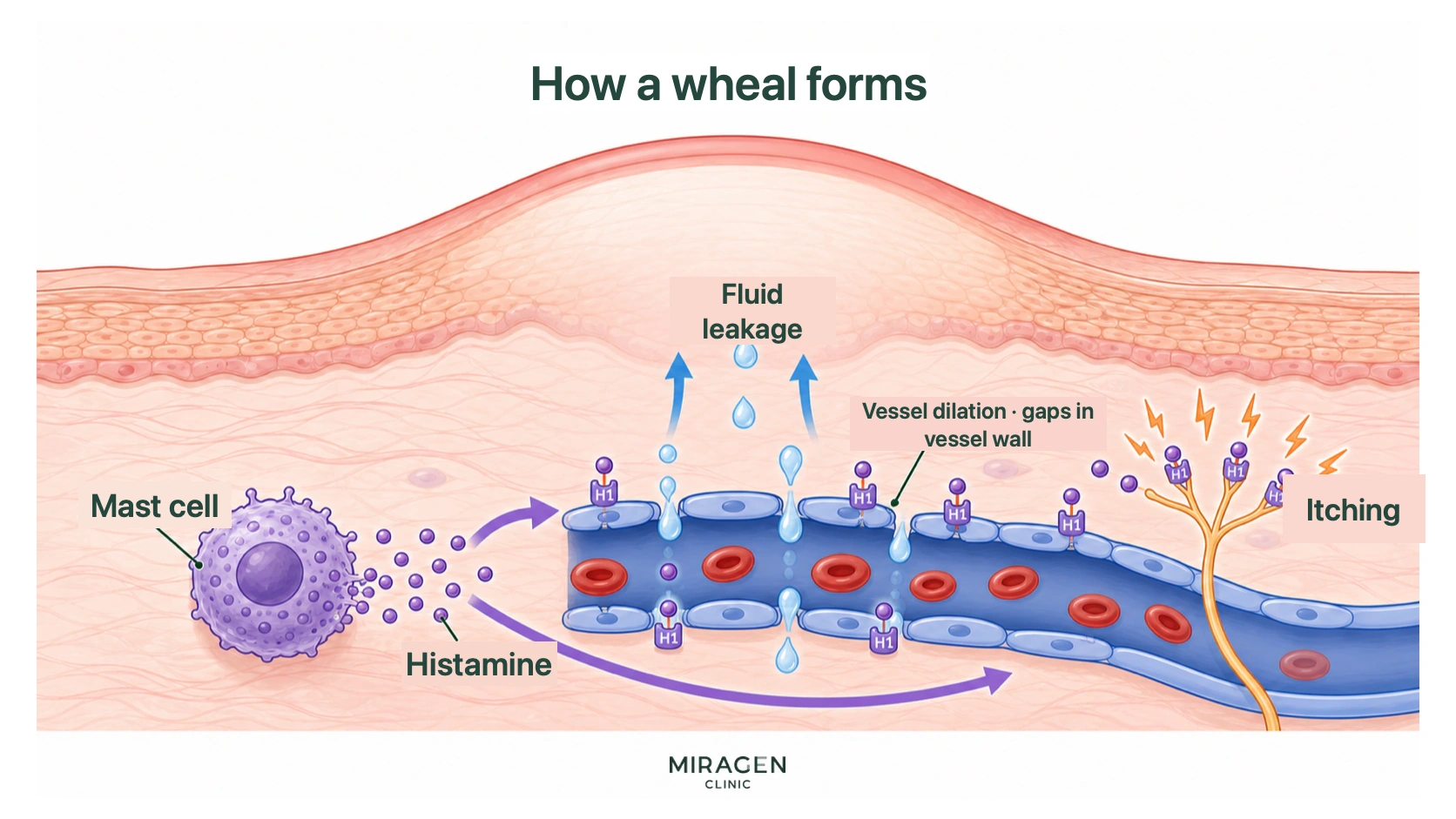
The skin lesions that respond best are wheals. Wheals are raised bumps on the skin, like mosquito bites, and usually disappear within 30 minutes to 24 hours.1
Wheals form when mast cells, immune cells in the skin, release histamine. When histamine binds to H1 receptors on blood vessels, the vessels dilate and gaps open in the vessel walls. Fluid then leaks from the vessels into surrounding tissue, causing the skin to swell and redden. At the same time, histamine stimulates H1 receptors on sensory nerves, causing itching.3
Antihistamines block H1 receptors, reducing wheals, redness, and itching.3
Key point of generational differences | Blood–brain barrier
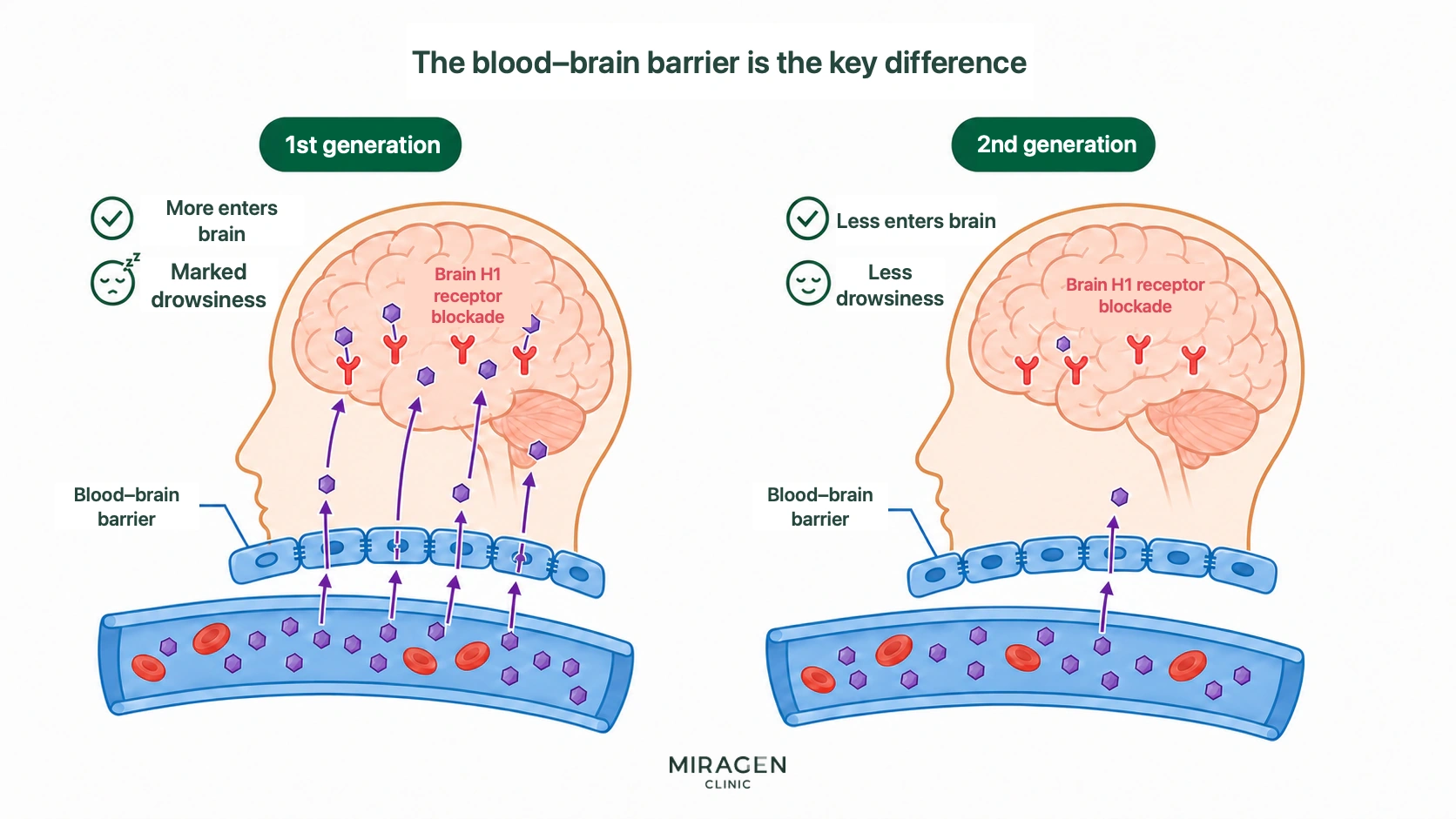
Officially, antihistamines are classified into 1st and 2nd generations, and the key difference is how much the drug crosses the blood–brain barrier. The blood–brain barrier is a filter that prevents substances in the blood from entering the brain indiscriminately.
1st-generation agents easily pass through this filter and block H1 receptors in the brain, which can cause not only drowsiness but also decreased concentration and reaction speed.3
On the other hand, 2nd-generation agents generally enter the brain in smaller amounts, making them less drowsy than 1st-generation ones.3 However, even among 2nd-generation agents, the degree varies, and Allegra is one of the least drowsy drugs as it hardly enters the brain even among the 2nd generation.4
Another Problem with First-Generation Drugs | Anticholinergic Side Effects
Early first-generation drugs not only cross the blood-brain barrier readily, but also have low selectivity for binding only to H1 receptors. Because muscarinic receptors are similar to H1 receptors, drugs like chlorpheniramine can bind to both receptors.5,6
When first-generation antihistamines bind to muscarinic receptors, they can cause dry mouth, constipation, difficulty urinating, and blurred vision. Confusion and delirium may also occur, and the burden of falls and cognitive decline is particularly high in older adults.7,8
These symptoms are called anticholinergic side effects. Because of these side effects, the American Geriatrics Society recommends avoiding first-generation drugs such as chlorpheniramine in Pheniramine tablets and hydroxyzine in Adipam tablets in people aged 65 and older.7
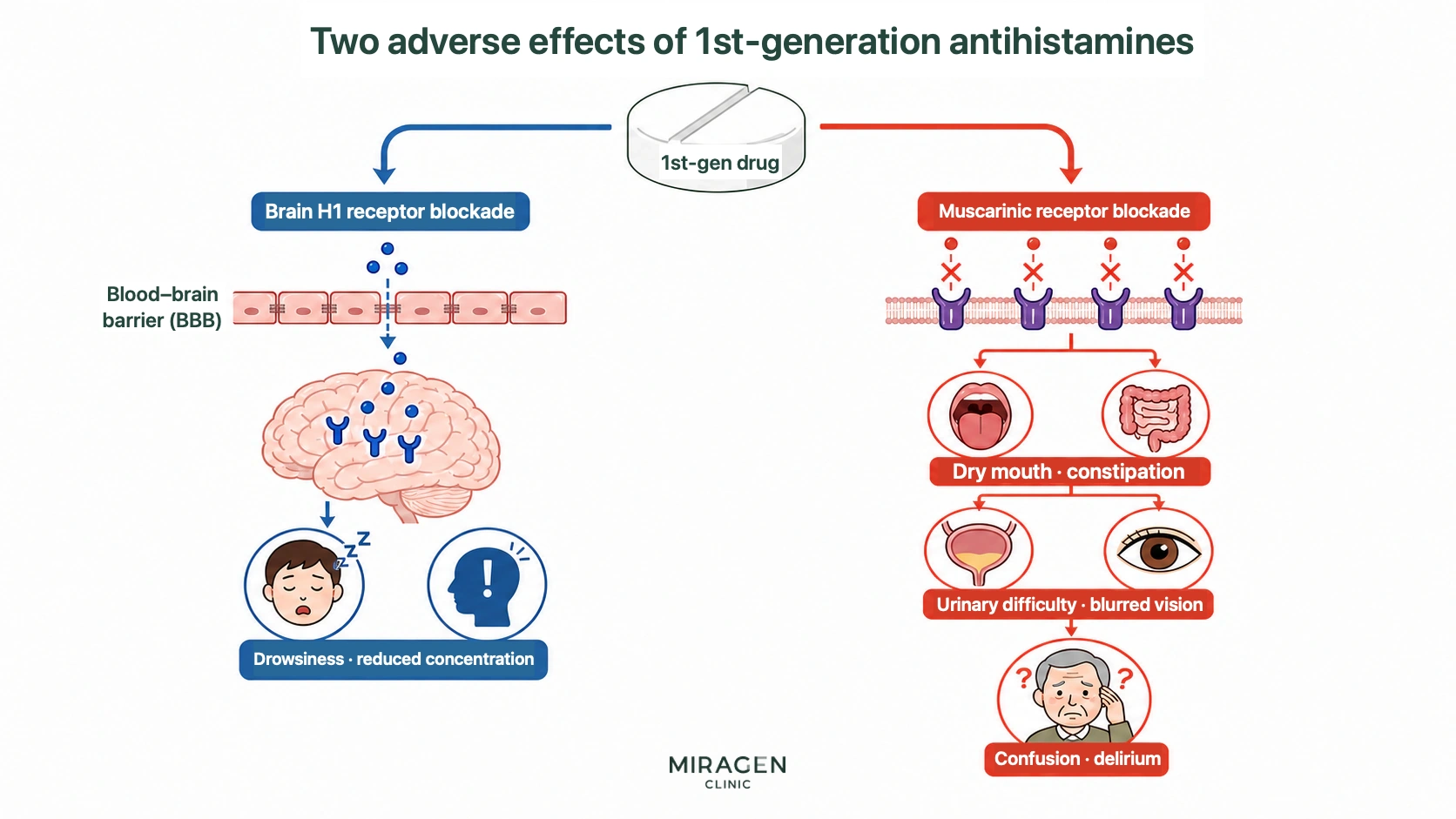
In contrast, 2nd-generation agents have higher H1 receptor selectivity and fewer anticholinergic side effects than 1st-generation drugs. Therefore, when antihistamines are needed in older adults, 2nd-generation agents are more appropriate than 1st-generation.5,7,9
1st, 2nd, and 3rd Generation Antihistamines
2nd-generation antihistamines were developed because 1st-generation agents easily enter the brain and bind to muscarinic receptors, which can cause side effects.3,5 However, some drugs among the 2nd generation are often referred to as 3rd generation by many people.10
While 3rd generation is not an officially recognized classification, the products called this are further improved versions of the 2nd generation.
| Generation | Leading products in Korea | Key difference |
|---|---|---|
| 1st Generation | Peniramin tablets · Adipam tablets | They enter the brain easily, causing drowsiness and anticholinergic side effects. |
| 2nd Generation | Zyrtec tablets · Claritin tablets | Brain entry and anticholinergic side effects are reduced. |
| 3rd Generation | Xyzal tablets · Allegra tablets · Aerius tablets | Improved versions of 2nd-generation products |
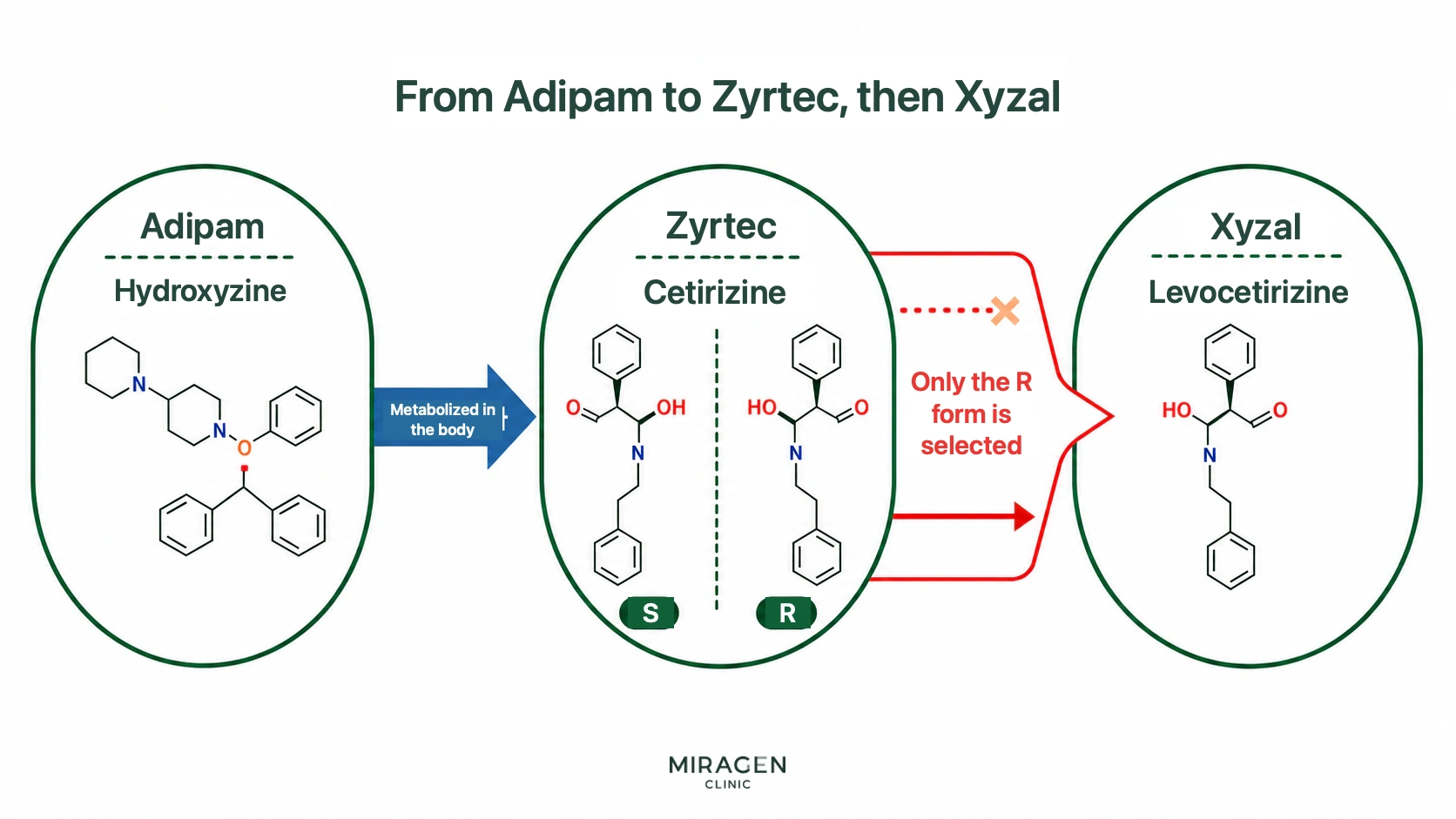
Xyzal tablets (levocetirizine), called 3rd generation, are a purified form of the R-form that primarily acts on H1 receptors, one of the two forms of Zyrtec tablets (cetirizine), a 2nd-generation drug. And Zyrtec tablets (cetirizine) are made from a substance formed when Adipam tablets (hydroxyzine), a 1st-generation drug, is metabolized in the body.11
In other words, Zyrtec tablets, a 2nd-generation refinement of Adipam tablets, a 1st-generation drug, were further refined to create Xyzal tablets, called 3rd generation.
Allegra tablets (fexofenadine), another drug called 3rd generation, are made from a substance formed when terfenadine, a 2nd-generation drug, is metabolized, and Aerius tablets (desloratadine) are made from a substance formed when Claritin tablets (loratadine), a 2nd-generation drug, is metabolized.3
They Do Not Work Well for Atopic Dermatitis · Eczema Itch
The itch of atopic dermatitis and eczema arises through different mechanisms than the itch of urticaria. Therefore, adding antihistamines to existing dermatitis treatment has limited benefit.2
In a 2026 study synthesizing 47 clinical trials involving a total of 6,230 participants, adding 1st-generation antihistamines to dermatitis treatment lowered itch scores by an average of 0.28 points on a 10-point scale, but no statistical difference from placebo was confirmed. In the same study, 2nd-generation antihistamines lowered itch scores by an average of 0.89 points, showing a statistical difference from placebo, but this fell short of the 3-point threshold defined as a patient-perceptible difference.2
The effect of taking 1st-generation antihistamines at night to reduce itching and scratching has also not been proven. In a study of 155 children aged 1–12 with atopic dermatitis over 4 weeks, taking chlorpheniramine, a 1st-generation drug, every night did not reduce sleep disturbance from itching and subsequent scratching compared to the placebo group.12
However, some patients find it easier to fall asleep due to the drowsiness caused by 1st-generation antihistamines, so in actual practice they are sometimes used not to treat itching but to aid sleep.
Topical antihistamines
This medication is not recommended for any skin condition. Most products readily available in Korea contain diphenhydramine, which lacks evidence for reducing itching and can cause contact dermatitis.13,14,15
For more details about Ichinon Cream, please refer to the Ichinon Cream article.
In a study reviewing 19 clinical trials of topical medications, the only ingredient confirmed to be effective was doxepin.13 However, there is no approved doxepin cream in Korea.15
Focus on the skin lesion, not the generation
Antihistamines are not a cure-all for itching. Therefore, the first thing to consider is whether these medications are likely to help with your specific skin lesion.
| Skin lesion | Appearance and course | Treatment approach |
|---|---|---|
| Wheals of urticaria | Raised like a mosquito bite, and the same lesion disappears within 24 hours. | Consider modern 2nd-generation agents first.1 |
| Atopic dermatitis · eczema | Dermatitis lesions that persist in the same area for a long time. | Consider other treatment options.2 |
Even for lesions where these medications may help, the most suitable medication can differ depending on the situation. The characteristics and precautions for Zyrtec tablets, Xyzal tablets, Allegra tablets, Peniramin tablets, and Adipam tablets will be explained in separate articles.
Frequently Asked Questions
Is Xyzal a second-generation or a third-generation antihistamine?
While some sources refer to levocetirizine as third-generation, no drug has been established that meets all third-generation criteria.16 The 2026 international urticaria guideline treats levocetirizine in Xyzal tablets as a modern second-generation agent.1 Levocetirizine is an ingredient that uses only the R-form of the two forms of cetirizine.11
Are there fourth-generation antihistamines as well?
The 2026 international urticaria guideline does not use 4th-generation H1 drugs as a separate drug class. Levocetirizine, fexofenadine, and desloratadine are also treated as modern 2nd-generation agents.1
Why does Allegra tablets cause less drowsiness?
Fexofenadine in Allegra tablets is classified as a drug that barely enters the brain, based on brain H1 receptor occupancy. Therefore, it is one of the least sedating options.4
Can I take antihistamines for atopic itch?
Routinely adding antihistamines solely to treat atopic itch is not recommended. The average reduction in itch does not reach a level patients can perceive, and improvement in sleep disturbance has also not been confirmed.2 In such cases, treatment for dermatitis should be adjusted first.
References
- Zuberbier T, Abdul Hameed Ansari Z, Abdul Latiff AH, et al. The International Guideline for the Definition, Classification, Diagnosis and Management of Urticaria. Allergy. 2026;81(8):2582-2632. PMID 41649409.
- Chu AWL, Wen A, Guyatt GH, et al. Antihistamines for atopic dermatitis (eczema): systematic review and network meta-analysis of randomised trials. BMJ. 2026;394:e100163. PMID 42526949.
- Simons FE, Simons KJ. H1 antihistamines: current status and future directions. World Allergy Organ J. 2008;1(9):145-155. PMID 23282578.
- Kawauchi H, Yanai K, Wang DY, et al. Antihistamines for allergic rhinitis treatment from the viewpoint of nonsedative properties. Int J Mol Sci. 2019;20(1):213. PMID 30626077.
- Shiroishi M, Kobayashi T. Structural Analysis of the Histamine H1 Receptor. Handb Exp Pharmacol. 2017;241:21-30. PMID 27826702. DOI 10.1007/164_2016_10.
- Yasuda SU, Yasuda RP. Affinities of brompheniramine, chlorpheniramine, and terfenadine at the five human muscarinic cholinergic receptor subtypes. Pharmacotherapy. 1999;19(4):447-451. PMID 10212017. DOI 10.1592/phco.19.6.447.31041.
- 2023 American Geriatrics Society Beers Criteria Update Expert Panel. American Geriatrics Society 2023 updated AGS Beers Criteria for potentially inappropriate medication use in older adults. J Am Geriatr Soc. 2023;71(7):2052-2081. DOI 10.1111/jgs.18372.
- Welsh TJ, van der Wardt V, Ojo G, Gordon AL, Gladman JRF. Associations Between Anticholinergic Medication Exposure and Adverse Health Outcomes in Older People with Frailty: A Systematic Review and Meta-analysis. Medicina. 2021;57(11):1230. PMCID PMC8605959. DOI 10.3390/medicina57111230.
- Slater JW, Zechnich AD, Haxby DG. Second-generation antihistamines: a comparative review. Drugs. 1999;57(1):31-47. PMID 9951950. DOI 10.2165/00003495-199957010-00004.
- Holgate ST, Canonica GW, Simons FE, et al. Consensus Group on New-Generation Antihistamines (CONGA): present status and recommendations. Clin Exp Allergy. 2003;33(9):1305-1324. PMID 12956754.
- Chen C. Physicochemical, pharmacological and pharmacokinetic properties of the zwitterionic antihistamines cetirizine and levocetirizine. Curr Med Chem. 2008;15(21):2173-2191. PMID 18781943.
- Munday J, Bloomfield R, Goldman M, et al. Chlorpheniramine is no more effective than placebo in relieving the symptoms of childhood atopic dermatitis with a nocturnal itching and scratching component. Dermatology. 2002;205(1):40-45. PMID 12145433.
- Eschler DC, Klein PA. Journal of Drugs in Dermatology. 2010;9(8):992-997.
- EuroGuiDerm Guideline on Atopic Eczema: Antipruritic treatment. 2022.
- Ministry of Food and Drug Safety, Korea Pharmaceutical Information Service. Accessed August 21, 2026.
- Rico S, Antonijoan R, Barbanoj M. Ebastine in the light of CONGA recommendations for the development of third-generation antihistamines. J Asthma Allergy. 2009;2:73-92. PMID 21437146.