

In clinic, patients sometimes show me health information they found online and ask, “Is this really true?” Some posts say “a cohort study found,” others say “clinical trial results,” and still others say “according to a meta-analysis.”
There are many types of medical research, and their reliability differs by type. In medicine, this reliability is called the level of evidence.1 I will explain what cohort studies, clinical trials, meta-analyses, and systematic reviews are, and which types of medical research are more trustworthy.
목차
Levels of evidence at a glance
In the figure and table below, the higher you go, the more trustworthy it becomes.1
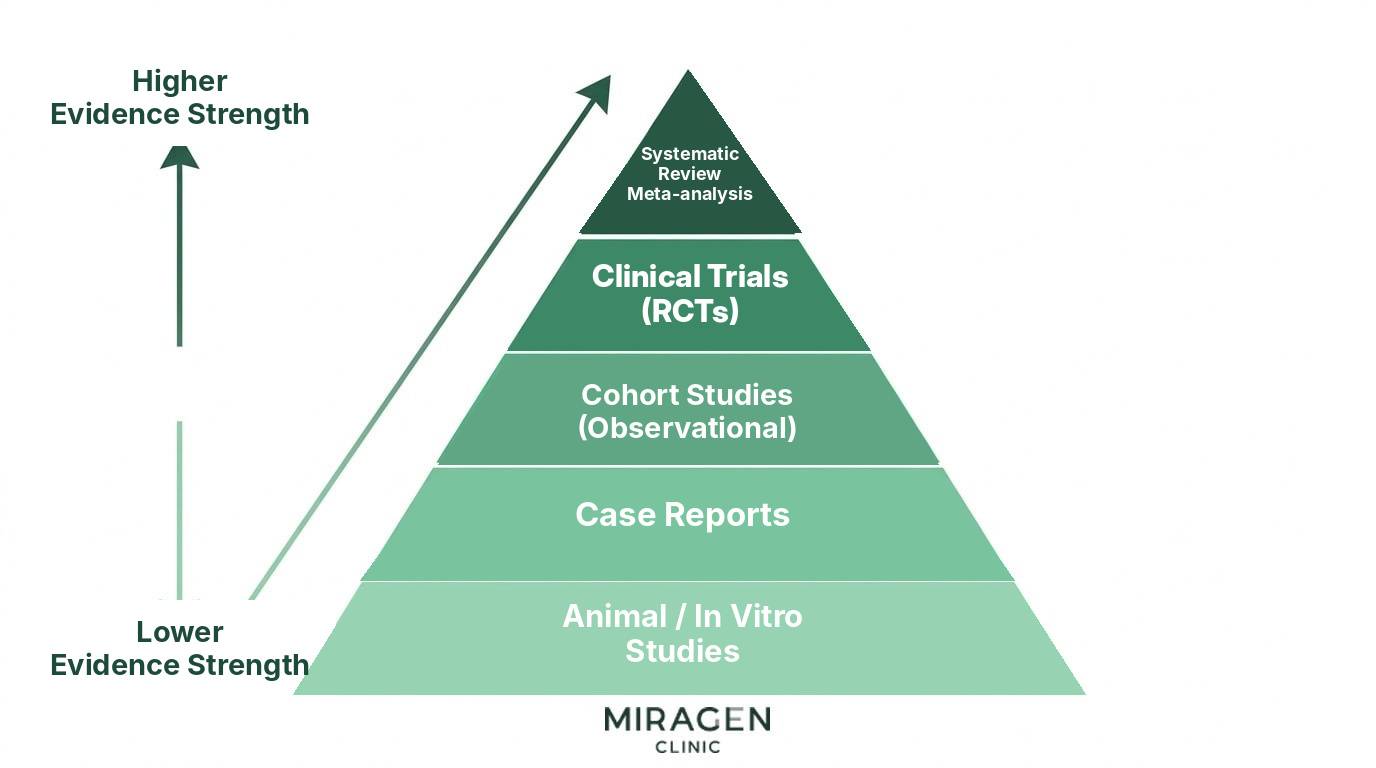
| Level of evidence | Study type | Key features |
|---|---|---|
| Highest | Analysis combining multiple clinical trials (systematic review + meta-analysis) | Collects all relevant studies and statistically pools results, compensating for the limitations of individual studies |
| High | Clinical trials (randomized controlled trials) | Randomly assigns patients and compares a drug with placebo. Strongest for demonstrating causality |
| Moderate | Observational studies (cohort studies, case-control studies) | Follows a specific group over time, or traces people with an existing disease back into the past. Researchers do not intervene |
| Low | Case reports, case series | Describes a small number of patient cases. Useful for identifying new phenomena, but difficult to generalize |
| Lowest | In vitro/animal studies, expert opinion | A pre-human stage, or based on experience without systematic research |
The key point of this pyramid is simple: the more people you compare under stricter conditions, the stronger the evidence becomes.2
Let’s look at each level one by one.
Systematic reviews vs. meta-analyses | What’s the difference?
At the top of the evidence pyramid are systematic reviews (the process of collecting all relevant papers, assessing their quality, and summarizing them) and meta-analyses (a method of statistically pooling the numerical results from those papers).3
These two terms are often confused, but they serve different roles.
| Systematic review | Meta-analysis | |
|---|---|---|
| What it does | Finds all relevant papers, assesses quality, and summarizes results | Statistically pools the numerical results of multiple studies |
| Nature | “Process” (how papers are collected and screened) | “Method” (how the collected numbers are combined) |
| Analogy | Gathering and reading every textbook that covers the exam scope, then selecting only the trustworthy ones | Calculating the average score of the selected textbooks |
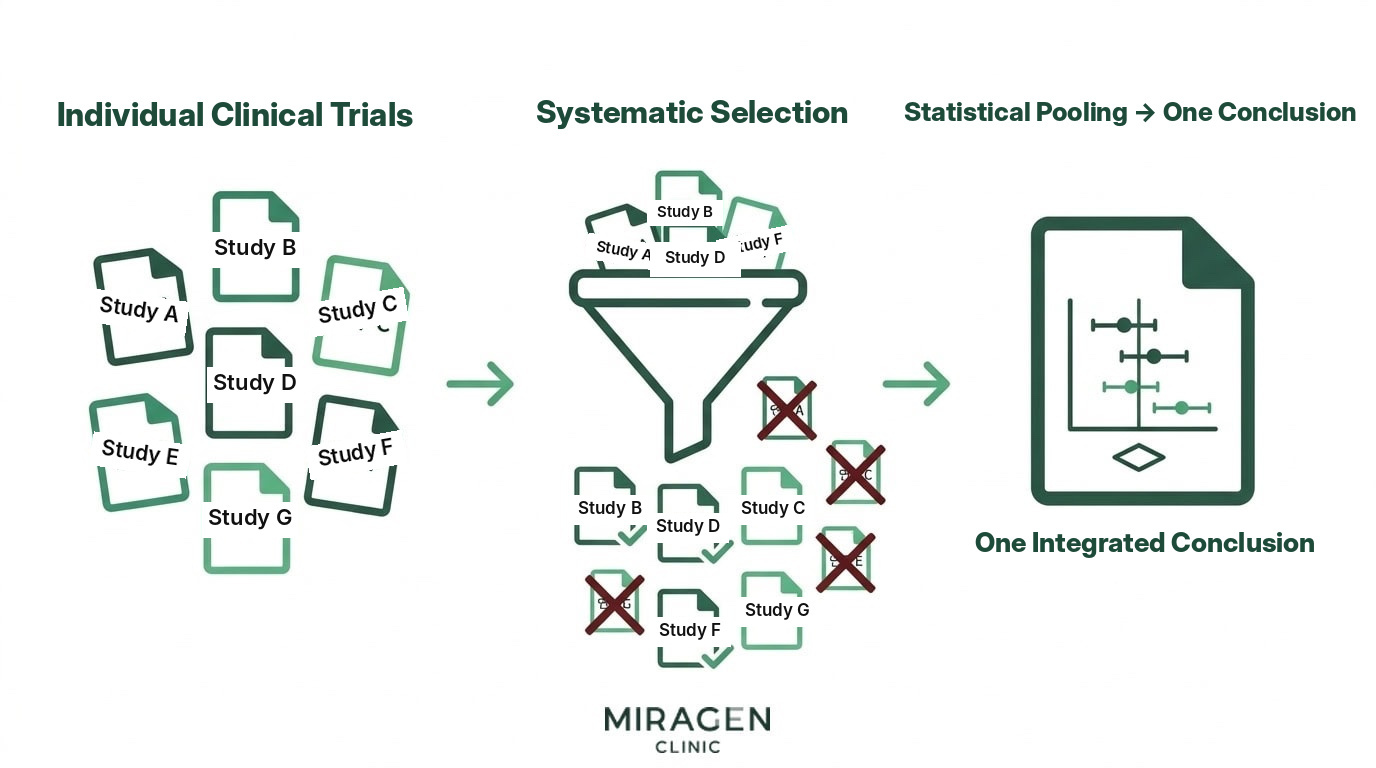
In practice, the two almost always appear together. In fact, most paper titles include both. That’s because they come as a set: first, collect studies systematically (systematic review), then pool the results (meta-analysis).4
This is why pooled analyses sit at the top of the evidence pyramid: they compensate for the limitations of any single clinical trial. Each trial differs in sample size, study duration, and measurement methods. Looking at only one trial leaves the question, “Could it have happened only in this study?” But when you pool 10–20 studies on the same topic, the errors of individual studies tend to cancel out.
However, there is an important caveat. A pooled analysis is not automatically trustworthy. If the included studies are low quality, combining many of them does not improve the quality of the conclusion. One paper published in 2016 even proposed that pooled analyses should be viewed not as the top of the pyramid, but as a “lens” for examining evidence.5
I agree with this perspective. When deciding a treatment plan in the clinic, if pooled results are available, I refer to them first—but I also review the quality and consistency of the studies included.
Cochrane: the international standard for pooled analyses
When searching for health information, you may come across the term “Cochrane review.” Cochrane is an international nonprofit organization founded in the UK in 1993. It identifies all clinical trials on a specific treatment, analyzes them systematically, and publishes a comprehensive report.
Cochrane reviews are trusted in medicine for three reasons. First, they do not accept pharmaceutical sponsorship, so conflicts of interest are reduced. Second, the analysis process is very rigorous (at least two independent reviewers screen papers and assess quality). Third, they are updated whenever new research is published.
So, if you want to confirm the effectiveness of a treatment, it is efficient to check a Cochrane review first, if one exists, rather than starting with individual studies. When I have a question, I also prioritize Cochrane reviews.
Clinical trial phases: from Phase 1 to Phase 4
Clinical trials are studies conducted in humans to confirm a drug’s effectiveness and safety.6 Clinical trial design is determined by three factors.
First: Is there a comparison group?
Trials are divided into controlled trials, which compare against placebo or an existing drug, and single-arm trials, which administer only the drug without a comparison group. A comparison group is needed to distinguish “improved because of the drug” from “improved over time.” Single-arm trials are mainly used when the goal is to observe the drug’s response rather than compare—such as Phase 1 (safety assessment).
Second: If it is a controlled trial—how are participants assigned?
When dividing patients into a drug group and a placebo group, if a computer assigns them randomly, it is a randomized clinical trial. Random assignment makes the two groups statistically similar in age, severity, underlying conditions, and so on, allowing you to compare the drug effect itself. If assignment is not random (e.g., by admission order), differences between groups can distort results, lowering the level of evidence.
Third: If it is a randomized clinical trial—who knows what they received?
If neither the patient nor the doctor knows who received the real drug, it is double-blind. If both know, it is open-label. Double-blinding makes the real drug and placebo look identical, blocking both psychological bias and assessment bias. When the forms differ—such as an injection vs. an oral medication—and blinding is not feasible, trials are conducted open-label.
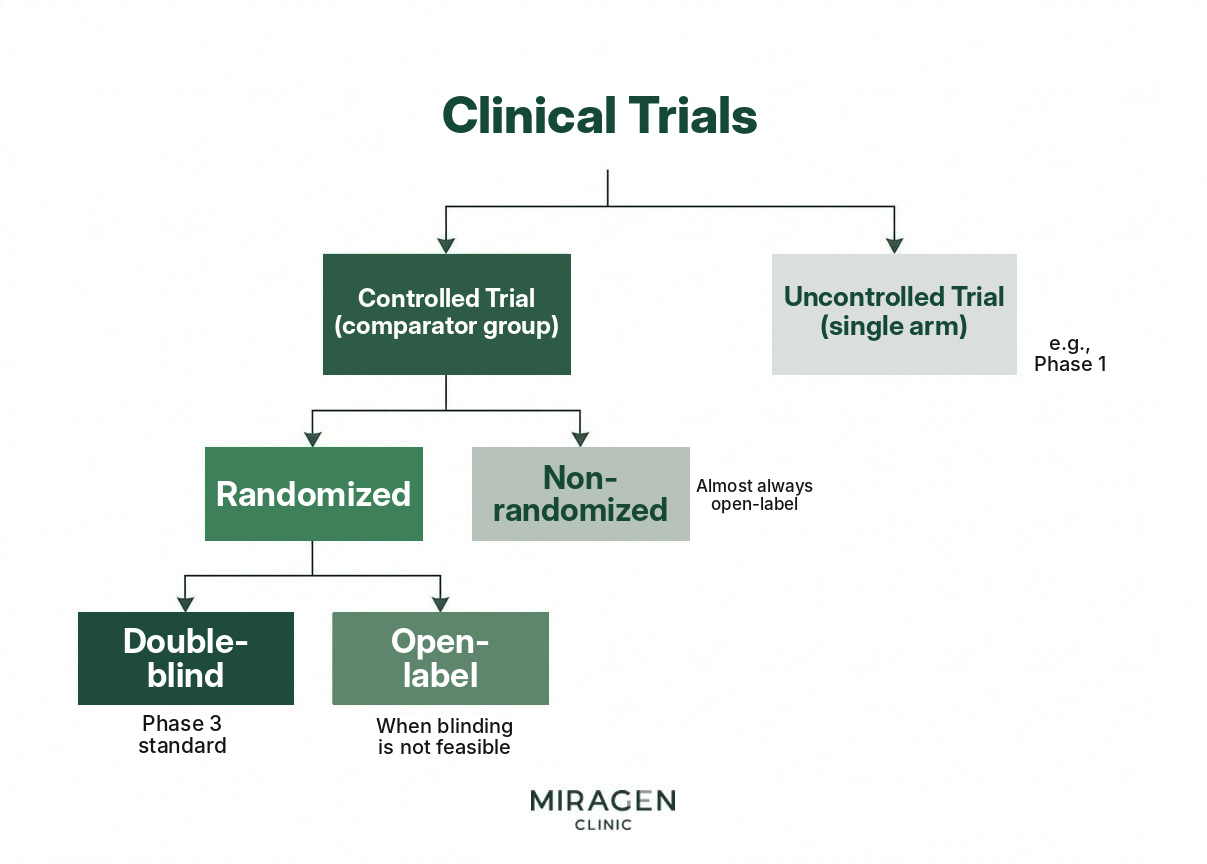
A design that includes all three—control group + randomization + double-blinding—is the most rigorous form of clinical trial and the standard for Phase 3 trials. New drugs go through Phases 1 to 4, and each phase has commonly used standard designs.7
| Phase | Purpose | Scale | Control group | Allocation | Blinding |
|---|---|---|---|---|---|
| Phase 1 | Confirm safe dosage range | 20–100 people | None (single-arm) | — | — |
| Phase 2 | Explore efficacy + determine optimal dose | 100–300 people | Yes (placebo, etc.) | Randomized | Double-blind or open-label |
| Phase 3 | Demonstrate efficacy at scale. Key for FDA approval | Hundreds to thousands | Yes (placebo/standard treatment) | Randomized | Double-blind |
| Phase 4 | Post-marketing long-term safety follow-up | Thousands to tens of thousands | Varies | Varies | Mostly open-label |
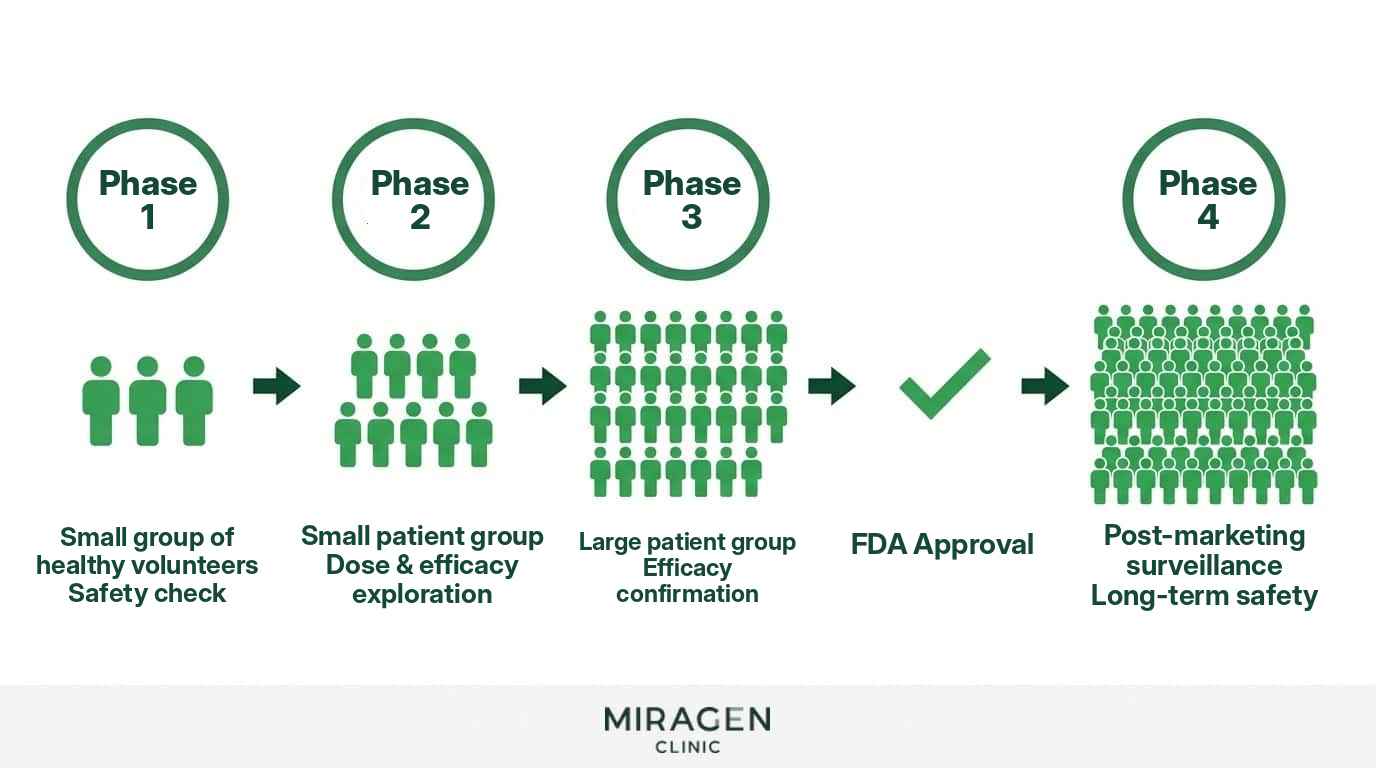
The results most often cited in the news are Phase 3 clinical trial results. That is because they use the most rigorous design—randomization + a control group + double-blinding.8
Phase 4 is conducted after a drug is marketed. Up to Phase 3, trials typically involve thousands of participants, making it difficult to detect rare side effects that occur in, for example, 1 in 10,000 people. In Phase 4, data from tens of thousands of patients in real prescribing settings are collected to track long-term side effects missed in Phase 3 and responses in special populations (older adults, pregnant women, etc.).7 In some cases, the MFDS or the FDA requires Phase 4 as a condition, and in other cases, pharmaceutical companies conduct it voluntarily.
Observational studies: cohort studies, case-control studies, case reports
The biggest difference between clinical trials and observational studies is whether the researcher intervenes.9 In clinical trials, researchers administer the drug directly to patients. In observational studies, researchers simply observe what has already happened, without intervening in treatment.
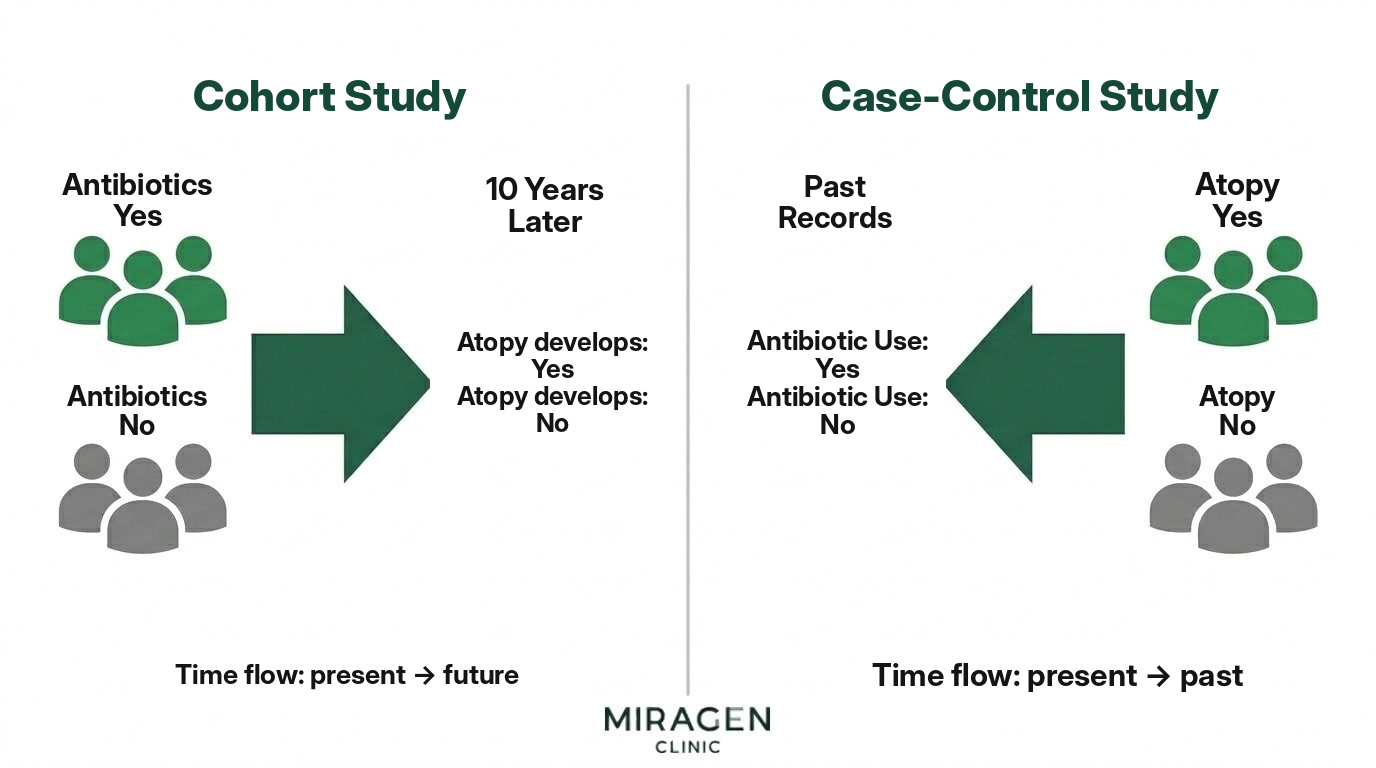
Let’s look at representative types of observational studies with examples.10 The key difference is the direction of time.
For example, suppose you want to know, “Does taking a lot of antibiotics in childhood increase the likelihood of developing atopic dermatitis?”
A cohort study goes from the present to the future. You gather 10,000 newborns and follow children who took antibiotics and those who did not for 10 years, observing who develops atopic dermatitis. Because the time order is clear, you can infer the direction “antibiotics → atopic dermatitis,” but it requires substantial time and cost.
A case-control study goes from the present to the past. You gather 200 children with atopic dermatitis (case group) and 200 without (control group), then compare past medical records. You are checking, “Did children with atopic dermatitis use more antibiotics in the past?” It is fast and inexpensive—especially advantageous for rare diseases—but past records may be inaccurate, and recall bias may occur if the case group remembers the past more intensely.
A case report is a detailed description of one patient or a small number of patients. It is useful for first identifying a new disease or a rare adverse effect, but it cannot be generalized from one or two cases, so it has the lowest level of evidence.
| Type | Direction of time | Strengths | Limitations |
|---|---|---|---|
| Cohort study | Present → future | Allows causal inference | High time and cost |
| Case-control study | Present → past | Fast and inexpensive; advantageous for rare diseases | Recall bias |
| Case report | — | First identification of a new phenomenon | Cannot be generalized |
There is a reason observational studies have a lower level of evidence than clinical trials. Because researchers do not randomly assign participants, other factors that affect outcomes (confounders) may be hidden.9
For example, even if an observational study finds that “people who take a lot of vitamin D are healthier,” those people may already be more health-conscious and exercise and manage their diet. You cannot distinguish whether it is due to vitamin D or healthy lifestyle habits.
Still, observational studies—including cohort studies—are not useless. When clinical trials are ethically impossible (for example, you cannot make people smoke to see whether “smoking causes cancer”), observational studies are the only option. If cohort study results are consistently replicated across multiple studies, they become strong evidence.
When reading health information, check these points only
Based on what we have covered so far, here is a checklist you can use when reading health-related news or blog posts. When I write blog posts such as the relationship between atopic dermatitis and food, I also try to indicate the level of evidence for each source I cite.
1. When it says “a study found,” what type of study is it?
The weight of evidence differs depending on whether it is an animal study, a small observational study, or a large clinical trial. The phrase “study results” alone does not tell you whether it was a cohort study or a clinical trial.
2. How many participants were included?
A study of 20 people cannot have the same reliability as a study of 2,000 people.
3. Is there a comparison group?
Check whether it is not just “I took this drug and got better,” but “the group that took this drug improved more than the group that took a placebo.” Without a comparison group, you cannot tell whether it was natural recovery or a drug effect.6
4. Have multiple studies reached the same conclusion?
Findings confirmed repeatedly across multiple studies are far stronger than results from a single study. If a pooled analysis (an analysis that combines multiple clinical trials) exists, it is best to check it before individual studies.11
5. Is the source clearly stated?
Reliable health information will include the paper source, the guideline name, and the study scale. If it only says “according to experts” or “it is known,” without specific sources, you should be more skeptical of the evidence.
References
- Burns PB, Rohrich RJ, Chung KC. The levels of evidence and their role in evidence-based medicine. Plast Reconstr Surg. 2011;128(1):305-310.
- Sackett DL, Rosenberg WM, Gray JA, et al. Evidence based medicine: what it is and what it isn’t. BMJ. 1996;312(7023):71-72.
- Linares-Espinos E, Hernandez V, Dominguez-Escrig JL, et al. Methodology of a systematic review. Actas Urol Esp (Engl Ed). 2018;42(8):499-506.
- Cumpston M, Li T, Page MJ, et al. Updated guidance for trusted systematic reviews: a new edition of the Cochrane Handbook for Systematic Reviews of Interventions. Cochrane Database Syst Rev. 2019;10(10):ED000142.
- Murad MH, Asi N, Alsawas M, et al. New evidence pyramid. Evid Based Med. 2016;21(4):125-127.
- Zabor EC, Kaizer AM, Hobbs BP. Randomized Controlled Trials. Chest. 2020;158(1S):S79-S87.
- Umscheid CA, Margolis DJ, Grossman CE. Key concepts of clinical trials: a narrative review. Postgrad Med. 2011;123(5):194-204.
- Bhide A, Shah PS, Acharya G. A simplified guide to randomized controlled trials. Acta Obstet Gynecol Scand. 2018;97(4):380-387.
- von Elm E, Altman DG, Egger M, et al. The Strengthening the Reporting of Observational Studies in Epidemiology (STROBE) statement: guidelines for reporting observational studies. J Clin Epidemiol. 2008;61(4):344-349.
- Munnangi S, Boktor SW. Epidemiology Of Study Design. StatPearls. 2024.
- Balshem H, Helfand M, Schunemann HJ, et al. GRADE guidelines: 3. Rating the quality of evidence. J Clin Epidemiol. 2011;64(4):401-406.
Frequently Asked Questions
Can’t you trust health information that only has cohort study results?
No. Observational studies can be very useful. However, compared with clinical trials, confounders are more likely to be involved, so they are classified one level lower in evidence. If multiple observational studies accumulate and show the same conclusion, it becomes fairly strong evidence.
Is a drug that passed Phase 3 clinical trials safe?
Phase 3 confirms efficacy and safety in hundreds to thousands of people, but very rare side effects (e.g., 1 in 10,000) may not be detected in Phase 3. That is why post-marketing Phase 4 (post-marketing surveillance) exists. If you have been prescribed a medication, it is important to discuss monitoring with your doctor.
If there is a meta-analysis, do you have to follow its conclusion no matter what?
Not necessarily. The quality of a pooled analysis (an analysis that combines multiple clinical trials) depends on the quality of the individual studies included. If you pool only low-quality studies, the conclusion also becomes uncertain. If a pooled analysis exists, refer to it first—but also review the scale and quality of the included studies.

We treat atopic dermatitis, rosacea, and seborrheic dermatitis.
Thanks to the valuable reviews you have shared in the community, many of you visit us even from far away.
We will repay you with sincere, attentive care.
DK Han
Chief Director, MIRAGEN Clinic
Graduate of University of Michigan, Ross School of Business
Graduate of Chungnam National University School of Medicine
(Former) Representative Director of Ewha Phoenix Rehabilitation Hospital
(Current) Representative Director of MIRAGEN Clinic


