When studying atopic dermatitis, you will encounter indicators such as EASI, SCORAD, EASI75, and IGA-TS. Those preparing for special medical expense exemption often hear that an EASI score of 23 or higher is required and wonder how this score is calculated. This article summarizes information that is difficult to fully explain during a consultation.
| Indicator | What it measures | Score Range | Primary Use |
|---|---|---|---|
| EASI | Location and Severity of Lesions | 0–72 | Special Medical Expense Exemption, Severity Classification |
| SCORAD | Lesions + Itching + Sleep Disturbance | 0–103 | Severity Assessment |
| EASI75 | Whether EASI has decreased by 75% or more | Achievement Rate (%) | Clinical Trial Efficacy Assessment |
| IGA-TS | Whether a nearly clear state has been achieved | Achievement Rate (%) | Clinical Trial Efficacy Assessment |
These four are the most frequently used indicators for evaluating atopic dermatitis. The first two assess the current severity of the skin, while the latter two evaluate how effective the treatment has been.
EASI — Where and how extensive the lesions are
EASI was developed in 2001, and a physician directly observes the patient’s skin to assign a score.1 There are two items evaluated:
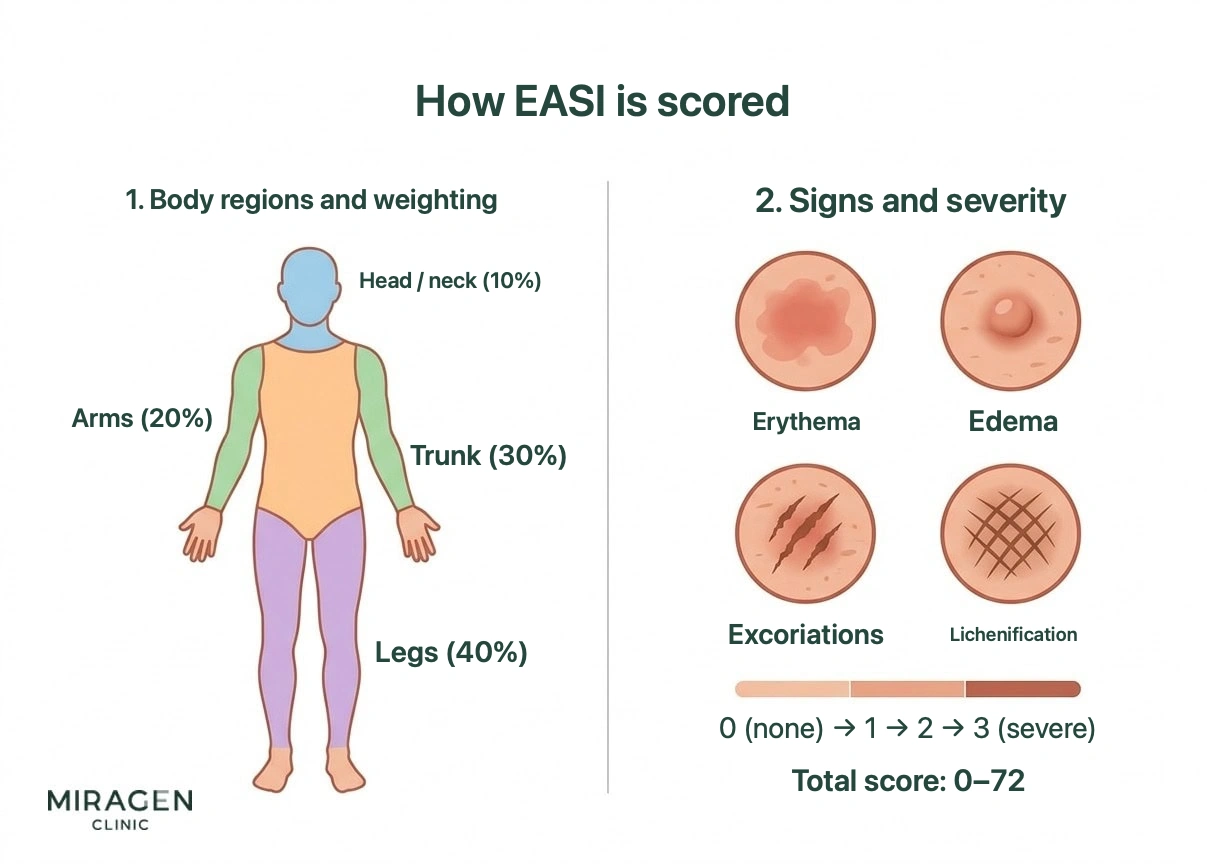
Location — The body is divided into four areas: head/neck, trunk, arms, and legs. The percentage of each area affected by eczema is scored from 0 to 6.
Severity — In each area, four symptoms—erythema, edema, excoriation, and lichenification—are scored from 0 (absent) to 3 (severe).
The area score and symptom score are multiplied, and area-specific weightings are applied and summed to yield the final EASI score. The range is from 0 (no lesions) to 72 (maximum systemic severity).
A 2015 study analyzed how EASI scores correspond to actual skin conditions.2
| EASI Score | Severity |
|---|---|
| 0 | Clear |
| 0.1–1.0 | Almost Clear |
| 1.1–7.0 | Mild |
| 7.1–21.0 | Moderate |
| 21.1–50.0 | Severe |
| 50.1–72.0 | Very Severe |
However, the ranges used for special medical expense exemption criteria in Korea differ slightly: mild is below 16, moderate is 16–23, and severe is 23 or above. An EASI score of 23 or higher is required for special medical expense exemption registration.
The most significant characteristic of EASI is that the score is assigned solely based on a physician’s visual observation. Patient-reported itching or sleep disturbance is not reflected in EASI. While this offers the advantage of objectivity, for the same reason, it may not always fully capture the patient’s actual suffering.
SCORAD — An indicator that includes itching and sleep disturbance
SCORAD is an indicator developed by the European Task Force on Atopic Dermatitis in 1993.3 Similar to EASI, it assesses the area and severity of lesions. However, it includes one additional factor.
SCORAD is divided into three parts:
Area — The percentage of body surface covered by lesions (0–100)
Severity — Six items: erythema, edema, oozing/crusting, excoriation, lichenification, and dryness (each 0–3, max 18)
Subjective Symptoms — Severity of itching + severity of sleep disturbance over the past 3 days (each 0–10, max 20)
These three values are entered into a formula (A/5 + 7B/2 + C) to yield the final score. The range is 0–103 points; scores below 25 indicate mild, 25–50 moderate, and above 50 severe.4
According to a study comparing EASI and SCORAD, the objective assessment components (area, severity) of the two indicators show a high correlation.5 The difference lies in Part C, which includes itching and sleep.
| Item | EASI | SCORAD |
|---|---|---|
| Lesion Area | Included | Included |
| Lesion Severity | 4 items (Erythema, Edema, Excoriation, Lichenification) | 6 items (+Oozing/Crusting, Dryness) |
| Itching | Not Included | Included (Patient Self-Assessment) |
| Sleep Disturbance | Not Included | Included (Patient Self-Assessment) |
| Score Range | 0–72 | 0–103 |
There may be patients whose EASI score is low but who cannot sleep due to itching every night. In such cases, SCORAD more accurately reflects the patient’s actual condition. Conversely, in clinical trials, EASI is preferred because it does not incorporate patient subjectivity. The 2014 international consensus also adopted EASI as a core outcome measure for clinical trials.6
EASI75 and IGA-TS — Indicators for assessing treatment efficacy
While EASI and SCORAD are indicators that measure “how severe the condition is now,” EASI75 and IGA-TS are indicators that determine “how much improvement has occurred after treatment.” They almost always appear when reading clinical trial results for atopic dermatitis treatments.
EASI75 is the percentage of patients whose EASI score has decreased by 75% or more from the pre-treatment score. For example, if a patient’s pre-treatment EASI was 28 points and dropped to 7 points or less after treatment, this patient achieved EASI75. EASI50 (50% reduction) and EASI90 (90% reduction) follow the same principle.
A result stating that “the EASI75 achievement rate in clinical trials is 60%” means that 60 out of 100 patients who received the drug experienced a reduction in their EASI score by more than 75%.
IGA-TS looks at it from a slightly different angle. IGA is a score where a physician assesses the patient’s overall skin condition on a single scale from 0 (clear) to 4 (severe).7 The TS in IGA-TS stands for Treatment Success, and two conditions must be met simultaneously:
First, the IGA score must reach 0 (clear) or 1 (almost clear).
Second, there must be an improvement of at least 2 grades compared to before treatment.
If a patient with a pre-treatment IGA of 4 (severe) improves to 1 (almost clear) after treatment, this is a 3-grade improvement, so IGA-TS is achieved. However, even if it decreases from 4 to 2, IGA-TS is not achieved because the “almost clear state” has not been reached.
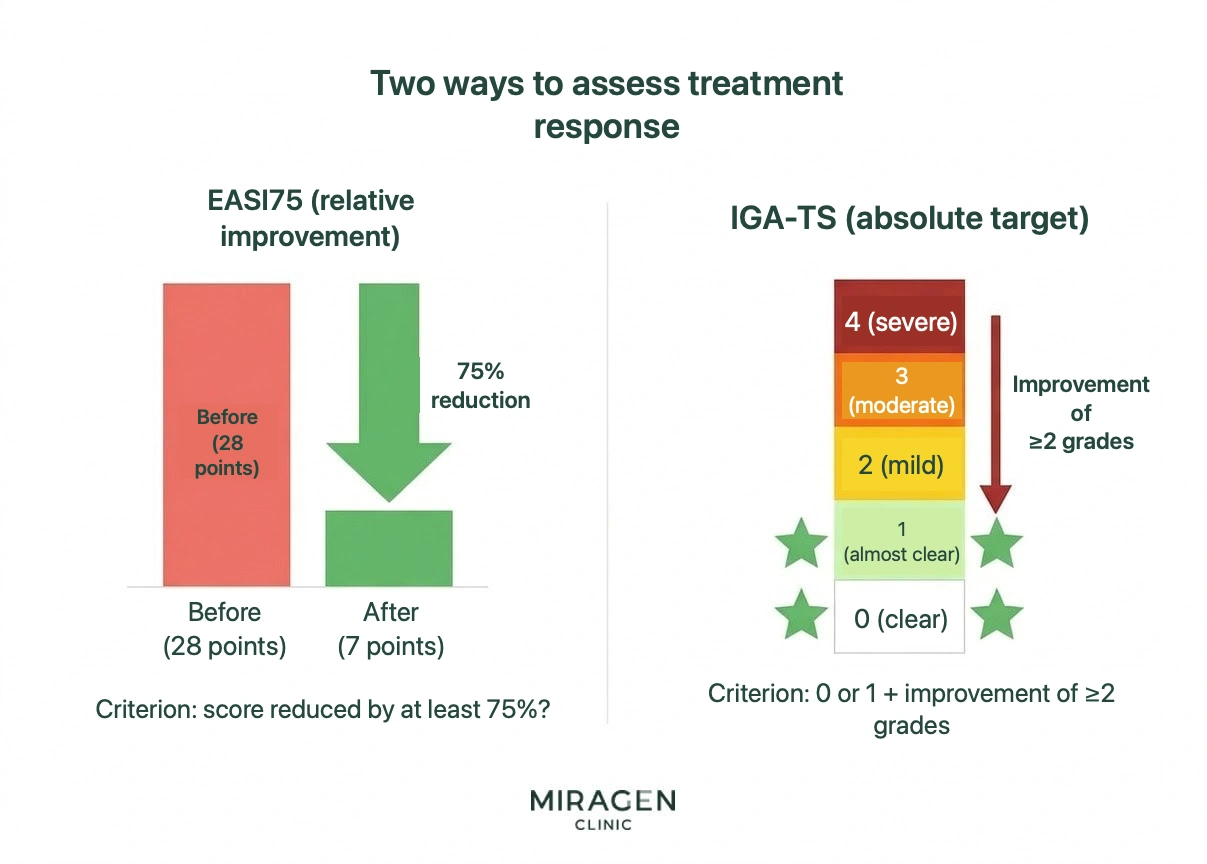
While EASI75 is a relative criterion that measures “how much it has decreased,” IGA-TS is an absolute criterion that assesses “whether a nearly clear state has been achieved.” The US FDA requires both EASI75 and IGA-TS as primary endpoints for approving atopic dermatitis treatments.8 This means that both must be passed for the drug’s efficacy to be recognized.
How they are used in special medical expense exemption and clinical trials, respectively
EASI and SCORAD are primarily used when applying for special medical expense exemption or when severity classification is required. Specifically, an EASI score of 23 or higher is a condition for special medical expense exemption registration, making accurate score calculation crucial in this context.
In contrast, in clinical trial results, the EASI75 achievement rate and IGA-TS achievement rate are key, rather than the EASI score itself. Phase 3 clinical trial results for new atopic dermatitis drugs like dupilumab, upadacitinib, and abrocitinib often report both figures side-by-side, such as “EASI75 achievement rate of 60% and IGA-TS achievement rate of 35% at week 16.”
How to interpret these numbers is simple:
A higher EASI75 achievement rate means that a greater number of patients experienced significant skin improvement, and a higher IGA-TS achievement rate means that a greater number of patients reached a nearly clear state. IGA-TS consistently appears lower than EASI75 because “reaching a nearly clear state” is a more challenging goal than “a 75% reduction.”
When researching information about atopic dermatitis treatments, understanding what question each of these four indicators answers will help you comprehend clinical trial results. You can find information on the general causes and treatments of atopic dermatitis on our information page.
Frequently Asked Questions
Can I calculate my EASI score myself?
Since EASI is a score assigned by a physician based on direct observation of lesions, it is difficult for patients to accurately calculate it themselves. However, for SCORAD, as subjective symptoms (itching, sleep disturbance) are included in the score, a rough self-assessment is possible using apps like ‘SCORAD phone’.
What does an EASI score of 23, required for special medical expense exemption, signify?
An EASI score of 23 corresponds to ‘severe’ atopic dermatitis by Korean standards. Roughly, this indicates widespread moderate to severe erythema, edema, and lichenification on the limbs and trunk. The exact score is determined by a physician who directly evaluates each affected area during a consultation.
Is a drug with a high EASI75 achievement rate always a good drug?
While the EASI75 achievement rate is an important indicator for comparing drug efficacy, it is difficult to judge solely based on this. Clinical trials vary in terms of patient severity, prior treatment history, and assessment time points. Caution is needed when simply comparing numerical values unless the clinical trials directly compared under the same conditions.
References
- Hanifin JM, Thurston M, Omoto M, et al. The eczema area and severity index (EASI): assessment of reliability in atopic dermatitis. Exp Dermatol. 2001;10(1):11-18.
- Leshem YA, Hajar T, Hanifin JM, et al. What the Eczema Area and Severity Index score tells us about the severity of atopic dermatitis: an interpretability study. Br J Dermatol. 2015;172(5):1353-1357.
- European Task Force on Atopic Dermatitis. Severity scoring of atopic dermatitis: the SCORAD index. Dermatology. 1993;186(1):23-31.
- Kunz B, Oranje AP, Labrèze L, et al. Clinical validation and guidelines for the SCORAD index: consensus report of the European Task Force on Atopic Dermatitis. Dermatology. 1997;195(1):10-19.
- Rullo VE, Segato A, Kirsh A, et al. Severity scoring of atopic dermatitis: a comparison of two scoring systems. Allergol Immunopathol (Madr). 2008;36(4):205-211.
- Schmitt J, Spuls PI, Thomas KS, et al. The Harmonising Outcome Measures for Eczema (HOME) statement to assess clinical signs of atopic eczema in trials. J Allergy Clin Immunol. 2014;134(4):800-807.
- Simpson E, Bissonnette R, Eichenfield LF, et al. The Validated Investigator Global Assessment for Atopic Dermatitis (vIGA-AD): The Development and Reliability Testing of a Novel Clinical Outcome Measurement Instrument for the Severity of Atopic Dermatitis. J Am Acad Dermatol. 2020;83(3):839-846.
- Thaci D, Simpson EL, Beck LA, et al. Efficacy and safety of dupilumab in adults with moderate-to-severe atopic dermatitis inadequately controlled by topical treatments: a randomised, placebo-controlled, dose-ranging phase 2b clinical trial. Lancet. 2016;387(10013):40-52.