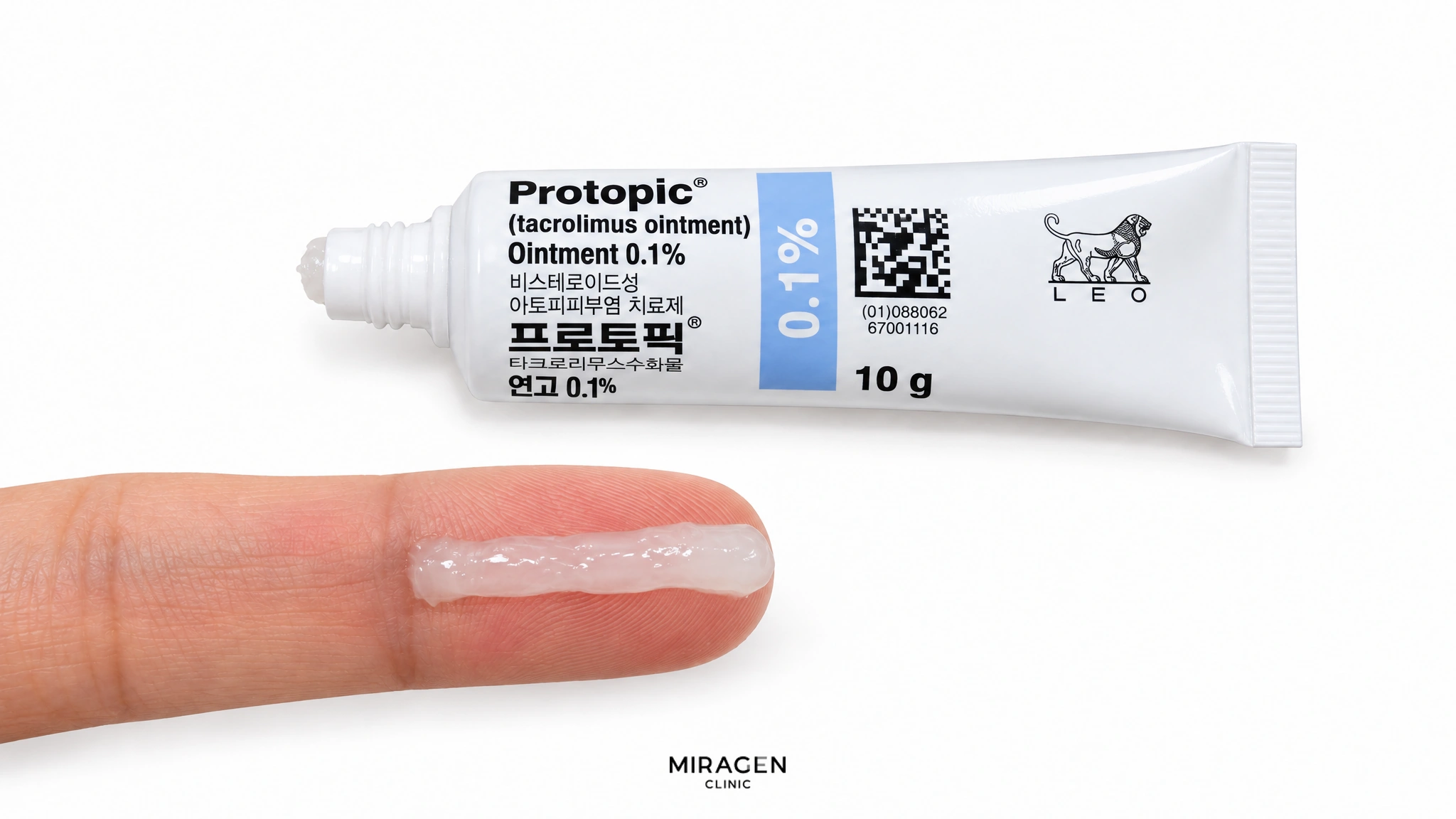
When I ask patients who have long suffered from facial dermatitis whether they have tried Protopic, many say they have. This is because the facial skin is thin, making steroid use more concerning in this area.
However, when I ask which concentration of Protopic they used, most are unaware that two concentrations exist.
Therefore, for those considering Protopic for facial use, I have compiled the practical differences between the two concentrations.
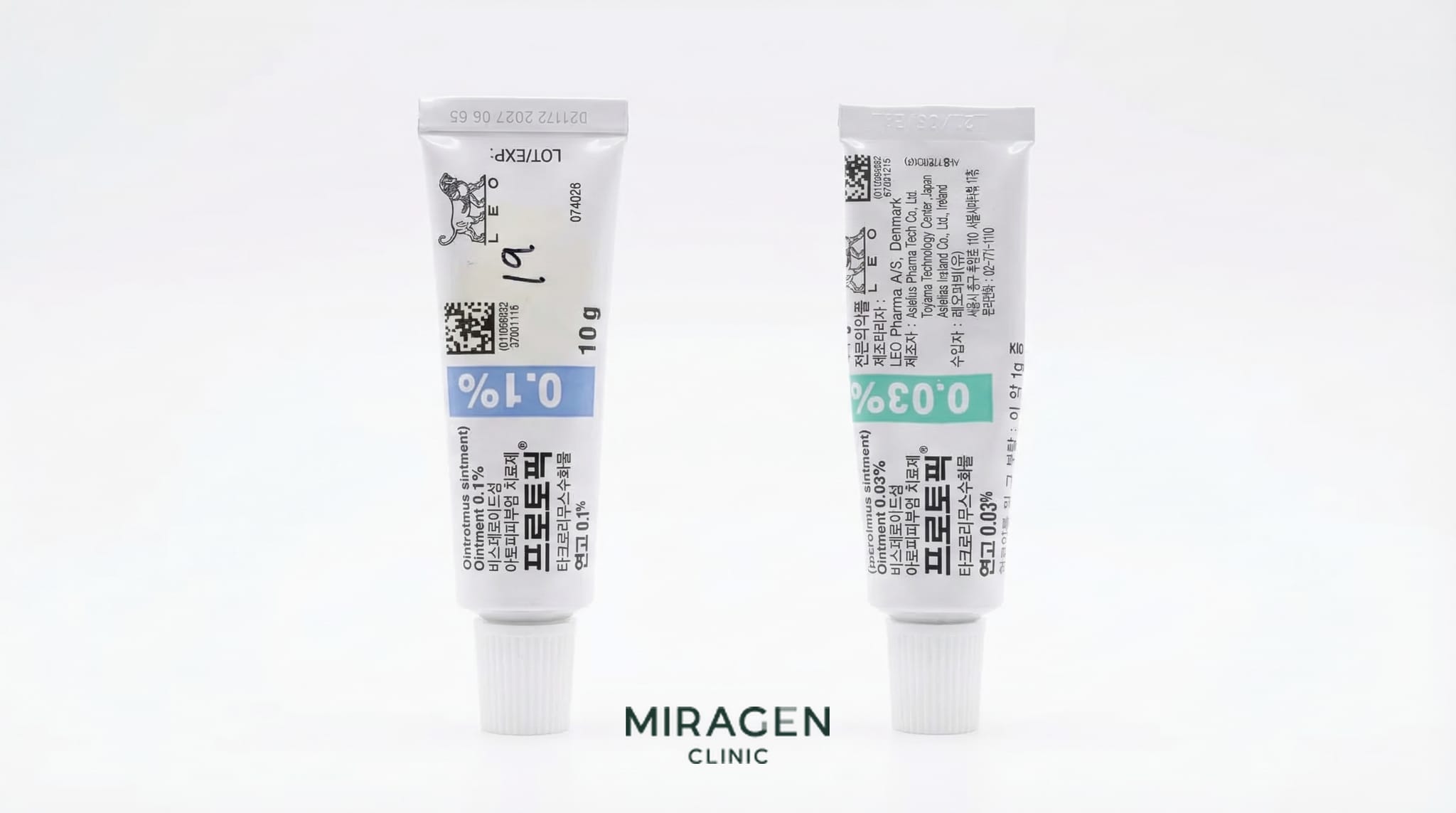
Protopic 0.1% vs. 0.03% at a Glance
| Item | Protopic 0.1% | Protopic 0.03% |
|---|---|---|
| Anti-inflammatory Strength (Literature-Based) | Comparable to mid-potency steroid | Comparable to low-potency steroid |
| Initial Irritation | Burning more frequent | Relatively less |
| Approved Age | 16 years and older (adults) | 2 years and older |
The clearest difference between the two concentrations is approved age. The 0.1% formulation is approved only for adults aged 16 and older, while 0.03%, like Elidel, can be used from age 2.1
There is also a clear difference in efficacy. The 0.1% concentration provides stronger anti-inflammatory action than 0.03%, and burning sensations occur more frequently with 0.1%.2
Efficacy Differences
Given that the two products differ in concentration by more than threefold, there are corresponding differences in efficacy.
A Cochrane systematic review analyzing six randomized controlled trials (1,640 participants) found that 0.1% was significantly superior to 0.03% by 18% in physician-assessed improvement rates.3
In pediatric clinical trials, both concentrations were more effective than Class 7 steroids (the weakest steroids), but 0.1% showed significantly better results than 0.03%.4
In adult trials, 0.1% achieved a 90% or greater improvement rate of 36.8%, significantly higher than the 27.5% seen with 0.03%.5
Some studies have shown that 0.1% is more effective than Class 3 steroids (mid-potency steroids) for facial atopic dermatitis,6 but in my clinical experience treating dermatitis, the anti-inflammatory effect of 0.1% is not as strong as mid-potency steroids.
Why Only 0.03% Is Approved for Children
As mentioned above, 0.1% is more effective in children as well, but only 0.03% is approved. This decision stems from safety concerns rather than efficacy.
There are two reasons. First, children have a higher body surface area-to-weight ratio, so applying the same area may result in greater systemic absorption than in adults, and this concern increases with higher concentrations. Second, long-term effects on the developing immune system had not been sufficiently established at the time.
Ultimately, it was determined that 0.03% alone provides sufficient efficacy, and the additional benefit of 0.1% did not justify the higher systemic exposure in children. Therefore, for children, 0.03% is the only option.7
Selection Criteria When Using Protopic on the Face
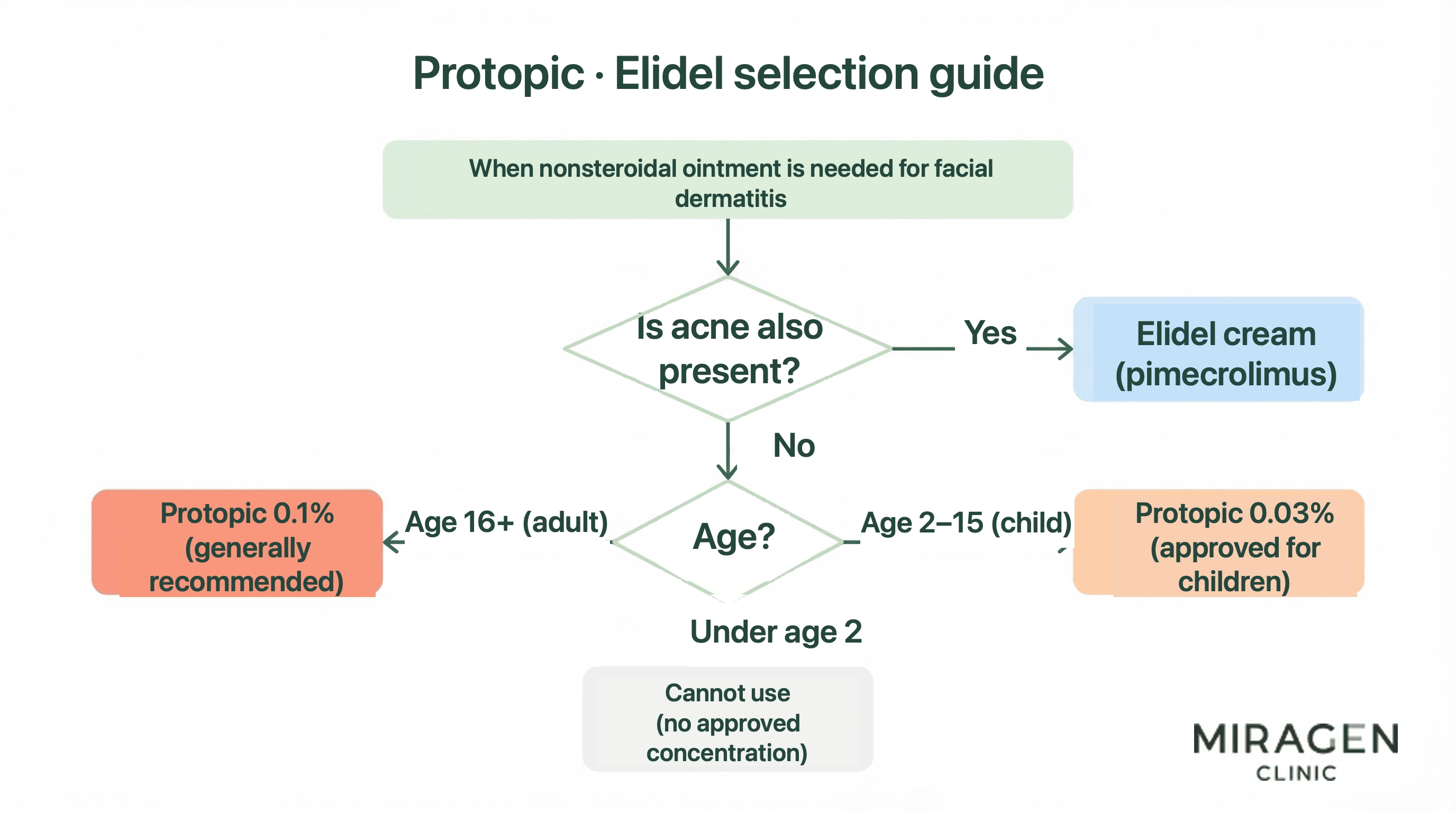
When a non-steroidal anti-inflammatory ointment is needed for facial dermatitis, I generally prescribe Protopic 0.1% to adult patients. This is because 0.1% is more effective both in research findings and in my experience.
The exception is when dermatitis and acne coexist. In such cases, the thick consistency of Protopic can clog pores and worsen acne, so I prescribe Elidel, which has a lighter cream formulation.
However, among adult patients with facial dermatitis, some have used 0.03%. Typically, their prescribing physician chose 0.03% due to concerns about initial burning, stinging, or worsening redness.
This discomfort is usually most severe during the first three days and then rapidly decreases—a short-term phenomenon. The cause of this discomfort is neuropeptides such as substance P and CGRP released from nerve endings, which become depleted with repeated application, leading to gradual reduction.
Furthermore, this initial discomfort can be significantly reduced by storing Protopic in the refrigerator and applying it cold. Cooling the sensory nerves first significantly reduces the burning sensation.
In fact, starting with 0.03% may not produce the expected results, leading patients to discontinue treatment, thinking “this medication doesn’t work for me.” Therefore, I thoroughly explain the initial discomfort and methods to alleviate it to adult patients, and prescribe 0.1% from the start.
For children, there is no choice, as only 0.03% is approved.
More detailed information can be found on the Protopic page.
Frequently Asked Questions
Protopic 0.1% stings too much—should I switch to 0.03%?
If the burning sensation does not gradually decrease, contact dermatitis should be suspected. In this case, switching to 0.03% may be considered. Methods to distinguish between a normal reaction and contact dermatitis can be found in the Protopic guide.
Can my child be prescribed 0.1%?
The 0.1% formulation cannot be used for children under 16 years of age. Pediatric clinical trials were designed only with 0.03%, so there is no basis for pediatric approval of 0.1%. Children aged 2 to 15 use 0.03%. For children under 2 years, no concentration is currently approved, and use is not recommended.
I’m an adult—can I start with 0.03%?
Yes, it is possible. However, 0.03% alone may not provide sufficient efficacy, leading some to discontinue treatment. Unless there is a specific reason, 0.1% is recommended for adults from the start.
References
- Paller A, Eichenfield LF, Leung DY, Stewart D, Appell M. A 12-week study of tacrolimus ointment for the treatment of atopic dermatitis in pediatric patients. J Am Acad Dermatol. 2001;44(1 Suppl):S47-57.
- Seo SR, et al. Disrupted skin barrier is associated with burning sensation after topical tacrolimus application in atopic dermatitis. Acta Derm Venereol. 2017;97(8):957-8.
- Martins JC, Martins C, Aoki V, et al. Topical tacrolimus for atopic dermatitis. Cochrane Database Syst Rev. 2015;(7):CD009864.
- Reitamo S, Van Leent EJM, Ho V, Harper J, Ruzicka T, Kalimo K, et al. Efficacy and safety of tacrolimus ointment compared with that of hydrocortisone acetate ointment in children with atopic dermatitis. J Allergy Clin Immunol. 2002;109(3):539-46.
- Hanifin JM, Ling MR, Langley R, Breneman D, Rafal E. Tacrolimus ointment for the treatment of atopic dermatitis in adult patients: part I, efficacy. J Am Acad Dermatol. 2001;44(1 Suppl):S28-38.
- Doss N, Reitamo S, Dubertret L, Fekete GL, Kamoun MR, Lahfa M, et al. Superiority of tacrolimus 0.1% ointment compared with fluticasone 0.005% in adults with moderate to severe atopic dermatitis of the face. Br J Dermatol. 2009;161(2):427-34.
- Seo SR, et al. Disrupted skin barrier is associated with burning sensation after topical tacrolimus application in atopic dermatitis. Acta Derm Venereol. 2017;97(8):957-8.